 Asep Darmawan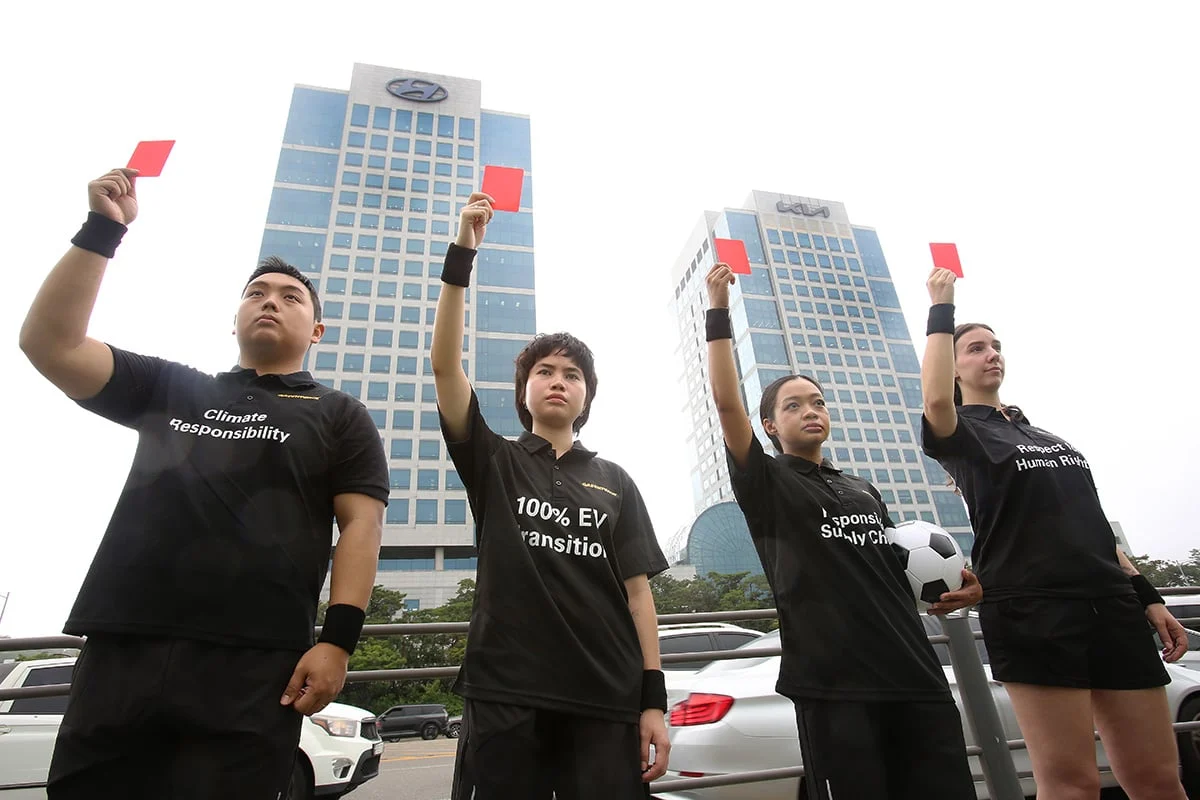
SEOUL – Greenpeace activists unfurled symbolic referee red cards today at the Hyundai Motor Group headquarters, targeting the automotive giant’s prominent sponsorship of the FIFA World Cup. The protest, a culmination of a month-long global campaign, demands that Hyundai immediately address alleged severe human rights violations, labor exploitation, and significant carbon-intensive risks embedded within its extensive global supply chain. Furthermore, the activists are calling on the company to reverse what they describe as a recent corporate backtrack on its commitment to an electric vehicle (EV) transition.
The demonstration in Seoul, spearheaded by Greenpeace East Asia, is backed by a formidable international coalition of eleven environmental and human rights organizations. This broad alliance aims to expose what they contend is a stark disparity between Hyundai’s public-facing sustainability rhetoric and the documented harms reportedly occurring within its supply chain. These alleged transgressions are unfolding against the backdrop of Hyundai’s multi-million dollar "eco-friendly" sports marketing campaign, which has drawn significant public attention through its association with the FIFA World Cup.
The global escalation of this campaign has been strategically timed with major World Cup matches, amplifying the pressure on Hyundai. This coordinated international effort previously culminated in the delivery of an Open Letter to Hyundai Executive Chair Euisun Chung. The letter urged the company to leverage its influential position as a premier FIFA sponsor to implement robust structural climate commitments and enforceable corporate accountability measures across its operations.
Market Risk: Hyundai’s Lagging Clean Transition and Supply Chain Governance
While Hyundai actively utilizes its FIFA sponsorship to project an image of corporate sustainability, a critical analysis of its sales figures reveals a continued heavy reliance on internal combustion engine (ICE) vehicles. Data indicates that ICE vehicles still constitute a substantial 93% of Hyundai-Kia’s annual sales, which collectively amount to 6.8 million vehicles. This persistent reliance translates into a significant environmental footprint, with the group’s combined annual carbon dioxide equivalent emissions reaching an estimated 250 million tonnes. This figure is comparable to the total national emissions of Spain, highlighting the scale of the company’s climate impact.
Independent automotive sustainability benchmarks further underscore concerns regarding Hyundai’s environmental performance and supply chain management. Recent assessments consistently rank Hyundai significantly behind global competitors such as Tesla, Volkswagen, and Mercedes-Benz in crucial areas of supply chain decarbonization and human rights due diligence. This lagging performance suggests a tangible market risk for Hyundai, as regulatory bodies and consumer preferences increasingly favor companies demonstrating genuine progress in environmental and social responsibility.
The South Korean automaker is facing mounting regulatory and reputational pressure to enhance its oversight of its manufacturing pipeline and its intricate network of sourcing relationships. A series of independent investigations conducted by organizations including Steel Watch, Mighty Earth, and Jobs to Move America have brought to light serious environmental and labor concerns within segments of Hyundai’s tier-one suppliers. These reports detail issues ranging from exploitative labor practices to significant environmental degradation.
A particularly concerning aspect highlighted by these investigations is Hyundai Steel’s continued reliance on coal-based production methods. This operational choice has drawn significant scrutiny over its contribution to air pollution and the associated substantial public health costs. These impacts are felt acutely in manufacturing hubs across South Korea and Brazil, where communities bear the brunt of the environmental fallout. The economic implications of these issues are also considerable, with billions of dollars in potential healthcare expenditures linked to air quality degradation.
Timeline of Global Actions
The month-long campaign has seen a series of targeted actions designed to exert sustained pressure on Hyundai Motor Group:
- Early November 2022: The global coalition officially launched its campaign, coinciding with the initial stages of the FIFA World Cup buildup, by releasing a joint statement detailing their concerns and demands.
- Mid-November 2022 (leading up to key World Cup matches): A series of high-profile international actions took place, including digital protests, targeted social media campaigns, and demonstrations in major cities across Europe and North America. These events aimed to capture global attention by linking Hyundai’s sponsorship with alleged supply chain malpractice.
- Late November 2022 (during crucial World Cup fixtures): The coalition intensified its efforts, organizing demonstrations and digital "red card" campaigns to coincide with high-stakes matches, maximizing media coverage and public awareness.
- Early December 2022 (culmination in Seoul): The campaign reached its peak with the direct protest at Hyundai Motor Group headquarters in Seoul, underscoring the urgency of the demands.
Statements from the Global Coalition
The multifaceted concerns surrounding Hyundai’s operations and sustainability commitments have been articulated by representatives of the global coalition:
Erin Eunseo Choi, Climate and Energy Campaigner at Greenpeace East Asia, expressed deep concern over Hyundai’s strategic direction: "Hyundai Motor’s latest sustainability report talks about ‘Electrification and Our Climate Response,’ but quietly dropping its concrete 2030 battery EV sales targets sends a very different signal. By shifting its roadmap to focus heavily on hybrids and Extended-Range EVs (EREVs) – vehicles that still rely on internal combustion engines – Hyundai is pursuing a false transition. While EREVs may masquerade as electric, they are not a true zero-emission solution; instead, they risk locking in reliance on fossil fuels and diverting vital resources from full battery electrification. When the vehicles Hyundai sells account for 79% of its Scope 3 emissions, slowing electrification is like pulling your striker off the pitch in the middle of a match. As war-driven oil price spikes fast-track the shift toward EVs, any indecision in making a true transition risks a further loss of market share.”
Nish Humphreys, Campaign Manager at Ekō, highlighted the stark contrast between Hyundai’s public image and its alleged supply chain realities: "Hyundai wants the world watching its Football World Cup ads, not the dark side of its supply chain. On the field, it’s sponsoring kids’ dreams. But behind the scenes, it’s a different game. Public reporting has raised serious concerns about child labor, worker deaths, and injuries, along with the unexplained disappearance of Indigenous activists in Mexico who protected Hyundai’s steel supplier. Together with the activists on the ground, over 7,400 people have ‘red-carded’ Hyundai in our virtual protest, joining a global crowd of 52,000 citizens, football fans, and Hyundai drivers who have signed the Ekō petition demanding the company clean up its supply chain before the final whistle blows."
Abhilasha Bhola, Climate Campaigns Director at Public Citizen, underscored the broader implications of corporate misconduct: "The record is clear: Hyundai-Kia’s supply chain is marred by documented human rights abuses, environmental destruction, and labor exploitation. The World Cup’s corporate sponsors cannot continue to profit while workers, communities, and our planet bear the deep impacts of corporate misconduct.”
Strategic Demands to Hyundai Motor Group
The global coalition has outlined three critical and non-negotiable directives for Hyundai Motor Group’s executive leadership:
- Commit to a Just Transition to 100% Battery Electric Vehicles by 2035: The coalition urges Hyundai to set ambitious and legally binding targets for a complete transition to zero-emission battery electric vehicles, aligning with climate science and global efforts to mitigate the climate crisis. This includes phasing out the production of internal combustion engine vehicles and significantly increasing investment in the development and manufacturing of battery EVs.
- Implement Robust Human Rights Due Diligence and Supply Chain Transparency: Hyundai is called upon to establish and enforce comprehensive due diligence mechanisms throughout its entire supply chain. This includes conducting thorough human rights impact assessments, ensuring fair labor practices, and providing mechanisms for grievance redressal for workers and affected communities. The company is also expected to publicly disclose detailed information about its suppliers and their adherence to human rights and environmental standards.
- Invest in Renewable Energy and Decarbonize Steel Production: The coalition demands that Hyundai prioritize the decarbonization of its operations, particularly in its steel production, which is a significant contributor to its carbon footprint. This involves a rapid transition to renewable energy sources and the adoption of cleaner steelmaking technologies, such as green hydrogen-based processes, to reduce air pollution and greenhouse gas emissions.
Broader Impact and Implications
The Greenpeace-led campaign against Hyundai Motor Group highlights a growing trend of increased scrutiny on corporate environmental, social, and governance (ESG) performance, particularly among globally recognized brands. The automotive industry, undergoing a profound transformation towards electrification, faces particular pressure to ensure that this transition is both environmentally sound and socially responsible.
Hyundai’s alleged backtracking on its EV transition targets, coupled with persistent reports of labor and environmental abuses in its supply chain, presents a significant reputational and financial risk. As consumers and investors become more attuned to ESG factors, companies that fail to demonstrate genuine commitment to sustainability and ethical practices are likely to face increasing challenges in maintaining market share and attracting investment.
The involvement of a broad coalition of international organizations, coupled with the high-profile nature of the FIFA World Cup sponsorship, has amplified the campaign’s reach and impact. This coordinated effort aims to leverage public opinion and regulatory pressure to compel Hyundai to adopt more sustainable and ethical business practices. The demands for increased transparency, a genuine commitment to electrification, and the decarbonization of heavy industries like steel production are critical for a just and sustainable future. The outcome of this campaign could set a precedent for how other major corporations are held accountable for their global supply chain impacts and their role in the critical transition to a low-carbon economy.
Media Documentation & Assets:
The coalition has provided access to a range of media documentation and assets, including photographs and videos of the protests, statements from coalition members, and detailed reports on the alleged human rights and environmental violations. These resources are available to media outlets to support their reporting on this ongoing issue.
Media Contact:
Yujie Xue, International Communications Officer, Greenpeace East Asia, [email protected]

 Muslim
 Basiran