 Nana Muazin
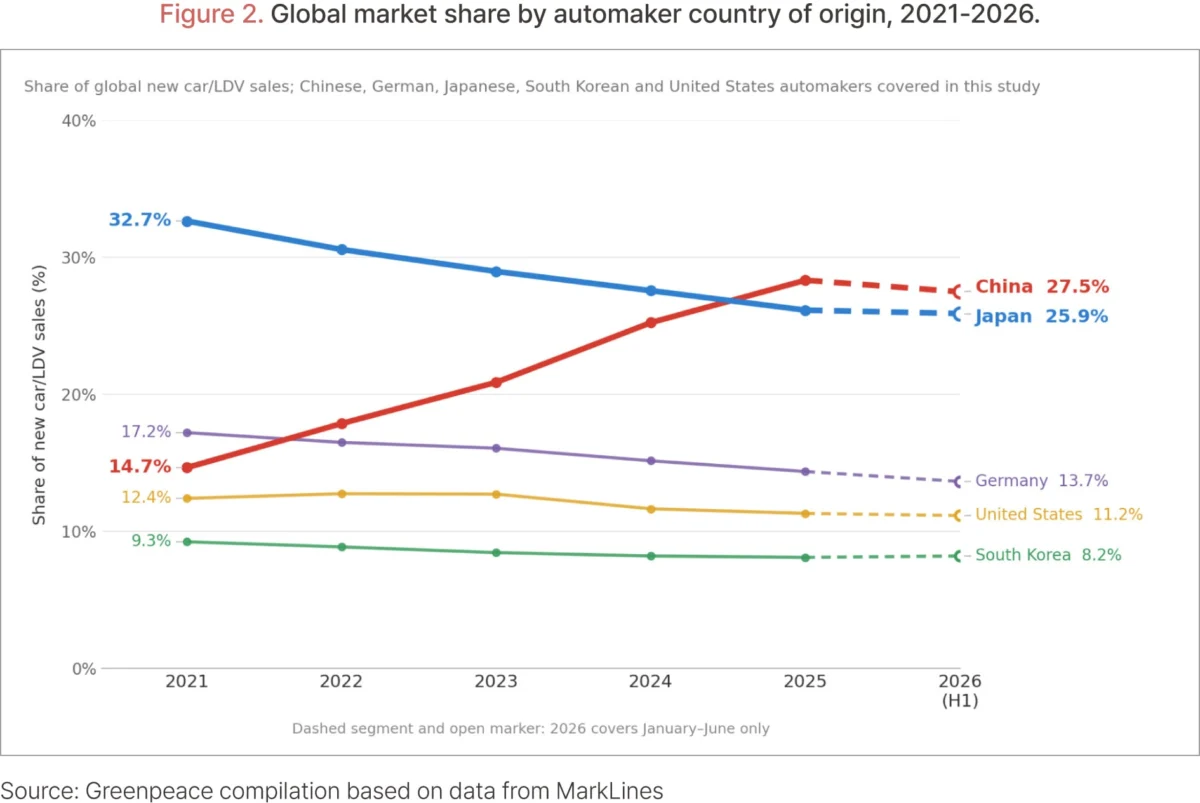
TOKYO, October 27, 2026 – The global passenger-vehicle market has witnessed a dramatic rebalancing, with Japanese automakers experiencing a significant decline in market share while Chinese manufacturers surge to the forefront. A comprehensive new report from Greenpeace East Asia reveals that the combined share of Japanese carmakers in the global passenger-vehicle market plummeted from 32.7% in 2021 to 25.9% in the first half of 2026. In stark contrast, Chinese automakers have seen their market share more than double, rising from 14.7% to an impressive 27.5%, officially overtaking Japan as the world’s largest national group by passenger-vehicle sales. This seismic shift is most pronounced in regions where the adoption of battery-electric vehicles (BEVs) has experienced the most rapid growth.
The report, titled "A Changing Landscape: The Challenges Facing Japanese Automakers in China and Southeast Asia’s EV Race," meticulously analyzes sales data from MarkLines. It identifies China and Southeast Asia – two pivotal regions undergoing aggressive electrification – as the primary battlegrounds where Japanese manufacturers are losing the most ground. This strategic erosion of market dominance is directly linked to the accelerating global shift away from internal combustion engine (ICE) vehicles and towards electrified alternatives.
"Japanese automakers are not simply facing a difficult quarter or a difficult year. They are watching their decades-long dominance slipping away as electric vehicles reshape the global car market," stated Erin Eunseo Choi, climate and energy campaigner at Greenpeace East Asia. "Their reliance on combustion engines and hybrids is costing them ground in China and Southeast Asia. As the oil price shocks from the Middle East conflict accelerate the global move to renewable energy and zero-emission transport, their delay makes catching up increasingly difficult."
The Greenpeace analysis tracked passenger-vehicle sales data for eight prominent Japanese automakers – Toyota, Honda, Nissan, Isuzu, Mazda, Mitsubishi Motors, Subaru, and Suzuki – across seven key global regions: Japan, the United States, China, Europe, Southeast Asia, Latin America, and India. This data was then benchmarked against the performance of 25 international competitors hailing from China, Germany, the United States, and South Korea. The analyzed regions collectively represent approximately 87.4% of Japanese automakers’ global sales, while the broader dataset encompasses about 88.3% of total global passenger-vehicle sales, providing a robust and representative picture of the industry’s evolving landscape.
The Accelerating Electrification Trend
The report’s findings underscore a fundamental structural shift in the automotive industry. Between 2021 and the close of 2025, the market share of BEVs in global new-car sales surged from a modest 6.5% to a significant 17.3%. Concurrently, the market share of traditional internal combustion engine vehicles (ICEVs) experienced a substantial decline, falling from 83.5% to 61.7%. This trend is occurring against a backdrop of Japanese automakers reportedly scaling back their previously ambitious EV targets. For instance, Toyota has allegedly reduced its planned 2026 BEV output from 1.5 million units to approximately 800,000 units. Similarly, Honda has reportedly withdrawn its long-term targets for BEVs and fuel-cell electric vehicles to constitute 100% of global sales by 2040, alongside its 2030 EV sales target, indicating a strategic recalibration that re-emphasizes conventional hybrids.
Geopolitical Factors and Consumer Behavior
The recent volatility in oil prices, exacerbated by the ongoing conflict in the Middle East, has intensified the urgency for consumers and fleet operators to transition to electric vehicles. This external pressure highlights a critical vulnerability for Japanese automakers, whose business models have historically been heavily reliant on ICEVs and conventional hybrids. The accelerating demand for cleaner, more sustainable transportation options, driven by both environmental concerns and economic considerations, poses a direct threat to their long-standing leadership in the global auto industry.
Chronology of a Market Shift
The period between 2021 and the first half of 2026 marks a critical turning point in the global automotive industry. This timeframe has been characterized by unprecedented technological advancements, shifting consumer preferences, and increasingly stringent environmental regulations, all of which have coalesced to accelerate the adoption of electric vehicles.
- 2021: The global passenger-vehicle market stood at a different equilibrium. Japanese automakers commanded a substantial 32.7% market share, demonstrating their enduring strength. In contrast, Chinese manufacturers held a more modest 14.7% share, and BEVs represented only 6.5% of global new-car sales.
- 2022-2023: This period saw a noticeable acceleration in BEV adoption, particularly in key markets like China and parts of Southeast Asia. Growing awareness of climate change, coupled with government incentives and improving charging infrastructure, began to sway consumer choices. Early adopters and forward-thinking manufacturers started to gain traction.
- 2024-2025: The trend intensified. The market share of ICEVs began a steeper decline, while BEVs continued their upward trajectory. Chinese automakers, with their early and aggressive investment in EV technology and production, started to make significant inroads into global markets, often offering competitive pricing and advanced features. Reports emerged of Japanese manufacturers reassessing their EV production targets, suggesting a lag in adapting to the rapidly changing market dynamics.
- First Half of 2026: The data compiled for the Greenpeace East Asia report reveals the culmination of these trends. Japanese automakers’ market share had fallen to 25.9%, while Chinese manufacturers had surged to 27.5%, marking a historic shift in global automotive leadership. BEVs now accounted for 17.3% of global new-car sales, indicating a fundamental reshaping of the industry. The report’s release in late October 2026 serves as a stark warning and a call to action for the Japanese automotive sector.
Supporting Data and Market Dynamics
The Greenpeace East Asia report’s reliance on MarkLines data provides a solid foundation for its conclusions. MarkLines is a globally recognized provider of automotive industry data, offering comprehensive statistics on vehicle production, sales, and market trends. The detailed analysis of sales figures across multiple regions and against a broad spectrum of competitors lends significant weight to the report’s findings.

The report highlights that the regions analyzed account for a substantial portion of Japanese automakers’ sales. This implies that the challenges faced in these specific markets have a disproportionately large impact on their overall global performance. The increasing competitiveness of Chinese EV manufacturers is not solely based on price; many have rapidly advanced their battery technology, software integration, and vehicle design, making them attractive alternatives to established Japanese brands.
The report’s focus on the BEV adoption rate as a key determinant of market share shifts is particularly insightful. Regions with higher BEV penetration, such as China, have seen the most dramatic changes. This correlation suggests that Japanese automakers’ slower transition to BEVs, and their continued reliance on hybrid technology as a primary electrification strategy, has put them at a significant disadvantage in these burgeoning markets.
Greenpeace’s Call for Accelerated Transition
In light of these findings, Greenpeace East Asia is urging Japanese automakers to fundamentally alter their strategic direction. The report specifically calls on market leader Toyota to take decisive action:
- End Global ICEV Sales by 2030: This ambitious target reflects the urgency of the climate crisis and the need for rapid decarbonization of the transport sector.
- Cut Scope 1-3 Emissions by at Least 43% from 2019 Levels by 2030: This aligns with the science-based targets required to limit global warming to 1.5°C, a critical pathway to achieving carbon neutrality by 2050.
"Japanese automakers still have a chance to regain their footing, but the window is closing fast," emphasized Choi. "The market is sending a clear signal: consumers and governments are no longer waiting for a gradual transition. Japanese automakers need to treat battery electric vehicles not as one option among many, but as the core of their future business model, and back that shift with credible targets and real investment."
This strong call to action from Greenpeace underscores the growing pressure on legacy automakers to align their business strategies with global climate goals and evolving market demands. The report serves as a critical assessment of the current automotive landscape and a stark warning about the potential consequences of inaction.
Broader Impact and Implications
The shift in global market leadership has profound implications for the automotive industry, international trade, and the broader effort to combat climate change.
- Economic Repercussions: A sustained decline in market share could lead to significant economic challenges for Japan, impacting its export revenues, employment in the automotive sector, and its position as a leading industrial nation. Conversely, the rise of Chinese automakers could boost China’s global economic influence and technological standing.
- Technological Innovation: The intense competition in the EV market is expected to spur further innovation in battery technology, charging infrastructure, autonomous driving, and vehicle software. The leading companies will set the pace for future automotive development.
- Environmental Progress: The accelerated adoption of EVs, driven by market forces and potentially by more aggressive corporate strategies, is crucial for reducing greenhouse gas emissions from the transportation sector, a major contributor to global warming. However, the environmental impact of battery production and disposal will also need to be addressed.
- Geopolitical Dynamics: The automotive industry has long been a symbol of national industrial strength. A shift in leadership from established Western and Japanese players to Chinese companies could alter geopolitical balances and influence international trade relations.
The Greenpeace East Asia report is a significant contribution to the ongoing discourse surrounding the future of the automotive industry. It provides critical data and analysis that underscores the urgency for Japanese automakers to adapt to a rapidly evolving global market, driven by the undeniable momentum of electrification and the imperative of climate action. The coming years will be decisive in determining whether these iconic Japanese brands can successfully navigate this transformative period or continue to cede ground to their increasingly formidable competitors.
Media Contacts:
Yujie Xue, International Communications Officer, Greenpeace East Asia, +852 5127 3416, [email protected]
Natalia Emi Hirai, Communications Manager, Greenpeace Japan, +81 (0)8065584446, [email protected]


 Asep Darmawan
 Siti Muinah