 Nana Muazin
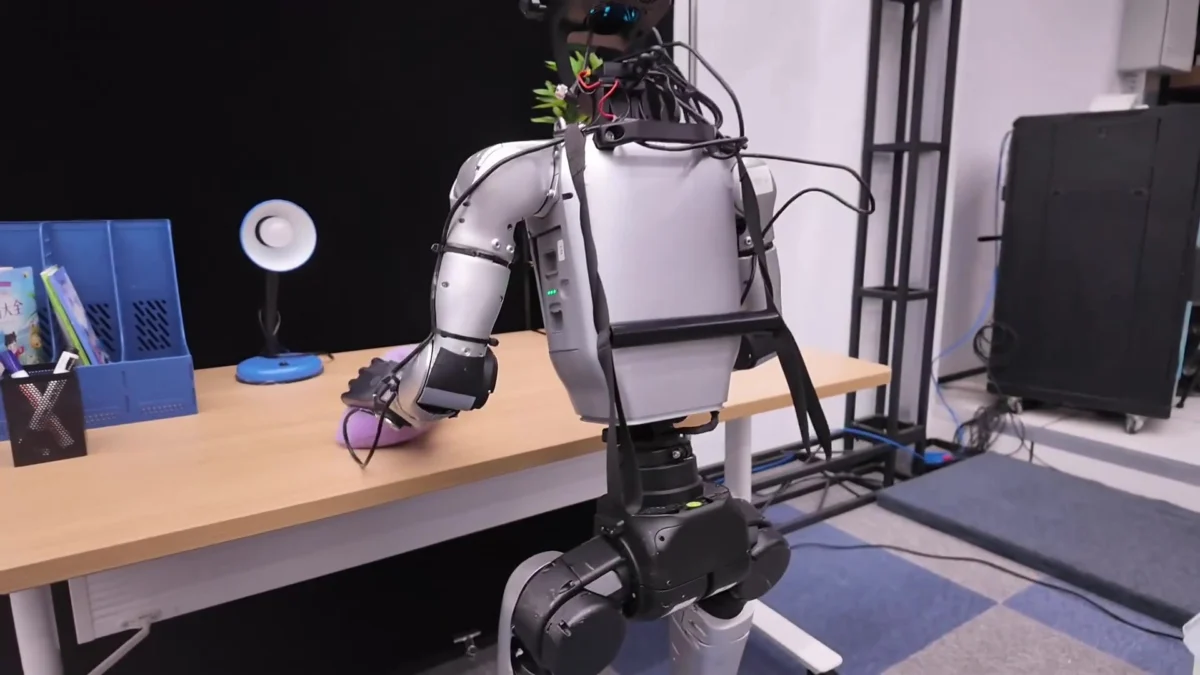
Alibaba’s Amap, a leading mapping and navigation service provider, in collaboration with Alibaba Token Hub, has officially unveiled Lambda0 (λ0), a pioneering foundation model engineered to imbue humanoid robots with sophisticated coordinated movement and manipulation capabilities. This innovative system leverages an unprecedented approach, learning directly from human demonstrations captured through first-person video synchronized with precise body and hand movements. The ultimate goal is to enable robots to seamlessly integrate complex actions such as walking, dynamic posture adjustments, and intricate two-handed operations into extended, multi-stage tasks within real-world environments.
The development of Lambda0 marks a significant leap forward in the field of embodied artificial intelligence, addressing long-standing challenges in teaching robots to perform human-like dexterous tasks. By observing and interpreting human actions, the model facilitates a more intuitive and efficient transfer of skills, moving beyond traditional, often cumbersome, robot-centric training methodologies.
A New Paradigm in Robot Training
At the core of Lambda0’s innovation lies its ability to distill complex human motor skills into actionable commands for robotic systems. Traditional methods of robot programming often involve tedious manual coding, extensive simulation, or expensive and time-consuming teleoperation where human operators physically control robots to generate training data. These approaches are not only resource-intensive but also struggle to capture the nuances and adaptability inherent in human movement.
Lambda0 offers a departure from these limitations by focusing on human-centric data. The system processes first-person video footage, providing the robot’s perspective of a task, while simultaneously integrating data from body and hand tracking. This multi-modal input allows the foundation model to learn not just the end-effector movements but also the crucial contextual information, body mechanics, and subtle adjustments that humans naturally employ during tasks. For instance, when a human performs an action like picking up an object while walking, Lambda0 learns the intricate coordination between leg movements, balance adjustments, and arm-hand manipulation, rather than treating these as isolated functions. This holistic learning is critical for enabling robots to perform dynamic, multi-faceted tasks that require continuous adaptation to changing environments and conditions.
HumanVerse: A Foundation for Dexterity
To power this ambitious learning paradigm, the Alibaba research team meticulously constructed HumanVerse, an expansive dataset comprising 500 hours of people performing a diverse array of activities in real-world environments. This colossal dataset is pivotal to Lambda0’s success, providing a rich tapestry of human behaviors, interactions with objects, and navigation through various settings. The sheer volume and realism of HumanVerse are instrumental in training a foundation model that can generalize across different tasks and environments, reducing the "sim-to-real" gap that often plagues robot learning approaches trained predominantly in simulated environments.
The activities captured in HumanVerse range from mundane daily chores to more complex manipulation tasks, all recorded with synchronized first-person video and body/hand motion data. This comprehensive data allows Lambda0 to build a robust understanding of human intent, kinematics, and dynamic control strategies. By observing humans perform tasks like opening doors, manipulating tools, carrying objects, or navigating cluttered spaces, the model learns the underlying principles of coordinated movement and object interaction. The emphasis on real-world data, as opposed to purely synthetic or lab-controlled demonstrations, is crucial for developing robots that can operate effectively outside controlled factory settings.
Overcoming Traditional Hurdles
The approach championed by Lambda0 significantly reduces the reliance on collecting demonstrations through robot teleoperation. Teleoperation, while effective for generating high-quality robot-specific data, is notoriously slow, requires highly skilled operators, and is often prone to human error, especially for complex or long-duration tasks. Furthermore, data collected via teleoperation can sometimes reflect the limitations of the teleoperation interface rather than optimal human performance, potentially leading to sub-optimal robot policies.
By utilizing human demonstrations, Lambda0 taps into an almost limitless supply of training data, as human activities are ubiquitous and easily recordable. This paradigm shift democratizes the data collection process, potentially accelerating the development cycle for new robotic capabilities. The ability to learn directly from humans performing tasks naturally in their own environments offers a scalable and cost-effective pathway to training highly capable humanoid robots.
Alibaba’s Strategic Vision in AI and Robotics
Alibaba’s foray into advanced humanoid robotics with Lambda0 is not an isolated endeavor but rather an integral part of its broader, long-term strategic vision in artificial intelligence and automation. The Chinese technology giant has consistently invested heavily in AI research and development across its various business units, from e-commerce and cloud computing to logistics and financial technology.
A Legacy of Innovation
Alibaba’s commitment to AI is evident through its DAMO Academy, a global research institute established in 2017, focusing on cutting-edge technologies including machine intelligence, natural language processing, computer vision, and robotics. Projects emerging from DAMO Academy and other Alibaba research hubs have consistently pushed the boundaries of AI applications, contributing to advancements in areas such as intelligent logistics (Cainiao Network), smart city solutions, and personalized consumer experiences. The development of Lambda0 aligns perfectly with this trajectory, leveraging Alibaba’s deep expertise in large-scale data processing, cloud infrastructure (Alibaba Cloud), and sophisticated AI algorithms. The company views AI and robotics as critical enablers for future economic growth, operational efficiency, and enhancing societal well-being.
The Broader Humanoid Robotics Landscape
The introduction of Lambda0 by Alibaba enters an increasingly competitive and rapidly evolving global landscape for humanoid robotics. Major players worldwide, including Boston Dynamics (Atlas), Tesla (Optimus), Figure AI, and Agility Robotics (Digit), are actively developing advanced humanoid platforms. The industry is characterized by significant investment and research into areas such as locomotion, manipulation, human-robot interaction, and energy efficiency.
While many competitors focus on hardware design and integrated systems, Alibaba’s contribution with Lambda0 emphasizes the crucial software layer – specifically, the intelligence required for general-purpose skill acquisition. This focus on foundation models for embodied AI is a strategic move, acknowledging that sophisticated hardware requires equally sophisticated software to unlock its full potential. The ability to train robots quickly and effectively on a wide range of tasks is arguably as important as the physical capabilities of the robots themselves.
Performance Metrics and Industry Impact
In the team’s rigorous evaluations, Lambda0 achieved a remarkable 62.5% success rate across a diverse set of real-world locomotion-and-manipulation tasks. This figure represents a significant achievement, especially considering the inherent complexity and variability of real-world environments compared to controlled laboratory settings.
Benchmarking Success
A 62.5% success rate for complex, multi-stage tasks involving both dynamic movement and fine manipulation in unstructured environments is generally considered a strong performance metric in the current state of robotics. Many robotic systems struggle with success rates above 50% when confronted with tasks requiring adaptability and robust error recovery in non-ideal conditions. The ability of Lambda0 to achieve this level of reliability suggests a robust learning framework that can generalize well from its HumanVerse dataset. As foundation models typically improve with more data and computational power, this initial success rate portends even higher capabilities as the model is refined and expanded. The project’s decision to release data-collection hardware configuration code and sample data underscores a commitment to open science, inviting the broader research community to build upon their work and accelerate advancements in the field. This open-source approach can lead to rapid iteration and improvement, benefiting the entire robotics ecosystem.
Economic Projections for Humanoid Robotics
The global market for robotics is experiencing exponential growth, driven by advancements in AI, declining hardware costs, and increasing demand for automation across various sectors. Humanoid robots, in particular, are poised for significant expansion. According to market research reports, the global humanoid robot market size was valued at several hundred million dollars in 2022 and is projected to reach several billion dollars by the end of the decade, exhibiting a compound annual growth rate (CAGR) exceeding 50%. This growth is fueled by anticipated applications in manufacturing, logistics, healthcare, retail, and even domestic assistance. Alibaba’s Lambda0 positions the company to be a key enabler in this burgeoning market, potentially providing the intelligence layer for future generations of humanoid robots.
Towards General-Purpose Robots: Implications and Future Outlook
The implications of a foundation model like Lambda0 extend far beyond specific tasks, hinting at a future where general-purpose humanoid robots become a practical reality. By learning from human demonstrations, these robots could eventually adapt to an almost infinite variety of tasks, mirroring human versatility.
Commercialization Pathways
For Alibaba, the commercialization pathways for Lambda0 are diverse. Internally, the technology could revolutionize its vast logistics network, Cainiao, by deploying humanoid robots in warehouses for picking, packing, and sorting tasks that require dexterity beyond current automated guided vehicles (AGVs) or robotic arms. In smart retail, robots powered by Lambda0 could assist customers, manage inventory, or perform cleaning tasks. Externally, Alibaba could license the Lambda0 model or its underlying technology to other robotics manufacturers, enabling them to build more capable and adaptable humanoid robots. This could establish Alibaba as a leading provider of embodied AI intelligence, much like it has become a leader in cloud computing.
Societal and Ethical Considerations
As humanoid robotics advances, societal and ethical considerations become increasingly pertinent. The deployment of general-purpose robots raises questions about potential job displacement, the need for new skill sets in the workforce, and the ethical implications of human-robot interaction. However, proponents also highlight the immense benefits, such as automating hazardous or monotonous jobs, providing assistance for the elderly or disabled, and enhancing productivity in critical sectors. Alibaba, as a major global technology player, will undoubtedly face scrutiny regarding the responsible development and deployment of such powerful AI systems. The company’s commitment to releasing parts of its research data suggests an awareness of the need for transparency and collaboration in navigating these complex issues.
Fostering Collaborative Research
The release of data-collection hardware configuration code and sample data is a strategic move that not only fosters transparency but also encourages collaborative research within the academic and industrial communities. By providing these resources, Alibaba enables other researchers to replicate their experiments, validate their findings, and build new capabilities on top of the Lambda0 framework. This open-science approach can accelerate the pace of innovation in embodied AI, leading to more robust and versatile robotic systems in the long run. It positions Alibaba not just as a developer of proprietary technology but also as a contributor to the global scientific commons.
Expert Perspectives and Reactions
The unveiling of Lambda0 is expected to elicit significant reactions from various stakeholders across the AI and robotics landscape.
Voices from Alibaba’s Leadership
While no direct statements beyond the project announcement are publicly available, it can be logically inferred that Alibaba’s leadership would emphasize the company’s long-term commitment to advancing AI for practical applications. A hypothetical statement might highlight Lambda0 as a testament to Alibaba’s innovative spirit, its dedication to solving real-world problems through advanced technology, and its vision for a future where intelligent robots seamlessly assist humanity in various aspects of life. Researchers involved would likely express enthusiasm for the potential of human-centric data to unlock new levels of robot intelligence and dexterity, and their hope for broader collaboration.
Industry Analyst Views
Industry analysts are likely to view Lambda0 as a strong signal of Alibaba’s intent to become a dominant force in the global robotics sector, particularly in the software and intelligence layers. They might commend the focus on foundation models as a scalable approach to robot training, noting that this positions Alibaba favorably against hardware-centric competitors. Analysts could also point to the strategic advantage of leveraging Alibaba’s vast ecosystem and data resources to accelerate robot development, suggesting that this move could intensify competition among tech giants vying for leadership in the future of automation. The 62.5% success rate for real-world tasks would likely be cited as a proof point for the model’s practical viability.
Academic Community’s Reception
The academic community would likely welcome the open release of data collection configurations and sample data. Researchers often rely on such resources to benchmark their own work, develop new algorithms, and foster reproducible science. Academics might praise the HumanVerse dataset as a valuable contribution to the field, recognizing the immense effort required to curate such a large and diverse real-world dataset. The innovative methodology of learning from first-person human demonstrations would likely be a topic of discussion, with researchers exploring its potential to generalize to even more complex scenarios and different robot platforms.
Conclusion: A Step Towards Embodied AI
The introduction of Lambda0 by Alibaba’s Amap and Token Hub represents a pivotal moment in the quest for truly intelligent and adaptable humanoid robots. By harnessing the power of human demonstrations and large-scale, real-world datasets, Lambda0 offers a compelling pathway towards equipping robots with the nuanced coordination and manipulation skills necessary to operate effectively in complex human environments. As Alibaba continues to invest in and refine this foundation model, it moves closer to realizing a future where humanoid robots can seamlessly integrate into various aspects of society and industry, performing a wide array of tasks with human-like dexterity and intelligence. The project’s commitment to open science further amplifies its potential impact, setting the stage for accelerated innovation across the entire robotics ecosystem.


 Evan Lee Salim

 Muslim