Siti Muinah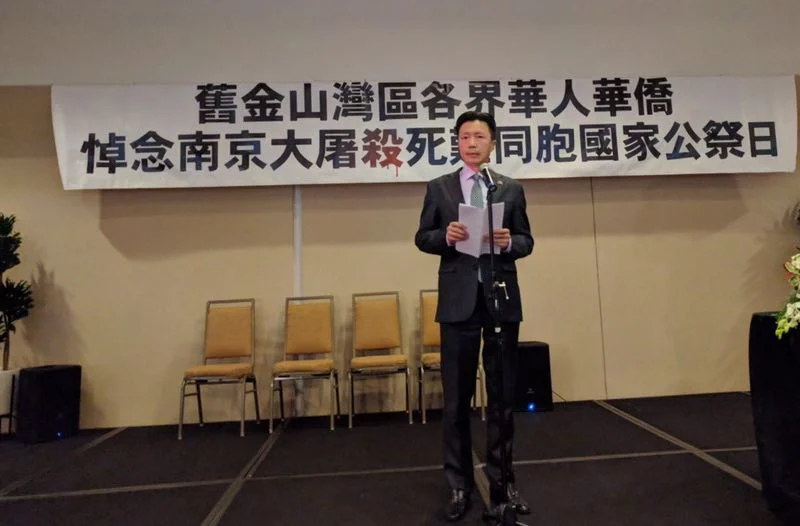
A somber assembly of hundreds, comprising representatives from the Chinese, Korean, and broader Asian communities in the San Francisco Bay Area, convened on Sunday to mark the 80th anniversary of the Nanjing Massacre, a horrific chapter of World War II committed by the Japanese Imperial Army. The annual memorial, a tradition spanning two decades, served as a powerful platform to illuminate the war crimes perpetrated during the brutal occupation of Nanjing and to impress upon attendees the enduring imperative of remembering this dark period in history. Organized by a coalition of prominent human rights and historical preservation groups, including the Rape of Nanking Redress Coalition, the Committee to Promote Reunification of China, the Alliance for Preserving the Truth of Sino-Japanese War, and the Comfort Women Justice Coalition, the event underscored a collective commitment to ensuring that the atrocities of the past are never forgotten.
The stark reality of the Nanjing Massacre was brought into sharp focus by Zha Liyou, the acting Chinese consul general in San Francisco, who addressed the gathering. He recounted the deliberate violation of international conventions by the Japanese Army, culminating in the "extremely cruel atrocity in Nanjing, where 300,000 Chinese civilians were murdered and one third of the buildings were destroyed." This figure, a chilling testament to the scale of the violence, has become synonymous with the immense human cost of the massacre.
The Brutal Onslaught of December 1937
The systematic slaughter commenced on December 13, 1937, the day Japanese troops captured Nanjing, then the capital of China. What followed was a period of over 40 days of unimaginable terror, during which Japanese soldiers engaged in widespread murder, rape, and destruction. The scale of sexual violence was particularly horrific, with tens of thousands of women subjected to rape, a crime that further compounded the suffering of the civilian population and left indelible scars on countless lives.
Judith Mirkinson, president of the Comfort Women Justice Coalition, drew a poignant parallel between the fate of Nanjing Massacre victims and the women who were sexually enslaved by the Japanese Imperial Army during World War II. "Our stories are linked," she stated, emphasizing that the plight of over 400,000 women subjected to sexual slavery is "part and parcel of what happened during the Nanjing Massacre." This interconnectedness highlights the pervasive nature of Japanese wartime atrocities and the need for a holistic understanding of the suffering inflicted across Asia.
Mirkinson further articulated the profound connection between truth and reconciliation, a concept particularly relevant in the context of historical injustices. She described the 20th century as "the most violent century in the history of the world" and posited that "one way to ensure peace in the 21st century is through truth and reconciliation." She unequivocally called for the Japanese government to acknowledge its crimes, stating, "Reconciliation does not come without truth. So the Japanese government must acknowledge their crimes. They must give justice to those few people who still survive from the Nanjing Massacre and to the memory of what happened there." This direct appeal underscores the ongoing struggle for accountability and redress.
A Wider Context of Conflict and Suffering
The Nanjing Massacre was not an isolated incident but a brutal manifestation of Japan’s aggressive expansionist policies that began with the invasion of Northeast China in September 1931. This was followed by a full-scale invasion on July 7, 1937, initiating a devastating war that lasted until Japan’s surrender in 1945. During this period of occupation, an estimated 35 million Chinese soldiers and civilians were killed or injured, a staggering number that paints a grim picture of the immense human toll of the Sino-Japanese War.
The commemoration in San Francisco this year held particular significance as it coincided with the Chinese government’s designation of the Nanjing Massacre as a National Memorial Day. This designation amplifies the global recognition of the event and reinforces the collective responsibility to remember. The worldwide participation of the Chinese community underscores the enduring impact of the massacre and the shared commitment to honoring its victims and survivors.
The Imperative of Remembrance for Lasting Peace
Zha Liyou eloquently articulated the purpose behind these commemorations, emphasizing that remembering the atrocities does not equate to perpetuating animosity. "To remember the atrocities committed by the Japanese Army during World War II does not mean to pass on the enmity but rather to remind people not to forget the history and inspire them to love peace," he stated. This sentiment highlights the forward-looking nature of historical remembrance, aiming to learn from the past to build a more peaceful future. He added that it might be a "comfort to the victims and those who sacrificed their lives that the Nanjing Massacre has been etched into the memory of the Chinese people and the world civilization."
The international recognition of the Nanjing Massacre’s significance was further solidified in 2015 when it was inscribed on the UNESCO Memory of the World Register. This prestigious designation acknowledges the massacre as documented heritage of universal value, ensuring its preservation and accessibility for future generations. The inclusion on this register underscores the global importance of confronting and remembering such historical events to prevent their recurrence.
Supporting Data and Historical Context
The Nanjing Massacre, also known as the Rape of Nanjing, stands as one of the most horrific episodes of civilian slaughter and wartime brutality in the 20th century.
-
Timeline of Key Events:
- September 18, 1931: Japan invades Manchuria (Northeast China).
- July 7, 1937: The Marco Polo Bridge Incident marks the beginning of the full-scale Second Sino-Japanese War.
- December 13, 1937: Japanese troops capture Nanjing.
- December 1937 – February 1938: The 40-plus days of massacre, rape, and looting in Nanjing.
- August 15, 1945: Japan surrenders, ending World War II.
- 2015: The Nanjing Massacre is inscribed on the UNESCO Memory of the World Register.
- Present: Annual commemorations, including the one held in San Francisco, continue to highlight the event.
-
Scale of Atrocities:
- Estimated Deaths: While the figure of 300,000 is widely accepted and commemorated, historical research and varying interpretations exist. However, the consensus points to hundreds of thousands of civilian deaths.
- Sexual Violence: Tens of thousands of women were raped, a deeply traumatic aspect of the massacre that continues to resonate.
- Destruction: Approximately one-third of Nanjing’s buildings were destroyed, crippling the city and its infrastructure.
-
The "Comfort Women" System: The Nanjing Massacre is intrinsically linked to the broader system of sexual slavery orchestrated by the Japanese military, wherein women from occupied territories were forced into sexual servitude. The scale of this system, affecting hundreds of thousands of women across Asia, underscores the pervasive nature of Japanese wartime atrocities.
Broader Implications and the Pursuit of Justice
The ongoing commemorations of the Nanjing Massacre serve multiple critical functions. Firstly, they act as a vital educational tool, ensuring that younger generations are aware of the horrific consequences of unchecked militarism and racial prejudice. By confronting these historical truths, societies can better equip themselves to resist the resurgence of such ideologies.
Secondly, these events are a powerful call for accountability and justice. The continued calls for the Japanese government to fully acknowledge its wartime actions and offer sincere apologies and reparations to victims and their families underscore the unresolved nature of historical grievances. This pursuit of justice is not merely about retribution but about achieving a genuine reconciliation that can foster lasting peace in East Asia and beyond.
Finally, the unity displayed by various communities in San Francisco highlights the transnational nature of historical memory and the shared human desire for peace. The inscription on the UNESCO Memory of the World Register signifies that the Nanjing Massacre is not just a national tragedy but a part of humanity’s collective memory, a stark reminder of the depths of human cruelty and the enduring importance of vigilance against its recurrence. The commitment to remembering the victims and survivors is a testament to the resilience of the human spirit and the unwavering pursuit of a world where such atrocities are relegated to the annals of history, never to be repeated.


 Nana Wu
 Suro Senen