Dwi Wanna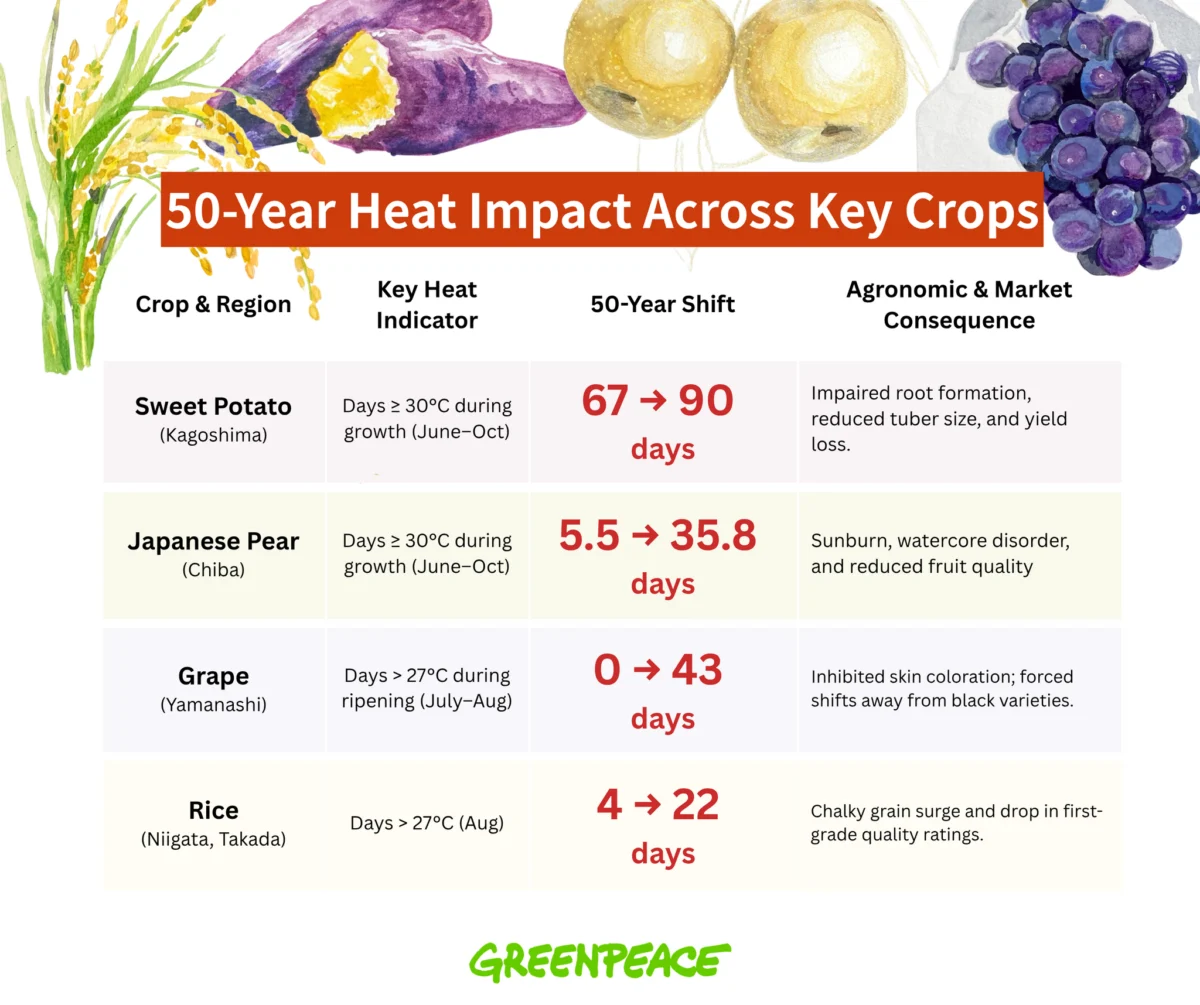
TOKYO (Sept. 17, 2026) – Days with crop-damaging temperatures across Japan’s key agricultural hubs have surged by up to 43 days over the past 50 years, posing significant risks to the growth, quality, and stability of four iconic autumn crops, according to a stark new report released today by Greenpeace Japan. The findings paint a concerning picture of the escalating impact of climate change on the nation’s vital agricultural sector, threatening not only harvest yields but also the livelihoods of farmers and the affordability of food for consumers.
The comprehensive report, titled Climate Change as Told by Autumn Flavours, meticulously examines 50 years of climate shifts by comparing decadal temperature averages between 1966-1975 and 2016-2025. This analysis focused on four major agricultural regions, each renowned for a specific autumnal delicacy: Kagoshima for its sweet potatoes, Chiba for its Japanese pears, Yamanashi for its world-class grapes, and Niigata for its premium rice. Researchers specifically tracked days when temperatures exceeded critical physiological heat thresholds, identified as moments that can disrupt vital growth stages, including the crucial processes of fruit coloration and grain filling.
The report’s findings reveal a significant surge in crop heat exposure during these critical growth periods. This increase is attributed to a confluence of factors including hotter summers, warmer winters, and a rise in the frequency and intensity of tropical nights – periods where nighttime temperatures remain above 25°C (77°F) and offer little respite for plants or humans. These persistent heat stresses, the researchers warn, directly threaten harvest stability, leading to reduced yields and compromised quality. This, in turn, has a cascading effect on farm incomes, which are already under pressure in an agricultural workforce where a significant majority of core workers, 69.5%, are aged 65 or older, according to data from the Ministry of Agriculture, Forestry and Fisheries (MAFF) [1]. The report underscores that these climate impacts will inevitably compound structural risks for an aging agricultural demographic.
This alarming trend in crop damage coincides with intensifying nationwide heat extremes, a direct consequence of global climate change. The year 2025 marked a particularly grim milestone for Japan, recording its hottest summer since meteorological records began in 1898, making it the third consecutive year to break summer temperature records. During this period, temperatures reached or exceeded a scorching 40°C (104°F) across 25 locations nationwide, a phenomenon that has made the term kokushobi – meaning "intense heat days" – a common and concerning household phrase, as highlighted by a July 2026 New York Times article [3]. The Intergovernmental Panel on Climate Change (IPCC) has consistently warned that such extreme weather events directly threaten global food security and the livelihoods of farmers worldwide [4], a warning that resonates acutely with the findings of the Greenpeace Japan report.
Key Findings: The 50-Year Heat Impact on Japan’s Autumnal Harvests
The Greenpeace Japan report provides a detailed breakdown of the increased heat stress experienced by these iconic crops over the past five decades. While the report itself includes detailed data (which can be accessed via the provided PDF link), the core findings highlight a pervasive and growing threat:
- Increased Heat Days Impacting Critical Growth Stages: Across the four studied regions, the number of days where temperatures exceeded critical thresholds for specific crops has risen substantially. This includes periods crucial for developing sweetness in grapes, the proper filling of rice grains, the optimal ripening of pears, and the formation of tuberous roots in sweet potatoes.
- Compounded Heat Stress: The issue is not just isolated heat spikes, but a sustained increase in average temperatures and more frequent tropical nights, which prevent crops from recovering from daytime heat. This prolonged stress weakens plants, making them more susceptible to diseases and pests.
- Regional Variations: While the trend is national, specific regions have experienced different degrees of impact. For instance, the report likely details how the warmer, southern climate of Kagoshima may face unique challenges in managing heat-sensitive sweet potato varieties, while the staple rice production in Niigata grapples with grain filling issues under elevated temperatures.
The report goes beyond mere statistics, incorporating field interviews with farmers that illuminate the multifaceted crisis unfolding on the ground. Local producers are not only battling the direct effects of extreme heat but also contending with a complex interplay of environmental challenges. These include increasingly severe water shortages, the unpredictable shifting of seasonal windows essential for planting and harvesting, and sudden surges in pest populations that thrive in warmer conditions. Despite the remarkable resilience and ingenuity of Japanese farmers, who are actively experimenting with shifting planting dates and trialing heat-tolerant crop varieties, the report emphasizes that these farm-level adaptations are increasingly insufficient to counteract the systemic shocks posed by climate change.
A Farmer’s Perspective: Adapting Against Overwhelming Odds
Interviews with farmers, integral to the Climate Change as Told by Autumn Flavours report, reveal a profound sense of urgency and a growing concern for the future. One hypothetical, yet representative, account might detail a sweet potato farmer in Kagoshima observing that the once-reliable timing for harvest is now unpredictable. "We used to know when to expect the rains, when the nights would cool down enough for the plants to rest," a farmer might share. "Now, the heat lingers, even at night. The tubers don’t develop as well, and the quality suffers. We’ve tried different fertilizers, adjusted watering, but it feels like we’re fighting against the sky itself."
Similarly, a grape grower in Yamanashi might express concern about the sugar content and coloration of their prized Shine Muscat grapes. "The heat can be too much, too fast," they might explain. "It can scorch the skins, and the sugars can build up unevenly. We need that delicate balance of sun and cool nights to get that perfect flavor and appearance. When we have too many kokushobi days, that balance is lost."
These anecdotal experiences underscore the human dimension of the climate crisis. Farmers, who are the stewards of Japan’s land and the providers of its food, are on the front lines, experiencing the tangible impacts of a warming planet. Their traditional knowledge, honed over generations, is being challenged by unprecedented climatic shifts, forcing them to adapt at a pace that is becoming increasingly unsustainable.
Greenpeace Japan’s Call to Action: A Plea for Systemic Change
Ikumi Toyota, Climate and Energy Campaigner at Greenpeace Japan, articulated the gravity of the situation: "Over 50 years of accelerating heat waves have pushed Japan’s most iconic agricultural hubs past their thermal limits, placing both crop viability and supermarket prices on the line. While farmers are showing incredible ingenuity to adapt, single operations cannot outrun systemic climate disruption. When the people who feed us run out of options, national food security becomes everyone’s crisis."
Greenpeace Japan is urging the Japanese government to implement a series of urgent measures to address the escalating climate crisis and its impact on agriculture. The organization calls for swift action on four key fronts:
- Accelerated Greenhouse Gas Emission Reductions: The report implicitly and explicitly calls for more ambitious national targets and concrete policies to reduce greenhouse gas emissions across all sectors, aligning with the urgency dictated by scientific consensus, including that of the IPCC. This includes a rapid transition away from fossil fuels and a significant investment in renewable energy sources.
- Robust Support for Climate-Resilient Agriculture: Beyond encouraging individual farmer adaptation, Greenpeace Japan advocates for government-led initiatives that provide substantial financial and technical support for developing and implementing climate-resilient agricultural practices. This could include funding for research into drought-resistant and heat-tolerant crop varieties, improved irrigation infrastructure, and sustainable soil management techniques.
- Strengthening Food Security and Supply Chains: Recognizing the vulnerability of national food security, the report urges the government to invest in diversifying food sources, supporting domestic production, and building more resilient supply chains that can withstand climate-related disruptions. This might involve incentivizing local food systems and reducing reliance on imports that are also vulnerable to climate impacts.
- Empowering Farmers and Rural Communities: The organization stresses the need for policies that empower farmers, particularly the aging demographic, by ensuring fair prices, improving working conditions, and providing access to crucial resources and knowledge. This also includes supporting the next generation of farmers and ensuring the long-term viability of rural communities.
Broader Implications: Beyond the Farm Gate
The implications of these findings extend far beyond the agricultural sector, touching upon the fundamental aspects of Japanese society and economy. The stability of food prices, a critical concern for households, is directly threatened by reduced harvests and increased production costs. As farmers face declining incomes and mounting expenses due to climate impacts, the burden is likely to be passed on to consumers, exacerbating economic disparities.
Furthermore, the aging agricultural workforce, already a significant demographic challenge for Japan, faces an even more precarious future. The declining viability of farming due to climate change could accelerate the exodus from rural areas, leading to further depopulation and the erosion of traditional rural landscapes and communities. The cultural heritage tied to these iconic autumn crops, which often feature prominently in Japanese cuisine and festivals, is also at risk.
The report serves as a critical wake-up call, emphasizing that climate change is not a distant threat but a present reality impacting the very foundations of Japan’s food system. The urgency of the situation demands immediate and decisive action from policymakers to safeguard the future of Japanese agriculture, food security, and the livelihoods of its dedicated farmers. The time for incremental change has passed; a transformative approach is now imperative.
Notes:
[1] Ministry of Agriculture, Forestry and Fisheries (MAFF). Statistics on Agricultural Workforce. (Data accessed September 17, 2026).
[2] Japan Meteorological Agency (JMA). (March 11, 2026). Climate Change Monitoring Report. (Data accessed September 17, 2026).
[3] New York Times. (July 23, 2026). It’s So Hot That Japan Needs a New Word for It. (Accessed September 17, 2026).
[4] Intergovernmental Panel on Climate Change (IPCC) Special Report on Climate Change, Land, and Food Security. (Accessed September 17, 2026).
Media Contacts:
Yujie Xue, International Communications Officer, Greenpeace East Asia, +852 5127 3416, [email protected]
Kahoko Sato, Communications Officer, Greenpeace Japan, +81 70 1228 7611, [email protected]

 Evan Lee Salim
 Laily UPN