
 Dwi Wanna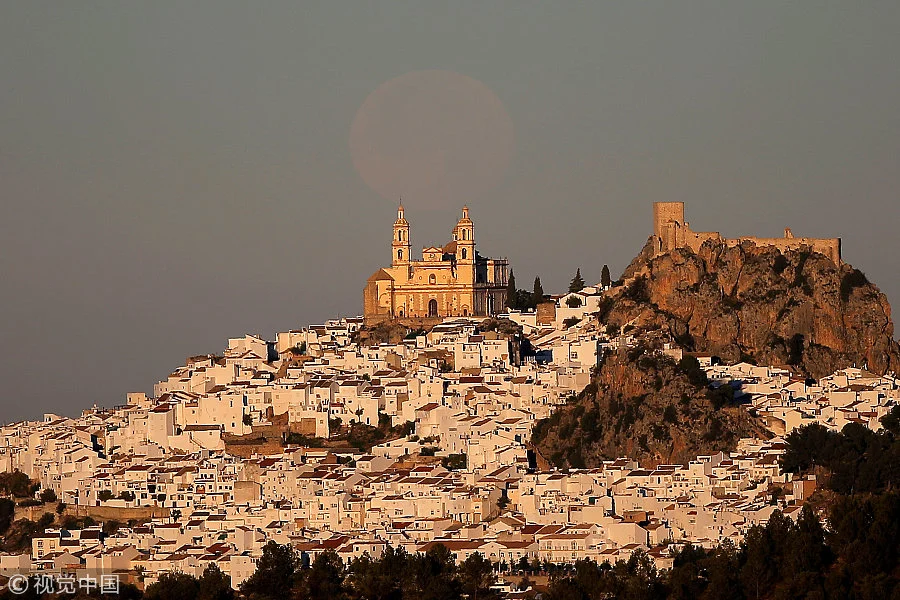
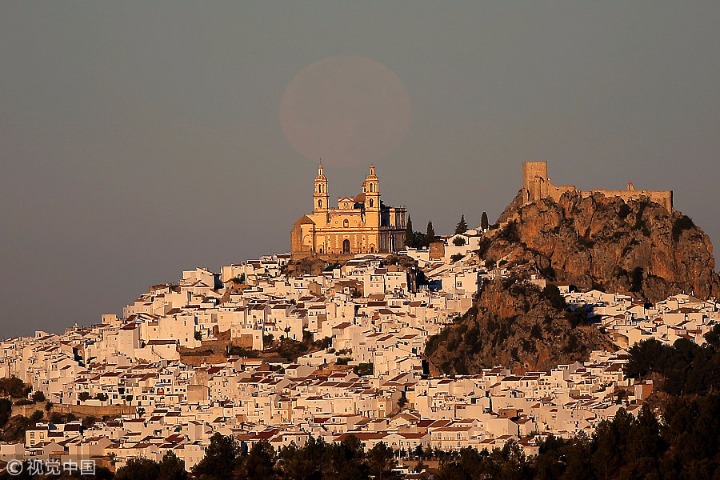
The supermoon, a captivating celestial phenomenon where a full moon coincides with its closest orbital point to Earth, graced the skies over Olvera, near Cadiz in southern Spain, on December 4, 2017. This particular lunar event, a full moon occurring at perigee, caused the moon to appear significantly larger and brighter than its average full moon appearance, captivating onlookers and photographers alike. The image captured shows the luminous orb positioned majestically above the historic church of Nuestra Senora de la Encarnacion, a scene that underscores the enduring human fascination with the night sky and its astronomical wonders. December’s full moon is traditionally known as the Cold Moon, marking the first full moon of the winter season in the Northern Hemisphere, adding a layer of seasonal significance to its already awe-inspiring presence.
Understanding the Supermoon Phenomenon
A supermoon, scientifically termed a perigean full moon, occurs when the moon’s elliptical orbit brings it to its closest point to Earth, known as perigee, simultaneously with the lunar phase of a full moon. The distance between the Earth and the moon is not constant; it varies due to the moon’s elliptical orbit. Perigee typically occurs at a distance of approximately 363,300 kilometers (225,700 miles) from Earth, while apogee, the farthest point, is around 405,500 kilometers (251,900 miles). When a full moon aligns with perigee, the moon can appear up to 14% larger and 30% brighter in the sky compared to when it is at apogee. This difference, while subtle to the untrained eye, is noticeable and contributes to the heightened visual impact of a supermoon. The supermoon observed on December 4, 2017, was part of a series of such events that occur periodically throughout the year, each offering a unique spectacle depending on atmospheric conditions and the specific orbital alignment. Astronomical bodies like the moon, despite their immense distances, exert tangible influences on our planet, from tidal forces to cultural interpretations that have persisted for millennia.
Historical and Cultural Significance of Lunar Events
Throughout human history, celestial events, particularly those involving the moon, have held profound cultural, religious, and scientific significance. Lunar cycles have been fundamental to the development of calendars, agricultural practices, and mythological narratives across diverse civilizations. The full moon, in particular, has been associated with a myriad of beliefs, ranging from mystical powers to heightened emotions. The term "Cold Moon" itself is rooted in the traditions of Native American tribes, reflecting the onset of winter’s harshest weather, the longest nights, and the scarcity of hunting opportunities. Other names for the December full moon include the "Long Night Moon" due to the winter solstice occurring around this time, and the "Oak Moon" or "Moon Before Yule" in European traditions. These names highlight the deep connection between human societies and the natural world, with celestial occurrences serving as vital markers of time and seasonal change. The supermoon observed in Spain was not merely a scientific anomaly but also a continuation of this age-old human tradition of observing and interpreting the night sky.
The December 4, 2017 Supermoon: A Closer Look
The supermoon on December 4, 2017, was particularly noteworthy due to its visual prominence. While supermoons occur several times a year, the apparent size and brightness can vary depending on the exact distance at perigee. Astronomical data from that period indicates that this particular supermoon was among the closer ones of the year, amplifying its visual impact. The photograph captured in Olvera showcases the moon as a radiant orb, its light casting a gentle glow upon the architectural silhouette of the church. This juxtaposition of a natural celestial event with a man-made structure serves as a powerful reminder of humanity’s place within the grand cosmic order. The atmospheric conditions on that night likely played a role in the clarity and brilliance of the moon’s appearance. Factors such as low humidity, minimal cloud cover, and the absence of significant light pollution contribute to optimal viewing conditions for astronomical events.
Broader Astronomical Context and Future Observations
The supermoon of December 4, 2017, is part of a predictable astronomical cycle. Scientists have been meticulously tracking lunar orbits and predicting these events for centuries, thanks to advancements in celestial mechanics. The understanding of the moon’s orbit has evolved from early empirical observations to sophisticated mathematical models. The study of lunar phases and orbital variations provides invaluable insights into the dynamics of the Earth-moon system, which in turn influences our understanding of planetary formation and evolution. Future supermoons will continue to occur, with their visibility and impact influenced by the same astronomical principles. For instance, a particularly close supermoon occurred on November 14, 2016, which was the closest supermoon since 1948. Subsequent supermoons, while perhaps not as exceptionally close, continue to offer opportunities for public engagement with astronomy and inspire scientific curiosity. Observing these events can foster a greater appreciation for the vastness of space and the intricate workings of our solar system.
The Role of Photography in Documenting Celestial Events
The widespread dissemination of images like the one from Olvera highlights the crucial role of photography in documenting and sharing astronomical phenomena with a global audience. Modern digital photography and the accessibility of high-quality cameras have democratized the ability to capture stunning celestial images. Astrophotography has evolved into a sophisticated field, with enthusiasts and professionals alike pushing the boundaries of what is possible in capturing distant celestial objects. The image of the supermoon over the Spanish church is not just a beautiful photograph; it serves as a scientific record, capturing the appearance of the moon at a specific time and location. Such images can be used by astronomers to study atmospheric conditions, to compare with historical records, and to inspire future generations of scientists and explorers. The visual appeal of supermoons, in particular, often sparks renewed public interest in astronomy, encouraging people to look up and learn more about the cosmos.
Analysis of Implications and Public Engagement
The occurrence of a supermoon, especially one as visually striking as the December 4, 2017 event, often leads to increased public engagement with astronomy. News reports and social media buzz surrounding such events can spark conversations and encourage individuals to seek out information about celestial bodies. This heightened awareness can translate into a greater appreciation for scientific endeavors and the importance of space exploration. Furthermore, the visual spectacle can inspire educational initiatives, with schools and observatories often organizing special viewing events or educational programs. While the direct scientific implications of a single supermoon are minimal – they do not cause significant geological events or dramatic weather changes, contrary to some popular myths – their indirect impact on public interest in science is substantial. The ability of a celestial event to capture the imagination of millions worldwide underscores the enduring human desire to understand our place in the universe. The supermoon over Spain serves as a testament to this, offering a moment of shared wonder and a reminder of the extraordinary beauty that unfolds in the night sky. Future observations and the continued advancement of astronomical technology promise even more breathtaking glimpses into the workings of the cosmos.


 Nana Wu
 Suro Senen