Nila Kartika Wati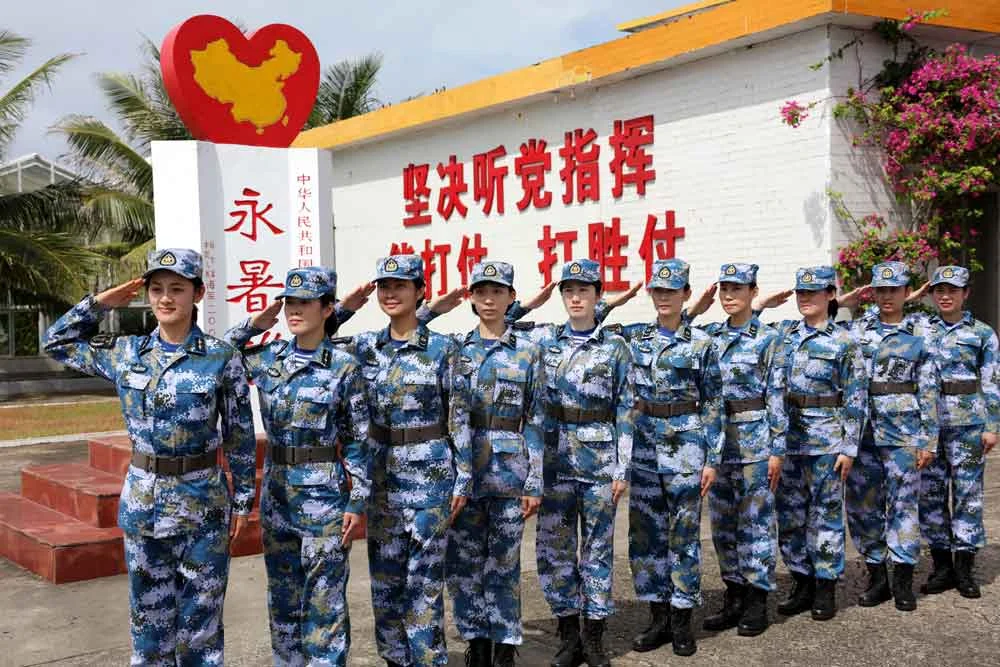
On December 11, 2017, the People’s Liberation Army (PLA) Navy officially announced that ten female service members had commenced duties with the garrison guarding the Nansha Islands, a cluster of reefs and atolls in the contested South China Sea. This landmark deployment represents the first instance of female personnel being permanently stationed in China’s southernmost territories, specifically on Yongshu Reef (internationally known as Fiery Cross Reef). The move underscores the PLA’s evolving personnel strategies and its enduring commitment to asserting its claims in the complex geopolitical landscape of the South China Sea.
Pioneering a New Era of Service in the South China Sea
The contingent of ten women comprises a mix of officers and sergeants, boasting an average age of 23, and notably, all possess a university diploma. Their diverse skill sets have seen them assigned to a wide array of crucial posts within the garrison, including staff coordination, communications, and essential medical services. This strategic allocation highlights a deliberate effort by the PLA to leverage highly educated and multi-skilled personnel in remote and challenging environments, optimizing operational efficiency and unit resilience.
Prior to this deployment, female PLA members had indeed visited and served on the Nansha Islands, but their assignments were typically short-term missions, with personnel remaining under the command of their originating units. The current deployment signifies a fundamental shift, establishing these women as integral, long-term components of the Nansha Islands Garrison, reflecting a deeper integration into the operational fabric of China’s forward presence.
Zhang Jiahong, the political commissar of the PLA Nansha Islands Garrison, addressed the welfare and health of the newly deployed female personnel. He was quoted as stating that these members would be periodically rotated back to the mainland every few months for rest and recuperation. This policy is designed to mitigate the unique physical and psychological challenges associated with prolonged service in isolated, remote, and often austere island environments, ensuring their sustained well-being and operational readiness.
One of the newly stationed service members, Zhou Yaling, offered a vivid personal account of her initial impressions. She remarked that the Nansha Islands proved to be "more beautiful than what they had imagined," describing a surprisingly developed infrastructure that includes "airports, harbors, streets, hospitals, and sporting grounds." Her observations paint a picture of the islands as "a lovely city on the sea," a testament to the extensive development efforts undertaken by China on these features over recent years. This perspective not only highlights the improved living and working conditions but also reinforces the narrative of China’s long-term and substantial investment in transforming these remote outposts into functional, habitable stations.
Strategic Context: The Nansha Islands and the South China Sea
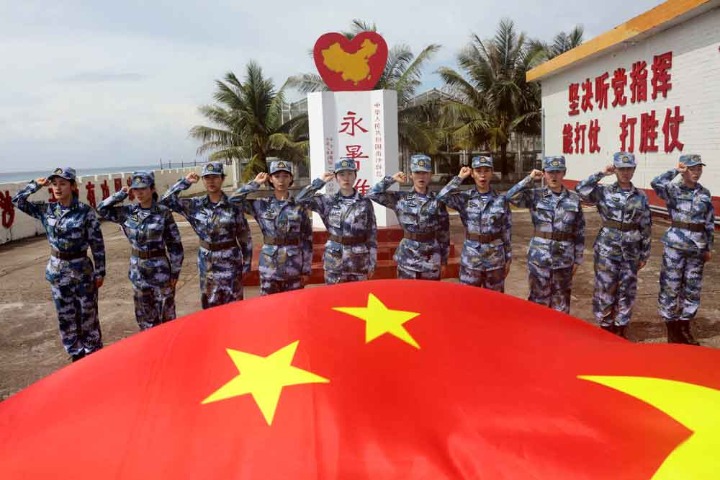
The Nansha Islands, internationally recognized as the Spratly Islands, are an archipelago of more than 100 small islands, reefs, and atolls situated in the South China Sea. They are subject to competing claims from multiple regional states, including China, Vietnam, the Philippines, Malaysia, Brunei, and Taiwan. The South China Sea itself is one of the world’s most critical waterways, through which an estimated one-third of global shipping — including vast quantities of oil and gas — passes annually. The region is also believed to hold significant untapped oil and natural gas reserves, in addition to rich fishing grounds, further amplifying its geopolitical and economic importance.
China asserts "indisputable sovereignty" over virtually the entire South China Sea, delineated by its expansive "nine-dash line" claim. This claim is largely rejected by other claimant states and challenged by international law, particularly the 2016 ruling by the Permanent Court of Arbitration in The Hague, which invalidated China’s historical claims under the United Nations Convention on the Law of the Sea (UNCLOS). Despite this, China has steadfastly refused to recognize the ruling and has continued to expand its presence and influence in the region.
Beginning in the early to mid-2010s, China embarked on an unprecedented land reclamation and island-building campaign across several features in the Nansha Islands. Yongshu Reef, where the female garrison is stationed, is one of the largest and most developed of these artificial islands. It now features a 3,000-meter airstrip capable of handling military transport aircraft, extensive port facilities for naval vessels, radar installations, and various military and civilian support structures. These developments have transformed what were once submerged reefs or small outcrops into substantial, fortified outposts, capable of projecting power and sustaining a significant military presence.
The Evolving Role of Women in the People’s Liberation Army
The deployment of female personnel to such a strategically sensitive and operationally demanding location reflects a broader trend within the PLA towards greater gender integration and the diversification of its workforce. Historically, women in the PLA were largely confined to support roles such as medical care, communications, and cultural performance. However, in recent decades, there has been a gradual but significant shift, with women increasingly being integrated into more combat-oriented and specialized roles across all branches of the military.
This evolution aligns with global trends observed in many modern armed forces, where women are taking on more prominent and challenging roles, including in combat units, aviation, and special operations. For the PLA, this represents a deliberate effort to enhance its overall capabilities, draw from a wider talent pool, and project an image of a modern, inclusive fighting force. The fact that the deployed women are university-educated officers and sergeants further underscores the PLA’s emphasis on professionalism and the intellectual capital of its personnel, even in remote garrisons. Their assignment to varied posts like staff, communications, and medical service demonstrates a practical approach to utilizing their skills where they are most needed, contributing directly to the garrison’s operational effectiveness and self-sufficiency.
Broader Implications and Analysis
The deployment carries multiple layers of significance, both domestically and internationally:
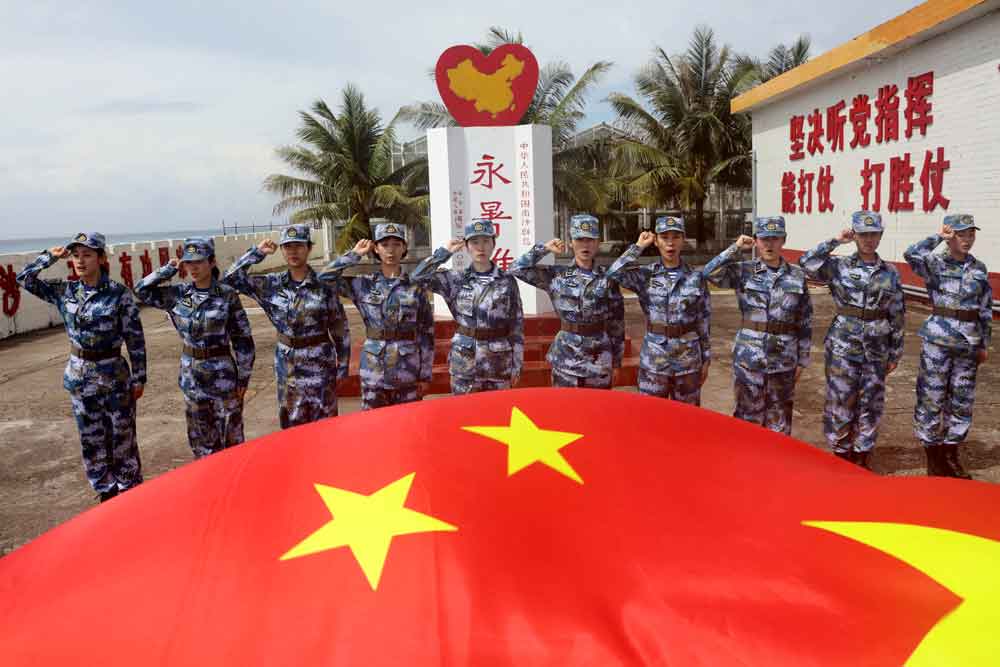
1. Symbolic Reinforcement of Sovereignty: By permanently stationing female service members, China further normalizes and solidifies its long-term presence on the Nansha Islands. It sends a clear message that these outposts are not merely temporary forward operating bases but integral, habitable parts of China’s sovereign territory, complete with diverse personnel contributing to their daily functions. This move subtly yet effectively counters narratives that portray China’s presence as purely militaristic or transient.
2. Modernization and Professionalization of the PLA: The integration of university-educated women into key operational roles in a challenging environment highlights the PLA’s ongoing modernization drive. It signals a commitment to recruiting highly skilled individuals and optimizing human resources, reflecting a shift from a purely manpower-intensive force to one that prioritizes talent, technology, and diverse capabilities. This move also contributes to the PLA’s image as a progressive and inclusive institution.
3. Enhancing Garrison Welfare and Morale: The presence of women can contribute to a more balanced and diverse social environment within the isolated garrison. Anecdotal evidence from other militaries suggests that mixed-gender units can sometimes lead to improved morale, better communication, and a more robust social fabric, which is particularly crucial in remote and stressful postings. The stated policy of regular rotational leave also underscores a commitment to the well-being of all personnel, male and female, serving in these demanding locations.
4. Geopolitical Messaging: While seemingly an internal personnel decision, the deployment of female troops in such a high-profile, contested region inevitably carries geopolitical weight. It reinforces China’s resolve to maintain and expand its control over the Nansha Islands, signaling to other claimant states and international observers that China’s presence is not only enduring but also becoming more comprehensive and normalized. It may also serve as a subtle deterrent, demonstrating the nation’s capacity to sustain a diverse and capable force in remote outposts.
5. Operational Enhancements: The specific roles assigned to the women—staff, communications, and medical service—are critical for the sustained operation of any remote military outpost. Their specialized skills directly enhance the garrison’s administrative efficiency, its ability to communicate with the mainland and other units, and its capacity to provide essential healthcare to its personnel. This diversified skill set contributes to the overall resilience and self-sufficiency of the Nansha Islands Garrison.
Timeline of Key Developments in the South China Sea (Post-2010):
- Early 2010s: China begins large-scale dredging and land reclamation activities on several features in the Nansha (Spratly) and Xisha (Paracel) Islands.
- 2014-2015: Rapid expansion of artificial islands, including Yongshu Reef, Meiji Reef (Mischief Reef), and Zhubi Reef (Subi Reef), with the construction of airstrips, harbors, and other infrastructure.
- 2016: The Permanent Court of Arbitration rules against China’s historical claims in the South China Sea, a ruling China rejects.
- Late 2016 – 2017: Continued militarization of the artificial islands, including the deployment of missile systems, radar installations, and hangar facilities.
- December 11, 2017: The PLA deploys its first permanent female garrison to the Nansha Islands, specifically on Yongshu Reef.
This significant personnel decision by the PLA reflects a multifaceted strategy combining military modernization, personnel diversification, and the steadfast assertion of sovereign claims in one of the world’s most complex and strategically important maritime regions. The presence of female service members on the Nansha Islands is not merely a symbolic gesture but a tangible indicator of China’s long-term commitment and evolving approach to its presence in the South China Sea.


 Ali Ikhwan
 Raul Delapena Setiawan