Muslim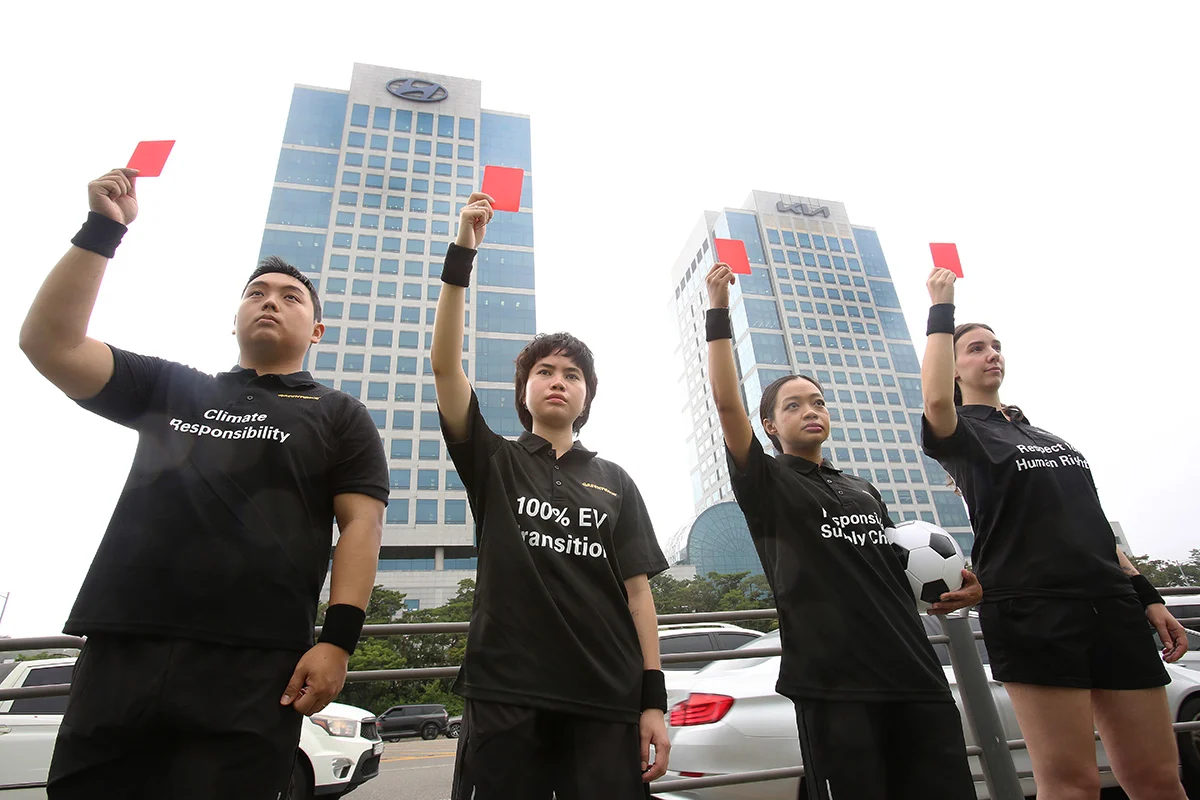
SEOUL – In a dramatic display targeting Hyundai Motor Group’s prominent sponsorship of the FIFA World Cup, Greenpeace activists unfurled symbolic referee "red cards" at the automotive giant’s headquarters today. The action serves as a stark ultimatum, demanding that the world’s third-largest automotive manufacturer immediately address pervasive human rights violations, rampant labor exploitation, and significant carbon-intensive risks embedded within its expansive global supply chain. Furthermore, the activists are calling for a reversal of Hyundai’s recent decision to scale back its ambitious electric vehicle (EV) transition plans.
This high-profile demonstration in Seoul represents the culmination of a month-long, globally coordinated campaign of protests aimed squarely at Hyundai-Kia’s lucrative World Cup affiliation. Spearheaded on the ground by Greenpeace East Asia, today’s finale in South Korea was amplified by a formidable international coalition comprising eleven leading environmental and human rights organizations. Their collective objective is to expose what they describe as a glaring disconnect between Hyundai’s public-facing sustainability narrative and the documented harms occurring within critical segments of its supply chain, all while the automaker invests millions in an "eco-friendly" sports marketing blitz.
The escalating international pressure has been meticulously timed with major FIFA World Cup matches, amplifying the campaign’s visibility and impact. Throughout the tournament, various actions have been executed by coalition partners, ranging from digital campaigns urging consumers to "red card" Hyundai to targeted outreach at fan zones and diplomatic missions. These efforts have aimed to galvanize public opinion and place direct scrutiny on Hyundai’s corporate practices during its moment of peak global visibility.
Earlier in the campaign, the international coalition delivered a formal Open Letter to Hyundai Executive Chair Euisun Chung. This comprehensive document implored the company to leverage its privileged position as a premier FIFA sponsor to implement robust, structural climate commitments and establish verifiable corporate accountability mechanisms that extend throughout its entire value chain. The letter underscored the urgency of these demands, emphasizing the long-term reputational and financial risks associated with inaction.
Market Risk: Hyundai’s Lagging Clean Transition and Supply Chain Governance
Despite Hyundai’s strategic use of the FIFA World Cup to project an image of corporate environmental responsibility, a stark reality persists: internal combustion engine (ICE) vehicles still constitute a staggering 93% of Hyundai-Kia’s annual sales, which total approximately 6.8 million units. This continued reliance on fossil fuel-powered vehicles results in a colossal combined annual carbon footprint for the group, estimated at 250 million tonnes of CO2 equivalent – a figure comparable to the total national emissions of Spain.
Independent automotive sustainability assessments have consistently ranked Hyundai significantly behind its global competitors, including industry leaders like Tesla, Volkswagen, and Mercedes-Benz, particularly in the critical areas of supply chain decarbonization and human rights due diligence. These benchmarks highlight a substantial gap in Hyundai’s approach to mitigating environmental and social risks associated with its vast manufacturing and sourcing operations.
The South Korean automaker is increasingly facing a dual onslaught of regulatory pressure and reputational damage, compelling it to strengthen oversight of its manufacturing pipeline and its intricate network of sourcing relationships. A series of in-depth investigations conducted by respected organizations such as Steel Watch, Mighty Earth, and Jobs to Move America have meticulously documented serious environmental and labor concerns within various tiers of Hyundai’s supplier base.
A particularly contentious issue remains Hyundai Steel’s continued adherence to coal-based production methods. This practice has drawn significant criticism for its substantial contribution to air pollution and the associated public health costs, estimated in the billions of dollars, across manufacturing hubs in both South Korea and Brazil. The environmental impact of these operations directly affects local communities and contributes to the broader climate crisis, creating a stark contrast with the company’s purported sustainability goals.
Statements from the Global Coalition
The international coalition has articulated its concerns through a series of pointed statements, shedding light on the specific grievances driving their campaign.
Erin Eunseo Choi, Climate and Energy Campaigner at Greenpeace East Asia, expressed deep disappointment regarding Hyundai’s recent strategic shifts. "Hyundai Motor’s latest sustainability report touts ‘Electrification and Our Climate Response,’ yet the quiet abandonment of its concrete 2030 battery EV sales targets sends a profoundly contradictory message," Choi stated. "By revising its roadmap to heavily favor hybrids and Extended-Range EVs (EREVs) – vehicles that fundamentally still depend on internal combustion engines – Hyundai is actively pursuing a false transition. While EREVs may present themselves as electric, they are not a genuine zero-emission solution. Instead, they risk entrenching our reliance on fossil fuels and diverting essential resources away from the urgent imperative of full battery electrification. Given that the vehicles Hyundai sells are responsible for 79% of its Scope 3 emissions, deliberately slowing electrification is akin to removing a star striker from the field mid-game. In an era where war-driven oil price volatility is rapidly accelerating the global shift towards EVs, any hesitation in committing to a true transition jeopardizes Hyundai’s future market share."
Nish Humphreys, Campaign Manager at Ekō, highlighted the stark contrast between Hyundai’s public image and its operational realities. "Hyundai seeks to capture the world’s attention with its Football World Cup advertisements, deliberately diverting focus from the darker aspects of its supply chain," Humphreys commented. "On the pitch, the company is sponsoring the dreams of young athletes. However, behind the scenes, a far more troubling narrative unfolds. Publicly available reports have raised grave concerns about child labor, worker fatalities and injuries, and even the unexplained disappearances of Indigenous activists in Mexico who were safeguarding the land surrounding Hyundai’s steel supplier. In solidarity with the activists on the ground, over 7,400 individuals have digitally ‘red-carded’ Hyundai through our virtual protest. They join a global chorus of over 52,000 citizens, football fans, and Hyundai drivers who have signed the Ekō petition, demanding that the company decisively clean up its supply chain before the final whistle blows on its corporate irresponsibility."
Abhilasha Bhola, Climate Campaigns Director at Public Citizen, provided a succinct summary of the coalition’s findings. "The evidence is irrefutable: Hyundai-Kia’s supply chain is demonstrably tainted by documented human rights abuses, severe environmental degradation, and pervasive labor exploitation," Bhola asserted. "The corporate sponsors of the World Cup cannot continue to profit handsomely while workers, vulnerable communities, and our planet bear the profound and often devastating consequences of corporate misconduct."
Strategic Demands to Hyundai Motor Group
The international coalition has outlined three non-negotiable directives that they expect Hyundai Motor Group’s executive leadership to address with immediate and decisive action. These demands are designed to create tangible change and ensure genuine accountability.
-
Accelerate a Just Transition to 100% Battery Electric Vehicles (BEVs): The coalition calls for Hyundai to reinstate and strengthen its commitment to a full transition to battery electric vehicles, setting ambitious but achievable targets for phasing out internal combustion engine sales. This includes a clear roadmap for investing in and scaling up the production of zero-emission vehicles, with a particular focus on ensuring these vehicles are manufactured using renewable energy and responsibly sourced materials. The group emphasizes that a genuine transition requires prioritizing BEVs over intermediate solutions like hybrids and EREVs, which perpetuate fossil fuel dependence.
-
Implement Robust Human Rights and Environmental Due Diligence Across the Entire Supply Chain: Hyundai must establish and enforce comprehensive due diligence policies that proactively identify, prevent, mitigate, and account for human rights and environmental risks throughout its entire supply chain, from raw material extraction to vehicle assembly. This necessitates increased transparency, independent audits, and mechanisms for remediation and redress for affected individuals and communities. Specific attention must be paid to the sourcing of critical minerals, labor conditions in manufacturing facilities, and the environmental impact of steel production.
-
Commit to Transparent Reporting and Stakeholder Engagement: The coalition demands that Hyundai Motor Group commit to transparently reporting on its progress in meeting these commitments. This includes publishing detailed data on its supply chain impacts, engaging in meaningful dialogue with civil society organizations, labor unions, and affected communities, and establishing independent oversight mechanisms to ensure accountability. Such transparency is crucial for rebuilding trust and demonstrating a genuine commitment to corporate responsibility.
Broader Impact and Implications
The Greenpeace-led protest and the broader campaign highlight a growing trend of increased scrutiny on multinational corporations, particularly those leveraging major global events like the FIFA World Cup for brand enhancement. The "red card" metaphor is a powerful tool, resonating with the global audience of the tournament and clearly communicating the coalition’s message of disapproval and demand for accountability.
The campaign’s focus on Hyundai’s supply chain underscores the complex nature of modern manufacturing and the interconnectedness of global economies. Issues such as child labor, unsafe working conditions, and environmental degradation in distant supplier locations can have significant reputational and financial repercussions for major brands. The detailed reports from organizations like Steel Watch and Mighty Earth provide concrete evidence that moves beyond general accusations, presenting specific instances of harm that are difficult for corporations to dismiss.
Hyundai’s backtracking on its EV transition goals, as highlighted by Greenpeace East Asia, comes at a critical juncture. With governments worldwide implementing stricter emissions regulations and consumer demand for sustainable transportation options rising, companies that falter in their electrification efforts risk losing market share and falling behind competitors who are embracing the future of mobility. The analysis suggests that such indecision could have long-term economic consequences for the automaker, beyond the immediate environmental and social concerns.
The involvement of a diverse coalition of eleven organizations, spanning environmental advocacy, human rights, and labor rights, demonstrates a unified front against what they perceive as systemic corporate malfeasance. The petition signatures and virtual "red card" actions indicate a significant level of public engagement and support for the campaign’s demands, suggesting that consumer awareness of corporate responsibility issues is growing.
The implications of this protest extend beyond Hyundai. It serves as a cautionary tale for other major corporations that engage in high-profile sponsorships while simultaneously facing criticism for their operational practices. The pressure from NGOs, coupled with increasing regulatory oversight and public demand for ethical business conduct, creates a challenging environment for companies that fail to align their public image with their actual performance. As the world increasingly prioritizes sustainability and human rights, the stakes for corporate accountability are higher than ever, and events like these signal a shift towards a more demanding era of corporate governance.
Media Documentation & Assets:
- High-resolution photographs and video footage of the protest at Hyundai Motor Group headquarters in Seoul.
- Infographics detailing Hyundai-Kia’s carbon footprint and EV transition metrics.
- Copies of the Open Letter to Hyundai Executive Chair Euisun Chung.
- Links to reports from Steel Watch, Mighty Earth, and Jobs to Move America detailing supply chain concerns.
- Digital assets for the "red card" campaign, including social media graphics and petition links.
Media Contact:
Yujie Xue, International Communications Officer, Greenpeace East Asia, [email protected]

 Raul Delapena Setiawan
 Neng Nana