Pevita Pearce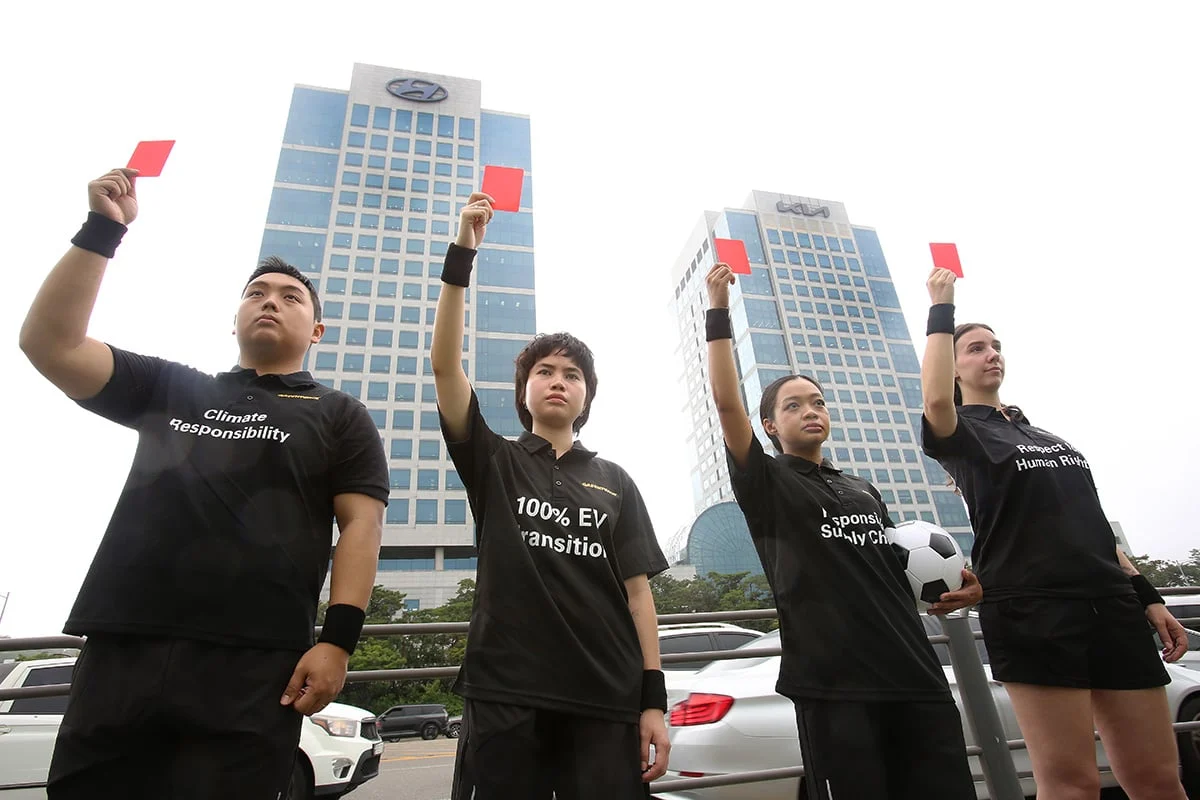
Greenpeace activists unfurled symbolic referee red cards at the Hyundai Motor Group headquarters in Seoul today, directly challenging the global automotive giant’s sponsorship of the FIFA World Cup. This high-profile protest, marking the culmination of a month-long international campaign, urges Hyundai to immediately address pervasive human rights violations, rampant labor exploitation, and significant carbon-intensive risks embedded within its vast global supply chain. Furthermore, the demonstrators are demanding that Hyundai reverse its recent corporate pivot away from a decisive electric vehicle (EV) transition, a move they argue undermines the company’s public sustainability pledges.
The demonstration in South Korea’s capital is the crescendo of a globally coordinated wave of actions meticulously timed to coincide with the prestigious World Cup tournament. While Greenpeace East Asia spearheaded the ground-level efforts in Seoul, the broader international campaign is a unified front, backed by a formidable coalition of eleven environmental and human rights organizations. Their collective aim is to expose what they describe as a stark and unacceptable dissonance between Hyundai’s carefully crafted public image of sustainability and the documented harms linked to segments of its supply chain. This is particularly concerning given the automaker’s multi-million dollar investment in "eco-friendly" sports marketing, which critics argue is being used to mask deeper systemic issues.
A Month of Escalating Pressure: A Global Chronology of Action
The international coalition’s campaign has been strategically deployed over the past month, with a series of significant actions timed to capture maximum global attention during key FIFA World Cup matches. These actions were designed to amplify the core demands and build sustained pressure on Hyundai Motor Group.
- Early November: As the World Cup build-up intensified, initial online campaigns were launched, highlighting concerning reports of labor abuses and environmental degradation linked to Hyundai’s suppliers. These campaigns utilized social media and digital platforms to disseminate information and galvanize public support.
- Mid-November: Coinciding with the opening matches of the World Cup, several international affiliates of the coalition organized smaller, localized protests and digital actions in major cities across Europe and North America. These events focused on specific supply chain issues, such as the reliance on coal-powered steel production and the human cost associated with mineral extraction for EV batteries.
- Late November: The campaign escalated with targeted digital "red card" campaigns directed at Hyundai’s online presence and social media channels. Thousands of citizens, football fans, and Hyundai drivers participated in these virtual protests, amplifying the message and demonstrating broad-based opposition to the company’s practices.
- December 5th: The international coalition delivered a formal Open Letter to Hyundai Executive Chair Euisun Chung. This comprehensive document laid out specific demands, urging the company to leverage its prominent position as a premier FIFA sponsor to implement robust, structural climate commitments and establish enforceable corporate accountability mechanisms across its entire value chain. The letter underscored the critical need for Hyundai to move beyond symbolic gestures and enact tangible, systemic change.
- December 10th (Today): The climax of the campaign, the physical demonstration at Hyundai Motor Group headquarters in Seoul, brought the concerns directly to the company’s doorstep. The symbolic red carding of the FIFA World Cup sponsor served as a powerful visual representation of the coalition’s demand for immediate action and a rejection of Hyundai’s current trajectory.
Market Risks and the Lagging Clean Transition: Hyundai’s Sustainability Scorecard
While Hyundai Motor Group actively leverages its FIFA World Cup sponsorship to project an image of corporate environmental responsibility, a critical analysis of its operations reveals significant disparities. Internal combustion engine (ICE) vehicles still constitute a staggering 93% of Hyundai-Kia’s 6.8 million annual sales. This continued reliance on fossil fuel-powered vehicles results in a colossal combined annual carbon footprint estimated at 250 million tonnes of CO2 equivalent – a figure comparable to the total national emissions of Spain.
Independent automotive sustainability benchmarks consistently rank Hyundai significantly behind global competitors such as Tesla, Volkswagen, and Mercedes-Benz. These rankings scrutinize crucial areas like supply chain decarbonization and the rigor of human rights due diligence processes. The data suggests that Hyundai faces considerable market risk if it fails to accelerate its transition to cleaner technologies and implement more stringent oversight of its manufacturing pipeline and sourcing relationships.
Compounding these pressures are a series of independent investigations by reputable organizations like Steel Watch, Mighty Earth, and Jobs to Move America. These investigations have unearthed serious environmental and labor concerns within segments of Hyundai’s tier-one supplier network. A particularly concerning issue highlighted is Hyundai Steel’s persistent reliance on coal-based production methods. This practice contributes significantly to air pollution and is associated with billions of dollars in public health costs across manufacturing hubs in South Korea and Brazil, impacting local communities and ecosystems.
Voices from the Global Coalition: Urgent Calls for Change
The international coalition has articulated a clear and urgent message, with representatives from key organizations emphasizing the critical need for Hyundai to align its actions with its stated sustainability goals.
Erin Eunseo Choi, Climate and Energy Campaigner at Greenpeace East Asia, expressed deep concern over Hyundai’s recent strategic shifts. "Hyundai Motor’s latest sustainability report speaks of ‘Electrification and Our Climate Response,’ yet the quiet dropping of its concrete 2030 battery EV sales targets sends a profoundly contradictory signal," Choi stated. "By pivoting its roadmap to heavily favor hybrids and Extended-Range EVs (EREVs) – vehicles that fundamentally still depend on internal combustion engines – Hyundai is engaging in a false transition. While EREVs may present themselves as electric, they are not a genuine zero-emission solution. Instead, they risk entrenching reliance on fossil fuels and diverting crucial resources away from the imperative of full battery electrification." Choi further elaborated on the market implications: "When the vehicles Hyundai sells account for 79% of its Scope 3 emissions, slowing electrification is akin to pulling your star striker off the field in the middle of a crucial match. As war-driven oil price spikes accelerate the global shift towards EVs, any indecision in making a true transition risks a further erosion of market share and long-term competitiveness."
Nish Humphreys, Campaign Manager at Ekō, highlighted the stark contrast between Hyundai’s public image and its supply chain realities. "Hyundai desires the world to be captivated by its Football World Cup advertisements, not to scrutinize the shadowed corners of its supply chain," Humphreys remarked. "On the field, it champions children’s dreams. However, behind the scenes, a far more complex and concerning game is being played. Publicly available reports have raised grave concerns regarding child labor, worker fatalities and injuries, and the disturbing unexplained disappearances of Indigenous activists in Mexico who were safeguarding a Hyundai steel supplier. In solidarity with the activists on the ground, over 7,400 individuals have virtually ‘red-carded’ Hyundai through our online protest. They join a global cohort of 52,000 citizens, football enthusiasts, and Hyundai drivers who have signed the Ekō petition, demanding that the company rigorously clean up its supply chain before the final whistle blows on its corporate irresponsibility."
Abhilasha Bhola, Climate Campaigns Director at Public Citizen, underscored the consistent pattern of misconduct. "The historical record is unequivocal: Hyundai-Kia’s supply chain is demonstrably marred by documented human rights abuses, significant environmental destruction, and pervasive labor exploitation," Bhola asserted. "The corporate sponsors of the World Cup cannot be permitted to continue profiting from their global reach while workers, vulnerable communities, and our planet bear the profound and lasting impacts of their corporate misconduct."
Strategic Imperatives: A Clear Mandate for Hyundai Motor Group
The global coalition has outlined three non-negotiable directives for Hyundai Motor Group’s executive leadership, demanding immediate and substantive action to rectify its supply chain and climate impact. These directives are designed to foster genuine accountability and drive meaningful change:
-
Establish Robust Supply Chain Due Diligence and Transparency: Hyundai must implement comprehensive, legally binding due diligence mechanisms across its entire supply chain. This includes proactively identifying, preventing, and mitigating human rights and environmental risks. Furthermore, the company is called upon to commit to full transparency regarding its suppliers, enabling independent audits and public scrutiny of its practices. This commitment should extend to ensuring that Indigenous rights are respected and that communities affected by resource extraction and manufacturing are adequately consulted and compensated.
-
Commit to a Genuine and Accelerated Electric Vehicle Transition: The coalition demands that Hyundai abandon its current trajectory of prioritizing hybrids and EREVs, which are not true zero-emission solutions. Instead, the company must recommit to ambitious, science-based targets for the rapid phase-out of internal combustion engine vehicles and a full transition to battery electric vehicles. This transition must be supported by significant investment in charging infrastructure and a commitment to sourcing battery materials responsibly and ethically.
-
Divest from Coal and Embrace Renewable Energy: Hyundai Motor Group must immediately cease its reliance on coal for steel production, particularly through its subsidiary Hyundai Steel. The company should accelerate its transition to renewable energy sources for its manufacturing operations and actively invest in and promote the use of green steel and other low-carbon materials throughout its supply chain. This includes supporting the development of clean energy solutions in regions where its operations have a significant environmental impact.
Media Documentation and Assets
A comprehensive package of media documentation and assets is available for journalistic use, including high-resolution photographs of the protest in Seoul, video footage of the activists and their message, and relevant infographics detailing the coalition’s demands and the evidence supporting their claims. These materials are intended to provide journalists with the necessary resources to accurately and effectively report on this critical issue.
Media Contact
For further information or to arrange interviews, please contact:
Yujie Xue
International Communications Officer
Greenpeace East Asia
[email protected]
The ongoing pressure campaign underscores a growing global demand for corporate accountability, particularly from major multinational corporations that benefit from widespread public platforms like the FIFA World Cup. The coalition’s coordinated efforts aim to ensure that Hyundai Motor Group faces not only the scrutiny of its consumers and the public but also the tangible consequences of its environmental and human rights record, urging a fundamental shift towards responsible and sustainable business practices.

 Neng Nana
 Lina Hope