Azzam Bilal Chamdy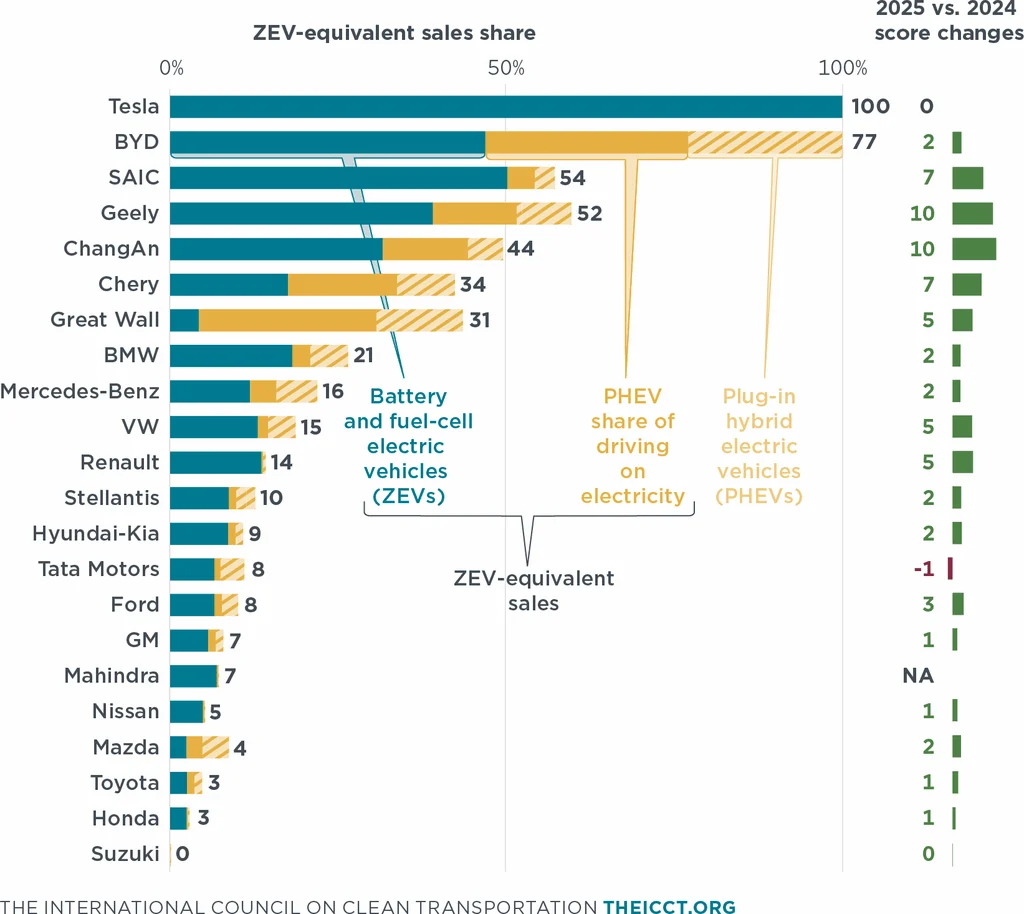
The global automotive industry is undergoing a seismic shift toward zero-emission transportation, a transition marked by accelerating innovation and intense competition. However, the pace at which major car manufacturers are embracing battery-electric vehicles (BEVs) varies dramatically, creating clear leaders and laggards on the path to decarbonization. This divergence was a central theme during a recent webinar hosted by Greenpeace Japan on July 13th, which brought together experts to analyze the electrification strategies of the world’s top automakers.
The session featured Dale Hall, Global Program Lead at the International Council on Clean Transportation (ICCT), and Erin Eunseo Choi, a Climate and Energy Campaigner for Greenpeace East Asia. Their discussion provided a comprehensive overview of how leading automotive companies are navigating this critical juncture, with a particular focus on the burgeoning markets of Southeast Asia and the broader implications of their strategic decisions on global climate goals.
Southeast Asia: A Crucial Battlefield for Future Mobility
Southeast Asia has emerged as a pivotal region in the global transition to electric mobility, with Indonesia standing out as a particularly significant market. As one of the largest automotive consumers in the region and a nation actively positioning itself as a hub for electric vehicle (EV) production and adoption, Indonesia’s trajectory offers a microcosm of broader industry trends. By the close of 2025, Indonesia’s BEV market experienced a remarkable surge, becoming the third-largest in Southeast Asia, with sales exceeding 103,000 units. For established automakers, especially those from Japan, a faltering performance in this dynamic market carries substantial long-term consequences for their global standing and future revenue streams.
Choi’s analysis highlighted how the distinct approaches of automakers from China, Japan, and South Korea are yielding vastly different outcomes in this strategically important region. These contrasting trajectories underscore the importance of adaptability and foresight in an evolving automotive landscape.
China’s Electrifying Ascendancy
Chinese automakers, spearheaded by industry giants BYD and Geely, have demonstrated an aggressive and highly effective strategy in expanding their electric vehicle sales. Despite a contraction in Indonesia’s overall automotive market, Chinese brands achieved an astonishing 153% year-on-year sales increase, nearly tripling their market share to capture 10% of the total.
BYD, in particular, has solidified its position as the undisputed leader in the EV segment within Indonesia, securing over half of the nation’s BEV market share. This remarkable penetration is part of a larger trend, with Chinese EV brands collectively accounting for more than 90% of Indonesia’s total EV sales in the first half of 2025. This dominance reflects not only strong product offerings but also a keen understanding of local market demands and a rapid deployment of manufacturing and sales infrastructure.
Japan’s Eroding Dominance and Strategic Hesitation
While Japanese brands have historically enjoyed a dominant position in Southeast Asian markets, their long-standing grip is demonstrably weakening. Data from the first quarter of 2025 revealed that most Japanese manufacturers, with the notable exception of Toyota, experienced sales declines in the region. This downturn occurred precisely as their Chinese competitors were experiencing explosive growth.
Choi identified a fundamental strategic issue: Japanese automakers have remained heavily focused on internal combustion engine (ICE) vehicles and hybrid technologies. Their electrification roadmaps, particularly for the Southeast Asian market, have lacked the urgency and clarity seen from Chinese competitors. This delay in prioritizing BEVs in a key growth region has broader implications, contributing to regional climate inequities. Vehicles sold in Southeast Asia, often powered by less efficient ICE technology, emit significantly higher carbon dioxide equivalents per vehicle compared to those sold in markets with high BEV adoption rates, such as Europe. Consequently, climate-vulnerable communities in Southeast Asia are disproportionately bearing the environmental burden of this slower transition.
South Korea’s Precipitous Decline in a Key Market
The trajectory of South Korean automakers, specifically Hyundai, serves as a stark cautionary tale for the industry. In the Indonesian BEV market, Hyundai’s sales have plummeted dramatically, falling from 7,590 units in 2023 to a mere 1,828 units in 2025, representing a staggering 75.9% decline.
While Hyundai has publicly articulated ambitious commitments to phase out combustion engines in developed markets like Europe and the United States, it has failed to establish similar clear timelines for the crucial Southeast Asian region. This disparity between its pledges in mature markets and its actions in the Global South risks eroding its regional competitiveness. As Choi pointed out, "This is not simply a story of government policy succeeding or failing in isolation. It’s a story about which companies adapted their business models fast enough to meet that policy environment – and which didn’t."
The ICCT Global Automaker Rating 2025: A Clear Delineation of Leaders and Laggards
Providing an objective, data-driven perspective, Dale Hall presented key findings from the ICCT’s comprehensive "Global Automaker Rating 2025." This report evaluates the electrification strategies and performance of the 22 largest global automotive manufacturers across six major markets, which collectively account for approximately 80% of global new car sales. The rating system offers a granular insight into which companies are truly leading the charge toward zero-emission mobility.
Overall Ranking Highlights:
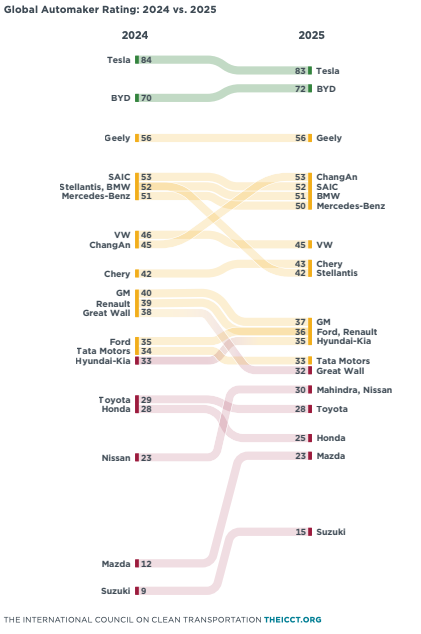
The ICCT’s overall ranking places Tesla and BYD at the apex, clearly identifying them as frontrunners in the global transition. In stark contrast, Japanese manufacturers occupied the bottom five positions in the overall assessment, significantly lagging behind their international peers. This broad assessment reinforces the observations made regarding the Southeast Asian market, indicating a systemic challenge for Japanese automakers in adapting to the new EV-centric automotive paradigm.
Zero-Emission Vehicle (ZEV)-Equivalent Sales Share Analysis:
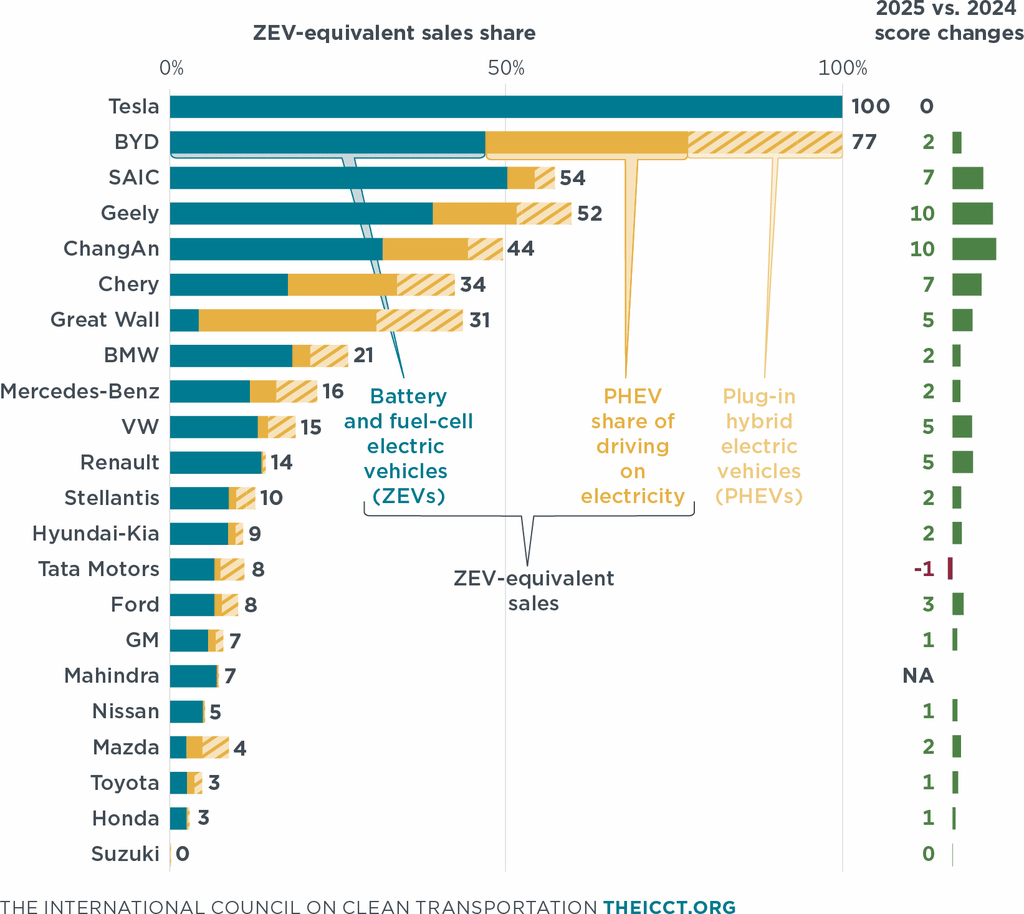
Across the evaluated markets, nearly all automakers have seen an increase in their electric sales share. Chinese brands, including Geely, Changan, and SAIC, have been particularly successful in this regard. However, the report highlights that legacy foreign automakers continue to trail significantly behind these emerging leaders. To meet increasingly stringent climate standards and evolving market demands, these established players will need to dramatically accelerate their BEV sales volumes. The current pace suggests a widening gap that could prove difficult to close.
ZEV Investment Trends:
A critical indicator of future market positioning is investment. Chinese manufacturers are actively ramping up their capital expenditures per vehicle, with a clear strategy to expand their global footprint, particularly into high-growth markets like Southeast Asia and Latin America. Conversely, legacy automakers in the US, Europe, and Japan have either reduced their ZEV investments or maintained them at stagnant levels. This retrenchment in investment weakens their future market position and their ability to compete effectively against more aggressive Chinese counterparts who are investing heavily in expanding production capacity and developing next-generation EV technologies.
ZEV Targets: Ambition Versus Reality:
The ICCT report also scrutinizes the stated ZEV targets of major automakers. While leading companies such as Changan and BYD have strengthened their ambitious EV targets, a concerning trend has emerged among several major legacy brands. These companies have either rolled back existing targets or lowered their 2030 EV goals, often signaling a pivot back towards hybrids. This retreat from aggressive electrification goals poses a significant threat to global climate targets, as it slows the overall rate of vehicle electrification and prolongs the use of internal combustion engines.
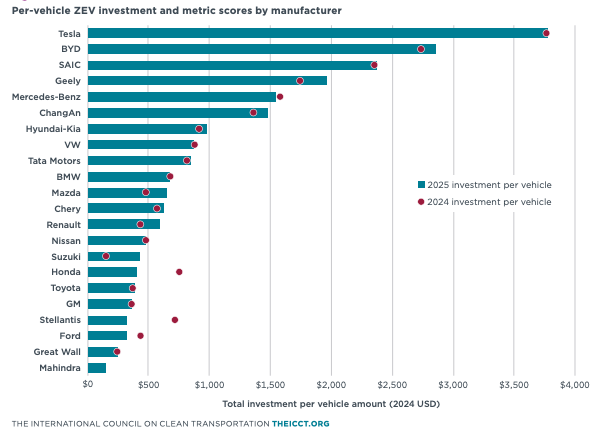
Dale Hall elaborated on these diverging strategies: "In terms of long-term strategic vision, we see a clear divergence across regional lines. Several of the legacy brands – like Stellantis in Europe, Ford in the US, and Honda in Japan – reduced their mid-term targets amid short-term policy changes and are trying to hedge their investments by adopting more flexible platforms and hybrids, reducing their EV investments. Whereas the market leaders – like BYD, Geely, and SAIC, all from China – are aggressively increasing their EV investments and expanding their production capacity into new markets, again like Southeast Asia and Latin America. That will continue to give them more economies of scale and further footholds in the fastest-growing car markets in the world."
Implications for the Global Automotive Landscape
The findings presented by Greenpeace East Asia and the ICCT paint a clear picture of a bifurcated automotive industry. Companies that have embraced a rapid and comprehensive shift to BEVs, particularly those from China, are capturing market share, driving innovation, and positioning themselves for long-term dominance. Their aggressive investment strategies and agile business models allow them to adapt quickly to evolving market demands and policy landscapes.
Conversely, established automakers that remain heavily invested in traditional technologies or have adopted a more cautious, hybrid-centric approach risk being left behind. Their hesitation in prioritizing BEVs, especially in crucial emerging markets, not only jeopardizes their future competitiveness but also has profound implications for global climate action. The continued reliance on internal combustion engines in regions with rapidly growing vehicle ownership exacerbates emissions, disproportionately impacting vulnerable populations and undermining international efforts to limit global warming.
The next few years will be critical in determining the long-term victors in the race to zero-emission transportation. The strategic decisions made today by automotive giants will shape not only the future of mobility but also the planet’s ability to meet its climate objectives. The industry’s ability to accelerate its transition to BEVs, coupled with supportive government policies and continued investment in sustainable technologies, will be paramount in achieving a truly green automotive future.

 Laily UPN
 Ammar Sabilarrohman