Lina Hope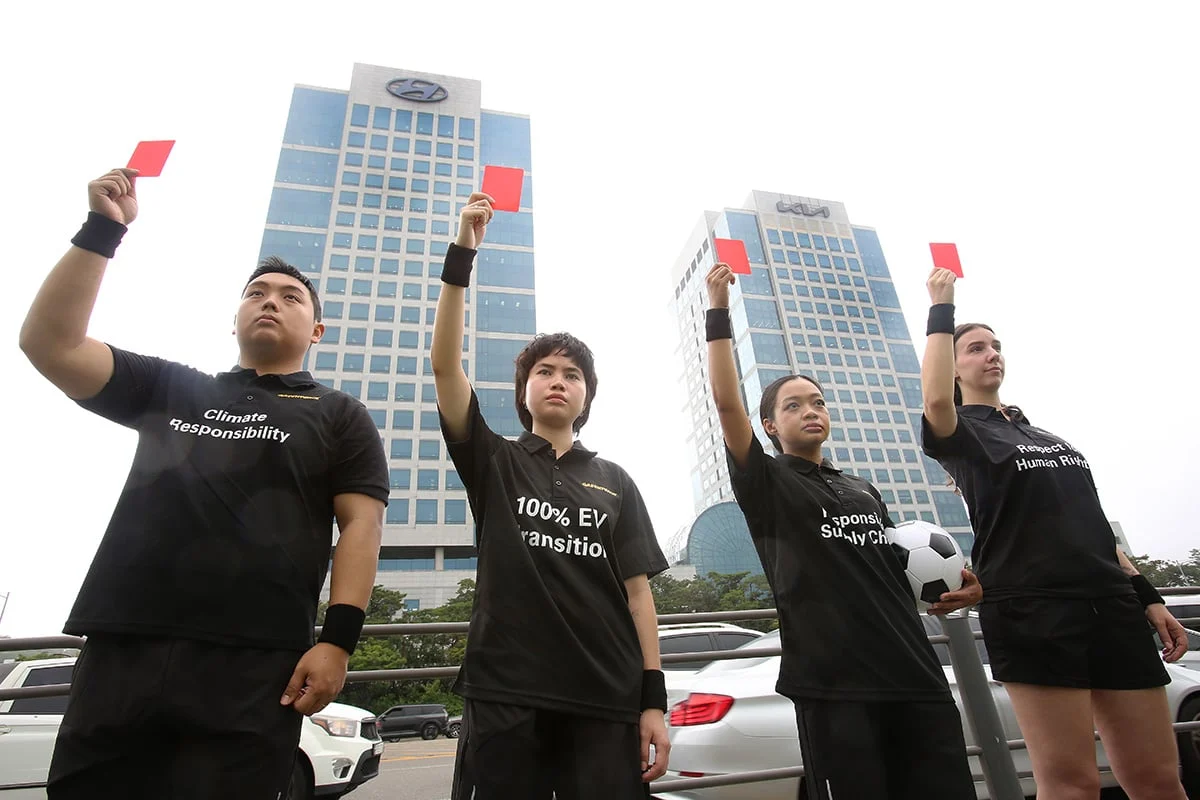
SEOUL – Greenpeace activists unfurled symbolic referee red cards outside the Hyundai Motor Group headquarters today, directly challenging the automotive giant’s sponsorship of the FIFA World Cup. This high-profile demonstration, the culmination of a month-long global campaign by a coalition of environmental and human rights organizations, demands that Hyundai immediately address alleged severe human rights violations, labor exploitation, and significant carbon-intensive risks embedded within its extensive global supply chain. The protest also targets a perceived recent corporate retreat from ambitious electric vehicle (EV) transition goals.
The action in Seoul, spearheaded by Greenpeace East Asia, is amplified by a broader international coalition comprising 11 environmental and human rights organizations. Their collective aim is to expose what they describe as a stark disparity between Hyundai’s public-facing sustainability rhetoric, heavily promoted through its multi-million dollar "eco-friendly" sports marketing campaigns, and the reported harms linked to various segments of its manufacturing and sourcing operations. The coalition asserts that the automaker’s commitment to sustainability is not being matched by tangible action across its vast network of suppliers.
The global escalation of this campaign has been strategically timed to coincide with key FIFA World Cup matches, leveraging the tournament’s immense global viewership to amplify their message. Prior to today’s demonstration, the international coalition formally delivered an Open Letter to Hyundai Executive Chair Euisun Chung. This letter urged the company to utilize its prominent position as a premier FIFA sponsor to implement robust structural climate commitments and establish enforceable corporate accountability mechanisms throughout its operations and supply chain.
Market Risk: Hyundai’s Lagging Clean Transition and Supply Chain Governance
While Hyundai leverages its FIFA World Cup sponsorship to project an image of corporate sustainability, the reality on the ground, according to the coalition, paints a different picture. Internal combustion engine (ICE) vehicles still constitute a staggering 93% of Hyundai-Kia’s approximately 6.8 million annual sales. This reliance on fossil fuel-powered vehicles contributes to a substantial environmental footprint. The group’s combined annual carbon emissions equivalent are estimated at 250 million tonnes of CO2, a figure comparable to the total national emissions of Spain.
Independent automotive sustainability benchmarks further highlight Hyundai’s comparative shortcomings. Recent analyses consistently rank Hyundai significantly behind global competitors such as Tesla, Volkswagen, and Mercedes-Benz in critical areas of supply chain decarbonization and human rights due diligence. This lagging performance suggests that the company may face increasing regulatory scrutiny and reputational damage as global markets and governments accelerate the transition to sustainable transportation and responsible manufacturing practices.
The South Korean automaker is facing mounting pressure from both regulatory bodies and the public to enhance oversight of its manufacturing pipeline and its complex network of sourcing relationships. Independent investigations conducted by organizations including Steel Watch, Mighty Earth, and Jobs to Move America have meticulously documented serious environmental and labor concerns within parts of the company’s tier-one supplier base. These reports detail issues ranging from hazardous working conditions to potential human rights abuses.
A significant point of contention has been Hyundai Steel’s continued reliance on coal-based production methods. This practice has drawn considerable criticism for its contribution to air pollution and the associated public health costs, estimated in the billions of dollars, across manufacturing hubs in South Korea and Brazil. Environmental advocates argue that this reliance on outdated and polluting technologies directly contradicts any claims of environmental responsibility and undermines the company’s sustainability aspirations.
A Chronology of Activism Leading to the Seoul Protest
The current wave of activism targeting Hyundai Motor Group is not an isolated incident but rather the culmination of a sustained effort by various organizations to hold the automaker accountable. This campaign has unfolded over several months, strategically employing global events and public attention to maximize impact.
-
Initial Investigations and Reports: Prior to the World Cup sponsorship spotlight, organizations like Steel Watch, Mighty Earth, and Jobs to Move America had already been conducting in-depth investigations into Hyundai’s supply chain. Their findings, released in various reports, began to surface concerns regarding labor conditions and environmental practices among its suppliers.
-
Pre-World Cup Awareness Campaigns: As Hyundai’s sponsorship of the FIFA World Cup became more prominent, environmental and human rights groups intensified their efforts to raise public awareness. This included online petitions, social media campaigns, and the release of explainer videos and infographics detailing the alleged issues.
-
Open Letter Delivery: A significant milestone in the campaign was the delivery of an Open Letter to Hyundai Executive Chair Euisun Chung. This formal communication, signed by a broad coalition of NGOs, outlined specific demands for climate commitments and corporate accountability, signaling a unified front from the advocacy community.
-
World Cup Match-Timed Actions: The campaign strategically timed major actions to coincide with significant FIFA World Cup matches. These actions, often taking place in key global cities, aimed to capture media attention and link Hyundai’s high-profile sponsorship directly to the alleged transgressions within its supply chain. Examples likely included public demonstrations, digital billboards, and targeted media outreach.
-
Culmination in Seoul: Today’s protest at Hyundai Motor Group headquarters in Seoul represents the apex of this coordinated global effort. The choice of location underscores the direct connection to the company’s leadership and its operational heart, aiming to deliver a clear and unambiguous message to the highest levels of the organization.
Statements from the Global Coalition
The unified voice of the international coalition underscores the urgency and breadth of their concerns. Each organization brings a unique perspective, contributing to a comprehensive critique of Hyundai’s practices.
Erin Eunseo Choi, climate and energy campaigner at Greenpeace East Asia, expressed strong criticism regarding Hyundai’s EV transition strategy. "Hyundai Motor’s latest sustainability report talks about ‘Electrification and Our Climate Response,’ but quietly dropping its concrete 2030 battery EV sales targets sends a very different signal," Choi stated. "By shifting its roadmap to focus heavily on hybrids and Extended-Range EVs (EREVs)—vehicles that still rely on internal combustion engines—Hyundai is pursuing a false transition." Choi elaborated, "While EREVs may masquerade as electric, they are not a true zero-emission solution; instead, they risk locking in reliance on fossil fuels and diverting vital resources from full battery electrification. When the vehicles Hyundai sells account for 79% of its Scope 3 emissions, slowing electrification is like pulling your striker off the pitch in the middle of a match. As war-driven oil price spikes fast-track the shift toward EVs, any indecision in making a true transition risks a further loss of market share." This statement highlights concerns that Hyundai’s current strategy may be insufficient to meet climate goals and could lead to missed market opportunities in the rapidly evolving automotive landscape.
Nish Humphreys, Campaign Manager at Ekō, emphasized the disconnect between Hyundai’s public image and its supply chain realities. "Hyundai wants the world watching its Football World Cup ads, not the dark side of its supply chain. On the field, it’s sponsoring kids’ dreams. But behind the scenes, it’s a different game," Humphreys commented. "Public reporting has raised serious concerns about child labor, worker deaths, and injuries, along with the unexplained disappearance of Indigenous activists in Mexico who protected Hyundai’s steel supplier." Humphreys also highlighted the broad public engagement with the campaign: "Together with the activists on the ground, over 7,400 people have ‘red-carded’ Hyundai in our virtual protest, joining a global crowd of 52,000 citizens, football fans, and Hyundai drivers who have signed the Ekō petition demanding the company clean up its supply chain before the final whistle blows." This indicates a significant public outcry and a desire for corporate accountability that extends beyond environmental issues to encompass fundamental human rights.
Abhilasha Bhola, Climate Campaigns Director at Public Citizen, provided a stark assessment of the situation. "The record is clear: Hyundai-Kia’s supply chain is marred by documented human rights abuses, environmental destruction, and labor exploitation," Bhola asserted. "The World Cup’s corporate sponsors cannot continue to profit while workers, communities, and our planet bear the deep impacts of corporate misconduct." This statement underscores the ethical dimension of the campaign, framing Hyundai’s sponsorship as a form of complicity in the alleged harms.
Strategic Demands to Hyundai Motor Group
The global coalition has articulated three core, non-negotiable directives for Hyundai Motor Group’s executive leadership, representing the demands that form the crux of their advocacy:
-
Commit to a Just Transition to 100% Electric Vehicles by 2035: The coalition insists that Hyundai must set a clear and ambitious target for transitioning its entire vehicle sales to 100% battery electric vehicles by 2035. This would include phasing out new internal combustion engine sales by this date and setting interim targets for EV sales to ensure progress. Furthermore, they demand that Hyundai publicly commit to investing significantly in the development and scaling of charging infrastructure and renewable energy sources to support this transition, ensuring it is a "just transition" that considers the impact on workers and communities.
-
Implement Robust Human Rights Due Diligence and Supply Chain Transparency: The coalition calls for Hyundai to adopt and implement comprehensive human rights due diligence policies across its entire supply chain, in line with UN Guiding Principles on Business and Human Rights. This includes conducting thorough and independent risk assessments for human rights violations, including forced labor, child labor, and gender-based violence, particularly in high-risk regions and among vulnerable populations. Crucially, they demand full transparency regarding its supply chain, including disclosing key suppliers and engaging in public reporting on its human rights performance and remediation efforts.
-
Establish Effective Grievance Mechanisms and Accountability for Harms: Hyundai is urged to establish accessible, effective, and independent grievance mechanisms for workers and communities affected by its operations and supply chain. These mechanisms should allow for the reporting of concerns without fear of reprisal and ensure timely and adequate remedy for any harms caused. The coalition also demands that Hyundai take accountability for past and ongoing harms, including actively engaging in remediation efforts and collaborating with affected communities to address environmental damage and social injustices.
Broader Implications and Market Analysis
The sustained pressure from the Greenpeace-backed coalition highlights a growing trend of intensified scrutiny on multinational corporations regarding their environmental, social, and governance (ESG) performance. Hyundai Motor Group’s dual role as a major global automaker and a prominent FIFA World Cup sponsor places it at a critical juncture. The "red card" protest serves as a potent metaphor for the risks the company faces if it fails to align its operations with global expectations for sustainability and ethical conduct.
The coalition’s emphasis on Hyundai’s lagging EV transition is particularly pertinent in the current automotive market. With governments worldwide implementing stricter emissions regulations and consumer demand for EVs surging, companies that do not accelerate their electrification efforts risk significant market share erosion and regulatory penalties. Hyundai’s stated reliance on hybrids and Extended-Range EVs, while potentially a transitional strategy, is being framed by critics as a dilatory tactic that delays the necessary shift to genuine zero-emission mobility. This could lead to Hyundai being perceived as out of step with the future of the automotive industry, potentially impacting its long-term investment appeal and consumer loyalty.
Furthermore, the detailed allegations concerning human rights abuses and labor exploitation within Hyundai’s supply chain, as documented by organizations like Steel Watch and Mighty Earth, pose a substantial reputational and legal risk. Investors, consumers, and regulatory bodies are increasingly demanding greater transparency and accountability for the entire value chain. Failure to address these concerns could lead to boycotts, divestment campaigns, and potential legal challenges, further impacting the company’s financial performance and brand value. The connection to Indigenous activists’ disappearances in Mexico, as raised by Ekō, adds a deeply concerning human rights dimension that demands immediate and thorough investigation.
The strategic use of the FIFA World Cup sponsorship as a platform for protest underscores the power of leveraging high-profile events to draw attention to corporate responsibility issues. By directly linking Hyundai’s multi-million dollar sports marketing campaign to alleged supply chain transgressions, the coalition is attempting to expose the perceived hypocrisy of promoting an "eco-friendly" image while allegedly perpetuating harmful practices. This approach can be highly effective in influencing public perception and pressuring corporate decision-makers.
The demands for a just transition, robust due diligence, and effective grievance mechanisms are becoming standard expectations for responsible corporate behavior. Hyundai Motor Group’s response to these demands will be closely watched by stakeholders across the globe, shaping its reputation and its trajectory in an increasingly sustainability-conscious world. The "final whistle" for its current practices, as suggested by Ekō, may be approaching if meaningful change is not implemented.
Media Documentation & Assets:
The coalition has indicated that media documentation and assets related to the protest and their findings are available upon request. This likely includes photographs, video footage of the demonstrations, copies of the Open Letter, and links to the investigative reports published by the partner organizations.
Media Contact:
Yujie Xue, International Communications Officer, Greenpeace East Asia, [email protected]

 Asep Darmawan
 Asro
Asro