
 Asro
Asro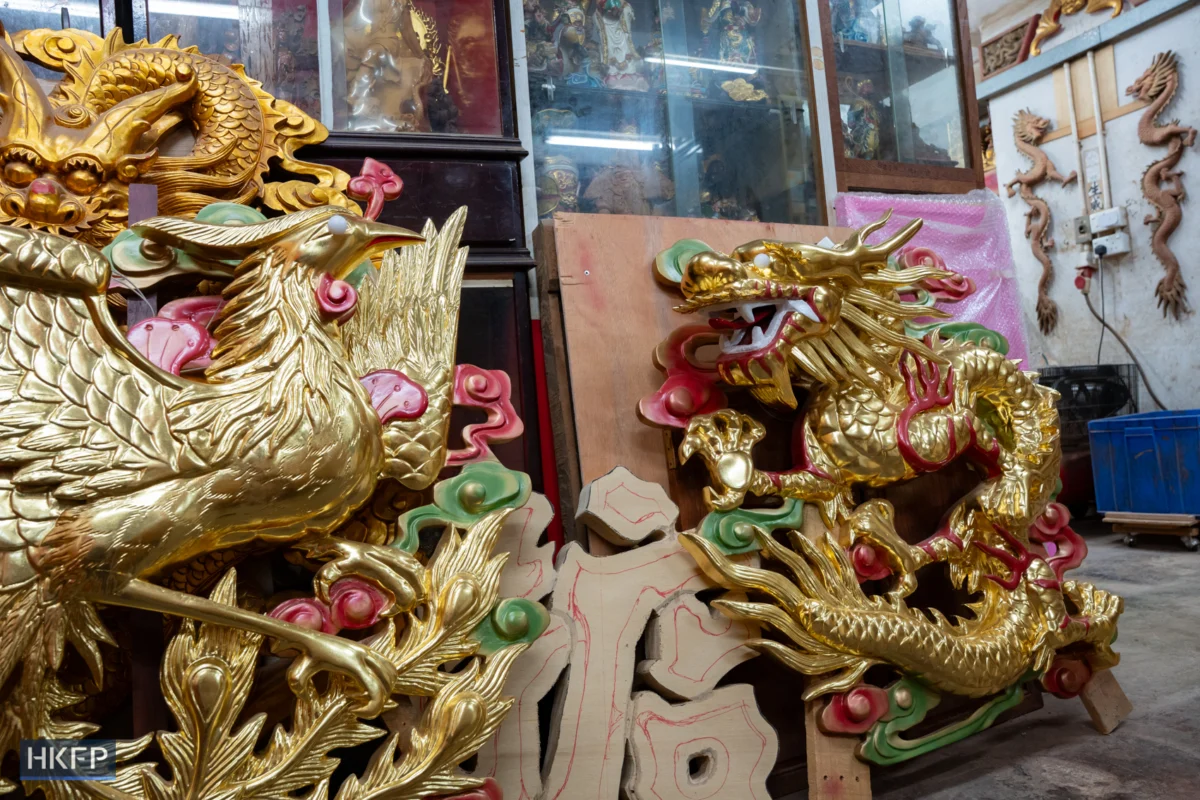
As Hong Kong navigated the seismic shifts from a manufacturing powerhouse to a global financial hub, a different kind of industry, one deeply rooted in tradition and spirituality, faced an existential crisis. While many family-run businesses adapted or disappeared, the Siu family, custodians of a centuries-old craft, continues to meticulously shape wood into divine figures, preserving a vital piece of Hong Kong’s intangible cultural heritage. In an ongoing series documenting the enduring spirit of "Made in Hong Kong," this report delves into the meticulous artistry and profound dedication of Hop Keung Cheong Kee, the territory’s last remaining workshop specializing in deity wood carving.

Nestled within the bustling industrial landscape of Kwai Chung, an unassuming workshop serves as the sanctuary for a fading art form. Here, under the watchful eyes of Buddhas and Taoist immortals, Vitus Siu, a master sculptor now 69 years old, works alongside his son, Sylvester Siu, and daughter-in-law. Their family legacy, stretching back to 1938, is etched into every grain of sandalwood and every stroke of gold leaf. Hop Keung Cheong Kee is not merely a business; it is a living testament to the resilience of tradition in the face of relentless modernization.
The workshop is an overwhelming testament to their craft. Statues of deities, large and small, fill the space. Some are freshly carved from fragrant sandalwood, their forms emerging from the raw material with breathtaking detail. Others are in various stages of gilding, their surfaces being meticulously adorned with shimmering gold leaf. This intricate process, far from mere decoration, is a profound demonstration of reverence, a visual offering to the divine. As Vitus Siu aptly put it in Cantonese, “Clothes make the man, and gold makes the Buddha.”

The Siu family’s journey began when Vitus Siu’s father, who immigrated from Guangdong province, apprenticed under his uncle in a deity statue shop. In 1959, he established his own business, "Cheong Kee," on Reclamation Street in Yau Ma Tei. At that time, Yau Ma Tei was a vibrant hub for local fishermen who formed the primary clientele. These seafarers, deeply devoted to deities like the sea goddess Tin Hau, would commission small wooden statues to symbolize deceased family members, to be worshipped on their boats as "household Gods."
"Fishermen have a strict set of rules when commissioning these statues," Vitus Siu recalled. "They consult a spirit medium to learn the wishes of the deceased, and we carve the statues according to the medium’s description." This intricate interplay between spiritual guidance and artistic execution highlights the profound cultural significance of their work.

Vitus Siu, who began learning the craft at the tender age of eight in his father’s workshop during the 1970s, was not content to merely follow the established Guangdong school of carving. Driven by an insatiable curiosity and a deep respect for the art, he sought to master the Ningbo school, widely regarded as the pinnacle of Buddhist statue artistry. This school was notoriously guarded, with masters rarely sharing its secrets outside their immediate male lineage.
"Masters of the Ningbo school will never share secrets of the art with others except their own male family members," Vitus Siu explained. Undeterred, he found a unique opportunity in the 1970s when antique shops on Hollywood Road, which had acquired antique Buddha statues carved by Ningbo masters, sent them to Cheong Kee for restoration. "I kept those statues long after they had been restored. I studied the ratio of the Buddha and the carving art," he recounted, supplementing his hands-on study with picture books on Buddha painting.

His early attempts were met with rigorous critique. His first Buddha commission from a monk initially led to rejection. "I realised later that the face of the Buddha statue was just not right," Vitus Siu admitted. "Buddha should have a very full and serene face. I adjusted it until the monk said, ‘Let’s finish the gold gilding.’ I knew he was satisfied." This pivotal experience solidified his dedication to specializing in Buddha statues, a craft demanding a complex synthesis of skillful painting, precise proportions, delicate facial expressions, and meticulous gold leaf application to achieve a flawless, mirror-like finish.
The art of deity wood carving itself is recognized as an intangible cultural heritage in Hong Kong, a testament to its historical and cultural value.

A significant turning point for Cheong Kee came in 1985 when the workshop relocated to a larger premises on Shanghai Street. Vitus Siu’s father suggested a rebranding, and Vitus, wanting to honor his brothers whose names all contained the character "Keung" (meaning strong), proposed "Hop Keung," signifying unity and strength. Thus, Hop Keung Cheong Kee was born. In the same year, Vitus Siu took over the family business as his father retired.
The trade was at a precipice. As fewer fishermen relied on the sea for their livelihood, the demand for traditional "household Gods" dwindled. Simultaneously, a new market emerged: Chinese restaurants, eager to adorn their dining halls with elaborate dragon and phoenix wood carvings. These mythical creatures, symbolizing male power (dragon) and feminine elegance (phoenix), were perfect for traditional wedding venues and celebratory spaces.

"The trend kicked off in the 1970s, starting with the Diamond Restaurants," Vitus Siu reminisced. "Many restaurants followed the trend, and the Jumbo Kingdom took it to the extreme, covering almost every interior wall with elaborate dragon and phoenix motifs." To capitalize on this burgeoning demand, Vitus Siu taught himself to paint dragons and phoenixes, further diversifying the workshop’s offerings. However, this trend also waned at the turn of the millennium, as younger couples increasingly favored Western-style hotel venues over traditional banquet halls.
The true existential threat to Hop Keung Cheong Kee, however, predated the decline of restaurant decor trends. Following China’s economic reforms in 1978, mainland entrepreneurs began establishing large-scale carving factories, leveraging lower labor costs and a vast pool of artisans. By the mid-1980s, these cost-effective statues flooded the Hong Kong market, making it nearly impossible for local workshops to compete.

"In the 1980s, a mainland master earned around 500 RMB a month, whereas a Hong Kong master was paid HK$180 to HK$250 a day," Siu explained, highlighting the stark economic disparity. At the time, HK$100 was equivalent to roughly 129 RMB. Faced with this insurmountable competition, one by one, Hop Keung Cheong Kee’s local rivals ceased operations. The Siu family, through sheer determination and strategic adaptation, managed to persevere, albeit with a significantly downsized workforce. Their survival hinged on focusing on what mainland factories could not easily replicate: the intricate and delicate art of restoration. A loyal clientele, appreciative of bespoke quality and deep-rooted craftsmanship, continued to seek them out for religious figures of exceptional caliber.
The torch of tradition is now being carried by Sylvester Siu, Vitus’s son. While he initially pursued a career as a salesman, a car accident involving his parents in 2014 brought him back to the family workshop. What began as a temporary commitment evolved into a deep passion for the art of deity statue restoration.

"I feel a deep sense of fulfillment when I successfully restore a historic statue," Sylvester Siu stated. He recalled one of his most significant achievements: the restoration of a colossal Amitabha Buddha statue for the renowned Po Lin Monastery on Lantau Island. The statue, including its base, measured nearly six meters in height. The pride he felt upon returning the meticulously restored icon to the monastery is still palpable; a photograph of the restored Buddha remains his phone wallpaper.
Sylvester has dedicated himself to honing his skills, particularly in the demanding art of gold gilding. He has diligently researched and compared techniques from mainland China and Japan to refine his approach, striving for the highest standards of excellence. Currently, deity statue restoration constitutes 70-80% of Hop Keung Cheong Kee’s work. Given that many Chinese temples in Hong Kong are designated historic buildings, any restoration work on their fixtures or deities requires stringent oversight from the Antiquities and Monuments Office. These complex projects can take months to complete, and Sylvester noted that their workshop is currently booked solid until the following year.

While Sylvester remains committed to the intricate world of antique restoration, his father, Vitus, is exploring new creative avenues. In recent years, he has channeled his artistic energy into crafting wooden artwork with a more contemporary flair. In collaboration with a local gallery, he has produced pieces such as handcrafted wooden mahjong tables, blending traditional craftsmanship with modern design sensibilities. Earlier this year, he also published a book documenting the rich history and traditional techniques of deity woodcarving, ensuring that his knowledge and legacy are preserved for future generations.
"There’s an old saying in our trade: those who carve Buddhas can never retire, or they’ll pass away quickly," Vitus Siu mused with a knowing smile. "In truth, ‘retirement’ just isn’t in my dictionary." This sentiment underscores a profound connection to their craft, a calling that transcends mere occupation and speaks to a life dedicated to preserving a sacred artistry. The enduring legacy of Hop Keung Cheong Kee is not just about wood and gold; it is about faith, tradition, and the unwavering spirit of artisans who continue to breathe life into the divine, one carving at a time.

 Asep Darmawan
 Lina Hope