Layla Zulfa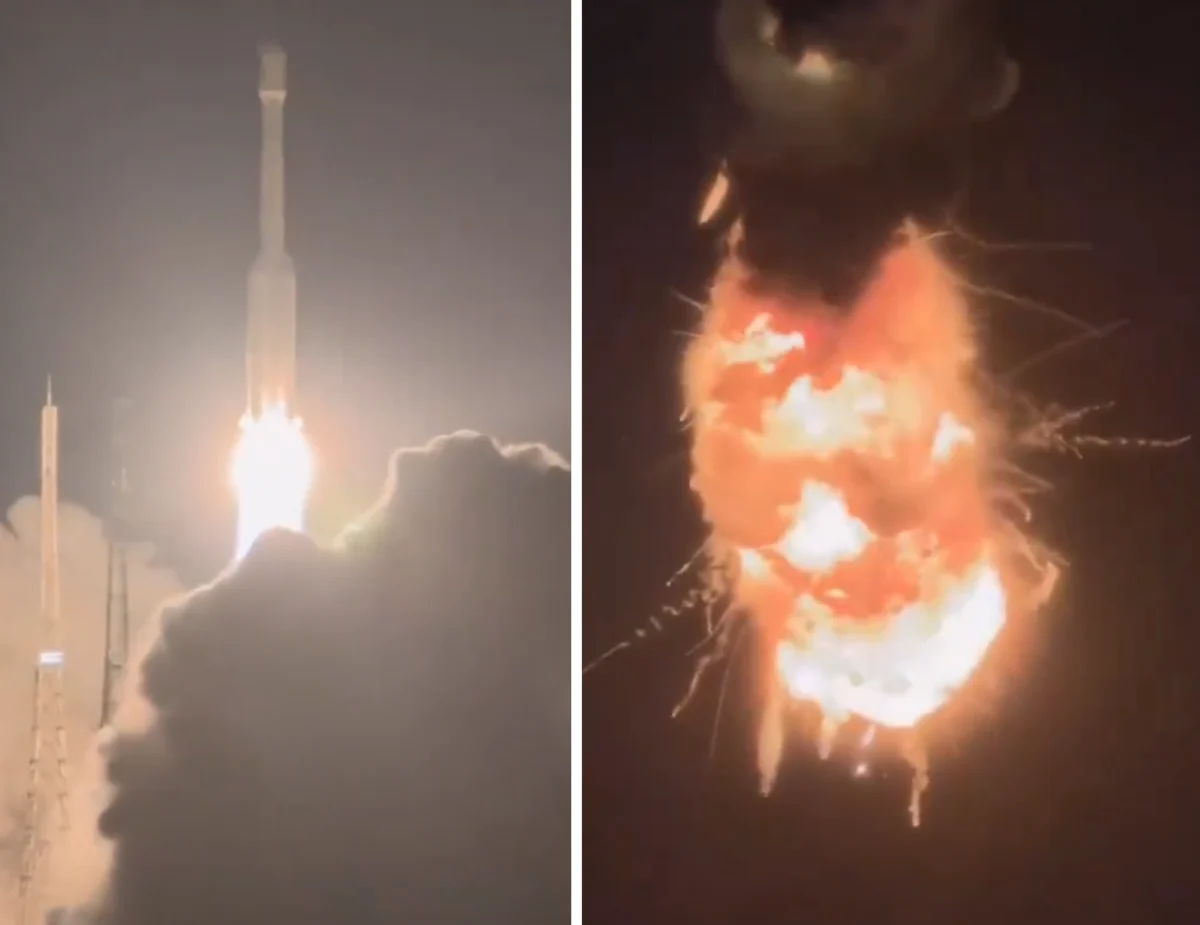
A Chinese Long March 7A carrier rocket, tasked with deploying the Zhongxing-4B communications satellite, suffered a catastrophic failure shortly after launch on Monday, August 10, 2026. State media, including Xinhua, attributed the incident to a "flight anomaly," while widespread reports and dramatic video footage circulating online indicated the spacecraft had exploded in mid-air, casting a fiery spectacle across the night sky. This marks a significant setback for Beijing’s ambitious space program, which has seen immense investment and rapid progress in recent years.
The incident occurred at approximately 8:02 pm local time (1202 GMT) when the Long March 7A lifted off from the Wenchang Space Launch Site, located on China’s southernmost province of Hainan. Eyewitness accounts and videos posted on social media platforms depicted the rocket’s ascent abruptly terminating in a brilliant fireball, followed by a cloud of grey smoke and falling debris, roughly 85 seconds after ignition. Singapore-based broadcaster Channel NewsAsia was among the first international outlets to report on the apparent explosion, sharing footage that captured the awestruck reactions of crowds observing the unfolding drama.
Details of the Catastrophic Launch Failure

The Long March 7A is a medium-lift launch vehicle, part of China’s newer generation of rockets designed to carry heavy payloads, particularly geostationary transfer orbit (GTO) satellites, and components for its planned space station. Its maiden flight in 2020 also ended in failure due to a malfunction, making this the second unsuccessful launch for this specific variant of the Long March family. The Zhongxing-4B satellite it was carrying was intended to provide advanced communications services, typically encompassing broadband internet, television broadcasting, and secure data transmission for both civilian and military applications. The loss of such a satellite represents not only a financial blow but also a delay in expanding critical infrastructure.
Xinhua, China’s official state news agency, confirmed the "anomaly" occurred during flight and stated that the cause of the failure is currently under investigation. Such investigations are typically exhaustive, involving detailed telemetry analysis, review of manufacturing processes, and examination of all operational procedures leading up to and during the launch. The findings will be crucial for understanding the root cause and implementing corrective measures to prevent future occurrences, which is standard practice in the global aerospace industry.
China’s Ambitious "Space Dream"
This latest setback comes at a time when China’s space program has been aggressively pursuing what President Xi Jinping has dubbed the country’s "space dream." Beijing has poured billions of dollars into its aerospace sector, aiming to establish itself as a dominant force in space exploration, scientific research, and commercial applications. The overarching vision includes several high-profile objectives:

- Permanent Space Station: The construction and sustained operation of its own modular space station, Tiangong, which is gradually being assembled in low Earth orbit. This station is intended to be a hub for scientific research and a symbol of China’s self-sufficiency in space.
- Lunar Exploration: Ambitious plans for robotic and crewed missions to the Moon. China has successfully landed rovers on both the near and far sides of the Moon, and its goal to land astronauts on the lunar surface before 2030 puts it in direct competition with the United States’ Artemis program.
- Mars Exploration: The successful landing of the Zhurong rover on Mars in 2021 marked a historic achievement, making China only the second nation to successfully operate a rover on the Red Planet.
- Satellite Constellations: Development and deployment of extensive satellite constellations for navigation (BeiDou), earth observation, and global communications, enhancing its strategic capabilities and offering commercial services.
- Reusable Rocket Technology: A recent success in July, China’s space agency announced the successful landing of a reusable rocket, marking a significant step towards reducing launch costs and increasing launch frequency, mirroring advancements by companies like SpaceX.
These initiatives are not merely scientific endeavors but also serve strategic geopolitical and economic interests, enhancing China’s technological prowess, national prestige, and influence on the global stage.
The Long March Rocket Family: Backbone of China’s Space Program
The Long March (Chang Zheng) series of rockets has been the workhorse of the Chinese space program for decades, with various iterations designed for different payload capacities and orbital destinations. The Long March 7A is a relatively new variant, an enhanced version of the Long March 7, which itself is a medium-lift, liquid-fueled rocket primarily used for launching cargo to the Tiangong space station and satellites to sun-synchronous orbit.
The Long March 7A variant is specifically designed for sending heavier payloads, such as large communications satellites like Zhongxing-4B, into geostationary transfer orbit (GTO). This orbit is crucial for communications satellites, as it allows them to eventually reach a geostationary orbit, where they appear stationary relative to the Earth’s surface, providing continuous coverage over a specific region. The 2020 failure of the Long March 7A was a significant setback for its introduction, and this second failure undoubtedly raises questions about the reliability and readiness of this particular launch vehicle for critical missions.

Despite these challenges, the Long March series has an impressive overall success rate. Since its first launch in 1970, it has undertaken hundreds of missions, deploying numerous satellites, probes, and crewed spacecraft. However, each failure, particularly involving newer variants or critical payloads, necessitates a thorough review and often leads to launch delays for subsequent missions while engineers pinpoint and rectify issues.
The Global Space Race and Inherent Risks
The incident serves as a stark reminder of the inherent complexities and risks associated with space exploration. Even the most advanced spacefaring nations and private companies experience failures. SpaceX CEO Elon Musk, commenting on the Chinese launch failure on X (formerly Twitter), succinctly stated, "Rockets are insanely hard," adding, "I hope they have a speedy recovery." This sentiment reflects a shared understanding within the global aerospace community that pushing the boundaries of technology inevitably involves setbacks.
Indeed, spaceflight success rates, while high, are never 100%. Globally, launch success rates hover around 90-95% for orbital missions, meaning failures, though rare, are a recognized part of the operational landscape. Recent incidents include a four-tonne piece of a SpaceX rocket unintentionally crashing into the Moon in the preceding week, highlighting the widespread nature of space-related events, both planned and unplanned.

The global space race has intensified in recent years, with not only traditional state actors like the United States, Russia, and Europe, but also emerging powers and a growing number of private companies vying for supremacy and commercial opportunities. The United States, through NASA and private partners like SpaceX, maintains a robust launch cadence and ambitious programs like Artemis, aiming to return humans to the Moon and establish a sustained lunar presence. India, Japan, and the European Space Agency also have significant capabilities and ongoing missions. This competitive environment fuels innovation but also underscores the pressure to perform, making each failure a subject of scrutiny and analysis.
Implications and the Path Forward
The immediate implications of the Long March 7A failure are multifaceted:
- Satellite Deployment Delays: The loss of the Zhongxing-4B communications satellite means a delay in the provision of its intended services. This could impact commercial contracts, government operations, and potentially force a re-scheduling or re-purposing of other satellites.
- Program Review and Delays: The ongoing investigation will likely lead to a temporary halt or slowdown in future Long March 7A launches, and potentially affect other Long March variants if common components or procedures are implicated. This could impact China’s overall launch manifest and the timeline for its space station assembly or other satellite deployments.
- Reputational Impact: While failures are understood in the industry, repeated issues with a specific rocket variant can impact confidence among potential international partners or commercial clients. However, China’s overall track record and long-term commitment to space exploration suggest this will likely be a temporary blip.
- Technological Scrutiny: The failure will prompt a deep dive into the rocket’s design, manufacturing, and operational protocols. Lessons learned from this incident will be critical for enhancing the reliability and safety of China’s future launch vehicles.
In the long term, spacefaring nations invariably learn from their failures. The investigation’s findings will be paramount in identifying the precise cause, whether it be a design flaw, a manufacturing defect, an operational error, or an unforeseen environmental factor. Such rigorous analysis is standard practice and forms the bedrock of continuous improvement in the aerospace industry. China’s space program, known for its resilience and methodical approach, will undoubtedly leverage this experience to refine its technology and procedures, reaffirming its commitment to achieving its ambitious "space dream" despite the inherent challenges of venturing into the cosmos. The incident, while a setback, underscores the immense difficulty of spaceflight and the relentless pursuit of perfection required to conquer the final frontier.


 Sagoh
Sagoh
 Asro
Asro