Lina Irawan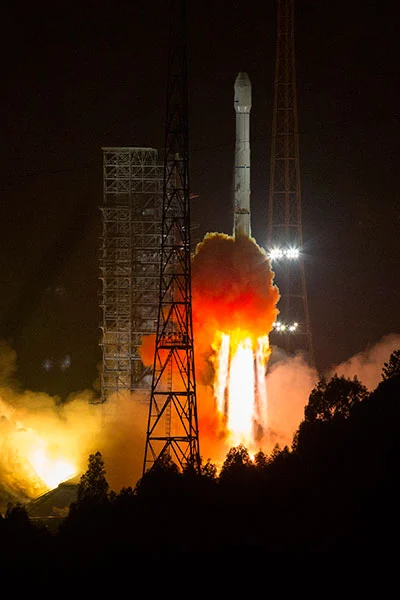
A significant milestone in international space cooperation was achieved on Monday, December 11, 2017, as China successfully launched Alcomsat-1, Algeria’s first-ever communications satellite, from the Xichang Satellite Launch Center. This pivotal event not only propelled Algeria into the ranks of spacefaring nations with its own independent satellite infrastructure but also represented China’s inaugural export of a communications satellite to an Arab country, underscoring Beijing’s growing influence and technological prowess in the global space market. The mission solidified the comprehensive strategic partnership between the two nations, opening new avenues for technological collaboration and regional development.
Detailed Launch Account and Orbital Insertion
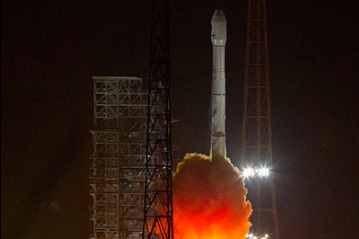
The launch sequence commenced precisely at 12:40 AM Beijing time (GMT+8), when a Long March 3B carrier rocket, a robust and proven workhorse of China’s space program, ignited its engines and thundered skyward from the southwestern province of Sichuan. For approximately 26 minutes, the towering rocket ascended through the Earth’s atmosphere, meticulously following its pre-programmed trajectory. Its primary objective was the precise injection of the Alcomsat-1 satellite into a geostationary transfer orbit (GTO), a crucial elliptical path that serves as an intermediate stage before the satellite reaches its final geostationary position approximately 36,000 kilometers above the equator.
China Great Wall Industry Corporation (CGWIC), the nation’s largest space contractor in the international market and the project’s prime contractor, confirmed the successful orbital placement. The Long March 3B rocket, known for its high reliability and capacity to deliver heavy payloads to GTO, has been instrumental in numerous Chinese and international satellite launches. Its selection for Alcomsat-1 underscored the confidence placed in Chinese launch capabilities for critical national infrastructure projects. Following separation from the upper stage of the rocket, Alcomsat-1 initiated a series of intricate maneuvers using its own propulsion system to gradually circularize its orbit and drift to its designated geostationary slot, where it would appear stationary relative to the Earth’s surface, providing continuous coverage to Algeria and surrounding regions.
Strategic Partnership and Diplomatic Acclaim
The successful launch was immediately met with high-level diplomatic recognition, with Chinese President Xi Jinping and his Algerian counterpart, President Abdelaziz Bouteflika, exchanging congratulatory messages on Monday morning. Their communications highlighted the profound significance of the Alcomsat-1 project within the broader context of the China-Algeria comprehensive strategic partnership.
President Xi Jinping emphasized that the satellite initiative served as a tangible manifestation of the deep and evolving bilateral ties between the two countries. He lauded it as an exemplary model of space cooperation between China and Arab nations, projecting its transformative potential for Algeria’s economic and social development. Xi reiterated China’s unwavering commitment to strengthening exchanges and cooperation across various sectors with Algeria, aiming to deepen the bilateral partnership for the mutual benefit of both nations and their respective peoples. His statement underscored China’s "win-win" approach to international collaboration, particularly with developing countries seeking to enhance their technological capabilities and infrastructure.
Echoing President Xi’s sentiments, Algerian President Abdelaziz Bouteflika hailed Alcomsat-1 as a remarkable achievement in space cooperation, reflecting the enduring traditional friendship that has characterized China-Algeria relations for decades. Bouteflika expressed Algeria’s readiness to further reinforce cooperation with China, signaling a desire for continued collaboration in advanced technological fields and strategic initiatives. This exchange of presidential messages underscored the project’s status not merely as a commercial transaction but as a cornerstone of strategic diplomatic engagement and mutual trust.
Alcomsat-1: A Technical Overview and Service Capabilities
Alcomsat-1 was designed and manufactured by the China Academy of Space Technology (CAST), a subsidiary of the state-owned China Aerospace Science and Technology Corporation (CASC), leveraging the robust and well-established DFH-4 (Dongfanghong-4) satellite platform. The DFH-4 platform is a versatile, high-power, medium-capacity geostationary communications satellite platform developed by China, known for its reliability and adaptability to various mission requirements. It has been used for multiple domestic Chinese satellites and a growing number of international exports, solidifying its reputation in the global market.
Weighing approximately 5.2 metric tons at liftoff, Alcomsat-1 is engineered for an impressive operational lifespan of 15 years, a standard duration for modern geostationary communications satellites. This long operational life ensures a sustained period of service provision and return on investment for Algeria. The satellite is equipped with a comprehensive suite of transponders, including Ku-band, Ka-band, and L-band, providing extensive coverage and diverse service capabilities across Algeria and parts of North Africa.
According to China Great Wall Industry Corporation, Alcomsat-1 is set to revolutionize a wide array of public services within Algeria. Its primary applications include:
- Television Broadcasting: Enhancing and expanding direct-to-home (DTH) television services, improving signal quality and reach, especially in remote and underserved areas where terrestrial infrastructure is challenging or costly to deploy. This will provide greater access to information and entertainment for the Algerian populace.
- Emergency Communications: Providing critical communication links during natural disasters, crises, or in areas where terrestrial networks are damaged or non-existent. This capability is vital for national security, disaster response, and humanitarian aid efforts, ensuring resilient communication channels when they are most needed.
- Remote Education: Facilitating distance learning initiatives and bridging the educational divide between urban and rural regions. By providing reliable internet and data connectivity, Alcomsat-1 can support e-learning platforms, virtual classrooms, and access to educational resources for students and educators nationwide.
- Satellite-based Signal Augmentation: Enhancing the accuracy and reliability of navigation systems, potentially supporting applications like precision agriculture, intelligent transportation systems, and improved air traffic control. This capability adds a layer of sophistication to Algeria’s national infrastructure.
- Broadband Internet Access: Crucially, Alcomsat-1 is expected to play a significant role in bridging Algeria’s digital divide by extending high-speed internet access to rural and remote areas, fostering economic development, and improving connectivity for businesses and citizens alike. This is particularly important for a country with diverse geography, including vast desert regions.
Fu Zhiheng, vice-president of China Great Wall Industry Corporation, confidently asserted that Alcomsat-1 stands on par with Western communications satellites in terms of both technology and capacity. This statement underscores China’s ambition to be a leading provider of high-quality, competitive space solutions globally. He also hinted at the existence of other contracts between his firm and various Arab countries, signaling a growing trend of Chinese space technology exports to the region, though specific details were not disclosed at the time.
The Journey to Orbit: A Chronology of Collaboration
The Alcomsat-1 project represents the culmination of years of meticulous planning, negotiation, and technological collaboration. The timeline of this landmark endeavor highlights the sustained commitment from both Algeria and China:
- December 2013: The foundational agreement for the Alcomsat-1 project was formally signed between the Algerian Space Agency (ASAL) and China Great Wall Industry Corporation (CGWIC). This contract initiated the design, manufacturing, launch, and in-orbit delivery of the satellite. The selection of a Chinese contractor over others from established space powers like Europe or the United States underscored Algeria’s strategic decision to deepen ties with China in critical technological sectors.
- 2014-2017 (Design and Manufacturing Phase): Following the contract signing, the China Academy of Space Technology (CAST) commenced the intensive design and manufacturing process for Alcomsat-1. This phase involved extensive engineering, component procurement, assembly, integration, and rigorous testing of the satellite’s various subsystems. Algerian engineers and technicians were reportedly involved in aspects of the project, receiving training and knowledge transfer, which is a common component of China’s space export deals, aiming to build local capabilities.
- November 2017: The fully assembled and tested Alcomsat-1 satellite, along with its associated ground support equipment, was transported to the Xichang Satellite Launch Center in Sichuan province. This involved complex logistics to ensure the delicate spacecraft arrived safely and was prepared for integration with the Long March 3B rocket.
- December 11, 2017: The Long March 3B carrier rocket successfully blasted off, placing Alcomsat-1 into geostationary transfer orbit. This marked the successful completion of the launch phase.
- Post-Launch (Weeks following launch): Following orbital insertion, Alcomsat-1 began its critical post-launch operations. This involved a series of apogee engine firings to raise its perigee and circularize its orbit, gradually moving it from the elliptical GTO to its final geostationary operational slot. During this period, extensive in-orbit testing (IOT) was conducted to verify the health and performance of all satellite subsystems and payloads. Once positioned and tested, control was formally handed over to the Algerian Space Agency.
China’s Growing Prowess in Space Exports
The Alcomsat-1 launch is a testament to China’s rapid advancements in space technology and its increasing competitiveness in the global commercial space market. For decades, the international satellite launch and manufacturing market was dominated by Western and Russian providers. However, China’s state-backed space industry, through entities like CGWIC and CAST, has steadily emerged as a formidable player.
China offers a comprehensive "turnkey" solution for satellite projects, encompassing design, manufacturing, launch, ground station construction, and technical training. This integrated approach, often coupled with competitive pricing and favorable financing terms, makes Chinese space technology an attractive option for developing nations looking to establish or enhance their space capabilities without incurring the prohibitive costs associated with traditional providers.
The export of Alcomsat-1 to an Arab country is particularly significant. It opens doors for further collaboration with other nations in the Middle East and Africa, many of whom are seeking to bolster their digital infrastructure, improve connectivity, and enhance national security through independent satellite systems. This aligns with China’s broader "Belt and Road Initiative" (BRI), which seeks to foster infrastructure development and connectivity across Asia, Africa, and Europe, with space infrastructure increasingly recognized as a vital component. China’s reliability in launch services, as demonstrated by the Long March series, further reinforces its position as a trusted partner.
Algeria’s National Ambitions and Digital Future
For Algeria, the launch of Alcomsat-1 represents a monumental leap forward in its national development strategy. As the largest country in Africa by land area, with vast and often sparsely populated regions, terrestrial communication infrastructure faces significant challenges. A national communications satellite offers a sovereign solution to bridge the digital divide, providing ubiquitous and reliable connectivity across its diverse landscape.
The satellite will contribute significantly to Algeria’s economic diversification efforts, supporting sectors like oil and gas exploration, agriculture, and tourism with enhanced communication and data services. It also enhances national security and sovereignty by providing independent communication channels, reducing reliance on foreign-owned satellite networks. The Algerian Space Agency (ASAL), established in 2002, has been working towards this goal, emphasizing the importance of space technology for socio-economic development, scientific research, and environmental monitoring. Alcomsat-1 is a cornerstone of this long-term vision, providing a critical piece of infrastructure that will empower various government ministries and public services.
Moreover, the project includes significant knowledge transfer and training for Algerian engineers and scientists, fostering local expertise in satellite operations and ground segment management. This capacity building is invaluable for Algeria’s long-term strategic independence in space and technology.
Broader Implications for Regional and Global Cooperation
The Alcomsat-1 mission carries broader implications beyond the bilateral relationship between China and Algeria. It sets a precedent for enhanced space cooperation between China and the wider Arab world, as well as with other African nations. As developing countries increasingly recognize the strategic importance of space assets, China’s accessible and comprehensive solutions are likely to find a growing market.
This collaboration contributes to the diversification of the global space industry, offering alternatives to established players and fostering greater competition, which can ultimately benefit all nations seeking access to space technology. It also reinforces China’s role as a leading proponent of South-South cooperation, empowering developing nations with advanced technologies to achieve their national development goals.
Future Outlook
The successful deployment of Alcomsat-1 is just the beginning for Algeria’s space ambitions and China’s role as a global space provider. The project’s success is expected to pave the way for further collaborations in earth observation, navigation, and even human spaceflight training in the future. As Alcomsat-1 begins its operational life, providing crucial services to the Algerian people, it stands as a shining example of how strategic international partnerships can drive technological advancement and foster mutual prosperity, redefining the landscape of global space cooperation.


 Nana Wu
 Lina Hope