Siti Muinah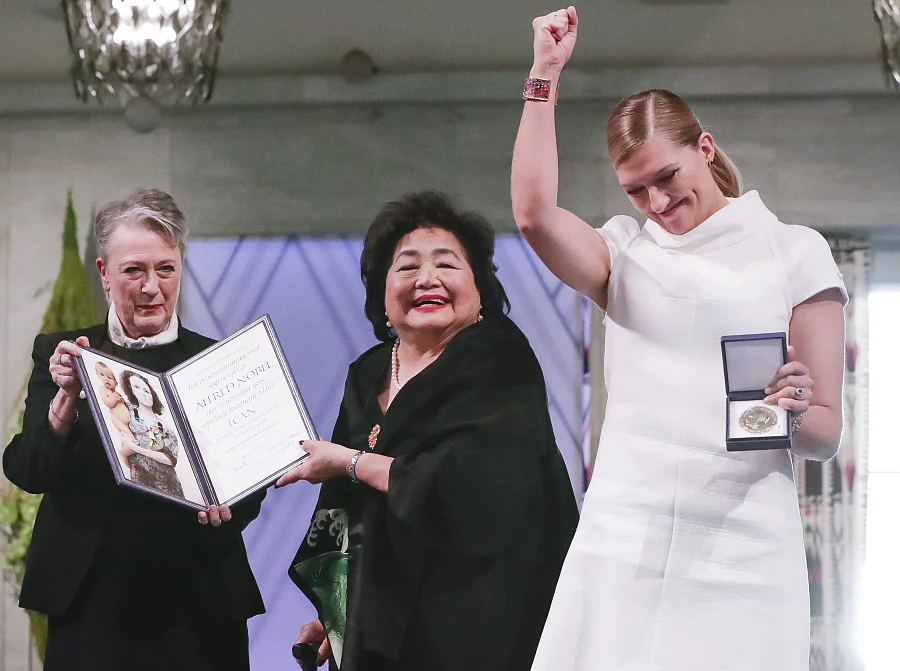
OSLO – The International Campaign to Abolish Nuclear Weapons (ICAN) was awarded the prestigious 2017 Nobel Peace Prize on Sunday, December 10, 2017, in Oslo, Norway, in recognition of its relentless efforts to draw global attention to the catastrophic humanitarian consequences of nuclear weapons and its instrumental role in achieving a treaty-based prohibition of these devastating instruments of war. The award ceremony, held at the Oslo City Hall, marked a significant moment for the disarmament movement, highlighting the urgent need for a world free from the existential threat posed by nuclear arsenals.

Berit Reiss-Andersen, the chairperson of the Norwegian Nobel Committee, formally presented the medal and diploma to Beatrice Fihn, the executive director of ICAN, and Setsuko Thurlow, a revered survivor of the 1945 atomic bombing of Hiroshima. In her address, Reiss-Andersen emphasized ICAN’s groundbreaking work in galvanizing international support for nuclear disarmament, stating that the organization has "given new momentum to the process of abolishing nuclear weapons." She further elaborated that the prize honors ICAN’s commitment to highlighting the immense suffering caused by nuclear weapon use and its success in advocating for a legally binding international treaty to ban them. This year’s award, she noted, continued a long-standing tradition of Nobel Peace Prizes recognizing efforts against nuclear proliferation and for disarmament.
The joint Nobel lecture delivered by Beatrice Fihn and Setsuko Thurlow served as a powerful testament to the urgency of their cause. Fihn issued a stark warning, asserting that the risk of nuclear weapon use is currently greater than at the conclusion of the Cold War. She underscored the increased danger posed by the proliferation of nuclear weapons to a larger number of states, the potential for their acquisition by terrorist groups, and the evolving threat landscape of cyber warfare. "The risk for nuclear weapons use is even greater today than at the end of the Cold War. But unlike the Cold War, today we face many more nuclear armed states, terrorists, and cyber warfare," Fihn stated, painting a grim picture of the current global security environment.

Setsuko Thurlow, an 85-year-old survivor of the Hiroshima bombing, delivered a deeply personal and moving account of her experiences as a 13-year-old girl when the United States dropped an atomic bomb on her city on August 6, 1945. She recounted the horrific loss of eight family members and 351 schoolmates, a stark reminder of the unimaginable human cost of nuclear conflict. Her impassioned plea for collective action aimed to "forever eradicate the threat of nuclear annihilation," resonating with the profound moral imperative behind the disarmament movement.
Genesis and Evolution of a Global Movement
The International Campaign to Abolish Nuclear Weapons (ICAN) is a coalition of non-governmental organizations (NGOs) spanning approximately 100 countries. Its formal inception took place in April 2007 in Austria, with its main operational hub subsequently established in Geneva, Switzerland. The campaign’s primary objective has been to promote universal adherence to and implementation of the Treaty on the Prohibition of Nuclear Weapons (TPNW), a landmark international agreement that unequivocally bans nuclear weapons, including their development, testing, possession, stockpiling, and use.

The genesis of ICAN can be traced back to a growing global concern over the persistent threat of nuclear weapons, particularly in the context of ongoing nuclear modernization programs by several states and the perceived lack of progress in disarmament efforts. The campaign emerged as a vital platform for civil society to collectively advocate for a world free from nuclear arms, bridging the gap between grassroots activism and international policy-making.
The Treaty on the Prohibition of Nuclear Weapons: A Milestone Achievement
ICAN’s most significant achievement has been its instrumental role in the negotiation and adoption of the Treaty on the Prohibition of Nuclear Weapons (TPNW). The TPNW was adopted by a vote of 123 states at the United Nations in July 2017 and opened for signature in September 2017. This treaty represents a groundbreaking legal instrument that unequivocally outlaws nuclear weapons, treating them as illegal under international law, similar to chemical and biological weapons.

The treaty’s negotiation process was driven by a coalition of states, largely from the Global South, who felt that existing disarmament frameworks, such as the Nuclear Non-Proliferation Treaty (NPT), had not yielded sufficient progress. ICAN played a crucial advocacy role throughout this process, mobilizing civil society, engaging with governments, and providing expert input to ensure the treaty’s robust provisions. The TPNW prohibits states parties from developing, testing, producing, manufacturing, acquiring, possessing, stockpiling, transferring, using, or threatening to use nuclear weapons. It also prohibits deploying nuclear weapons on their territory and providing assistance or encouraging any activity prohibited by the treaty.
The Humanitarian Impact: A Core Argument
A central tenet of ICAN’s advocacy has been its unwavering focus on the catastrophic humanitarian consequences of nuclear weapons. The campaign has consistently highlighted that any use of nuclear weapons would result in widespread death, destruction, and long-term environmental devastation, rendering large areas of the planet uninhabitable and posing an existential threat to humanity. By emphasizing the humanitarian dimension, ICAN has sought to shift the discourse on nuclear weapons away from strategic deterrence and towards the unacceptability of their very existence.

The testimony of survivors like Setsuko Thurlow, who endured the horrors of the Hiroshima bombing, serves as a powerful and visceral reminder of the human cost. These personal accounts, combined with scientific data on the immediate and long-term effects of nuclear explosions – including radiation sickness, genetic mutations, widespread famine due to nuclear winter, and societal collapse – form the bedrock of ICAN’s persuasive arguments.
The Nobel Committee’s Rationale and Broader Context
The Norwegian Nobel Committee’s decision to award the 2017 Peace Prize to ICAN underscored the growing international recognition of the imperative to abolish nuclear weapons. The committee explicitly cited ICAN’s "ground-breaking efforts to achieve a treaty-based prohibition of such weapons." This recognition validated the persistent advocacy of civil society organizations and highlighted the effectiveness of international cooperation in addressing global security challenges.

The committee’s statement also placed the award within the historical context of Nobel Peace Prizes awarded to individuals and organizations working towards nuclear disarmament. Past recipients, such as the Pugwash Conferences on Science and World Affairs and the International Physicians for the Prevention of Nuclear War, have similarly championed the cause of nuclear abolition. The 2017 award signaled a renewed emphasis on this critical issue in the global peace and security agenda.
Global Reactions and Implications
The awarding of the Nobel Peace Prize to ICAN generated a wide range of reactions globally. While disarmament advocates and many international organizations celebrated the decision as a victory for peace and humanitarianism, nuclear-armed states and their allies offered a more muted response, with some expressing reservations about the TPNW and its implications for existing security architectures.

- Support and Celebration: Governments that have ratified the TPNW, along with numerous NGOs and civil society groups, widely applauded the award. They viewed it as a significant boost to the ongoing efforts to stigmatize and eliminate nuclear weapons, encouraging more states to join the treaty.
- Skepticism and Opposition: Nuclear-weapon states, including the United States, Russia, the United Kingdom, France, and China, as well as states under their nuclear umbrellas (such as NATO members, Japan, and South Korea), did not sign the TPNW. They argue that the treaty undermines existing disarmament regimes, such as the NPT, and does not adequately address the complex security challenges that they believe necessitate nuclear deterrence. Their official responses often reiterated their commitment to existing disarmament frameworks while sidestepping direct engagement with the TPNW.
- Analysis of Implications: The Nobel Prize has undoubtedly amplified the visibility of ICAN and the TPNW on the international stage. It has provided a significant moral and political impetus for further advocacy and diplomatic engagement. However, the practical impact of the prize and the treaty on the actual disarmament of nuclear weapons remains to be seen. The challenge lies in persuading nuclear-armed states and their allies to embrace the TPNW and to dismantle their arsenals. The ongoing geopolitical tensions and the perceived security threats faced by these states continue to be significant obstacles.
Looking Ahead: The Road to Abolition
The 2017 Nobel Peace Prize serves as a powerful recognition of ICAN’s tireless advocacy and its pivotal role in the adoption of the Treaty on the Prohibition of Nuclear Weapons. While the path to a world free from nuclear weapons is fraught with complex political and security challenges, the award has invigorated the disarmament movement and underscored the enduring relevance of the call for a nuclear-weapon-free future. The campaign’s continued work in raising awareness, advocating for universal adherence to the TPNW, and holding nuclear-armed states accountable will be crucial in transforming this vision into a tangible reality, ensuring that future generations are not held hostage by the specter of nuclear annihilation. The voices of survivors like Setsuko Thurlow, coupled with the persistent efforts of organizations like ICAN, continue to be a beacon of hope in the global pursuit of lasting peace and security.


 Nana Wu
 Suro Senen