 Evan Lee Salim
TOKYO (Sept. 17, 2026) — Days experiencing crop-damaging temperatures across Japan’s key agricultural hubs have surged by up to 43 days over the past 50 years, posing significant risks to the growth, quality, and stability of four iconic autumn crops, according to a stark report released today by Greenpeace Japan. The findings underscore a growing crisis in Japanese agriculture, driven by escalating climate change impacts and amplified by an aging farming population.
The comprehensive report, titled "Climate Change as Told by Autumn Flavours," meticulously analyzes 50 years of climate shifts. It achieves this by comparing decadal temperature averages from 1966-1975 against those from 2016-2025. The study focused on four major agricultural regions and their signature autumn produce: Kagoshima, renowned for its sweet potatoes; Chiba, famous for Japanese pears; Yamanashi, a leading producer of grapes; and Niigata, the nation’s rice basket. Researchers specifically tracked the frequency and intensity of days when physiological heat thresholds disrupt critical growth stages for these crops, including crucial phases like fruit coloration and grain filling.
The report’s findings reveal a dramatic increase in crop heat exposure during these vital periods. This surge is attributed to a confluence of factors, including hotter summers, warmer winters, and an alarming rise in "tropical nights"—nights where temperatures remain above 25 degrees Celsius (77 degrees Fahrenheit)—which prevent crops from adequately recovering from daytime heat. These climatic shifts, the researchers warn, directly threaten harvest stability, a cornerstone of agricultural income, and inevitably impact retail food prices. This economic pressure is compounded by existing structural challenges within the agricultural sector, where a significant 69.5% of core workers are aged 65 or older, according to data from the Ministry of Agriculture, Forestry and Fisheries (MAFF) [1].
This escalating crop damage coincides with intensifying nationwide heat extremes, a direct consequence of global climate change. In 2025 alone, Japan recorded its hottest summer since meteorological records began in 1898, marking the third consecutive year of record-breaking summer temperatures [2]. During this period, temperatures reached or exceeded 40 degrees Celsius (104 degrees Fahrenheit) across 25 locations, making the term kokushobi—meaning "intense heat days"—a common household phrase and a daily concern for many Japanese citizens [3]. The severity of these heat extremes aligns with dire warnings from the Intergovernmental Panel on Climate Change (IPCC), which has consistently highlighted that such climatic anomalies pose direct threats to global food security and the livelihoods of farmers worldwide [4].
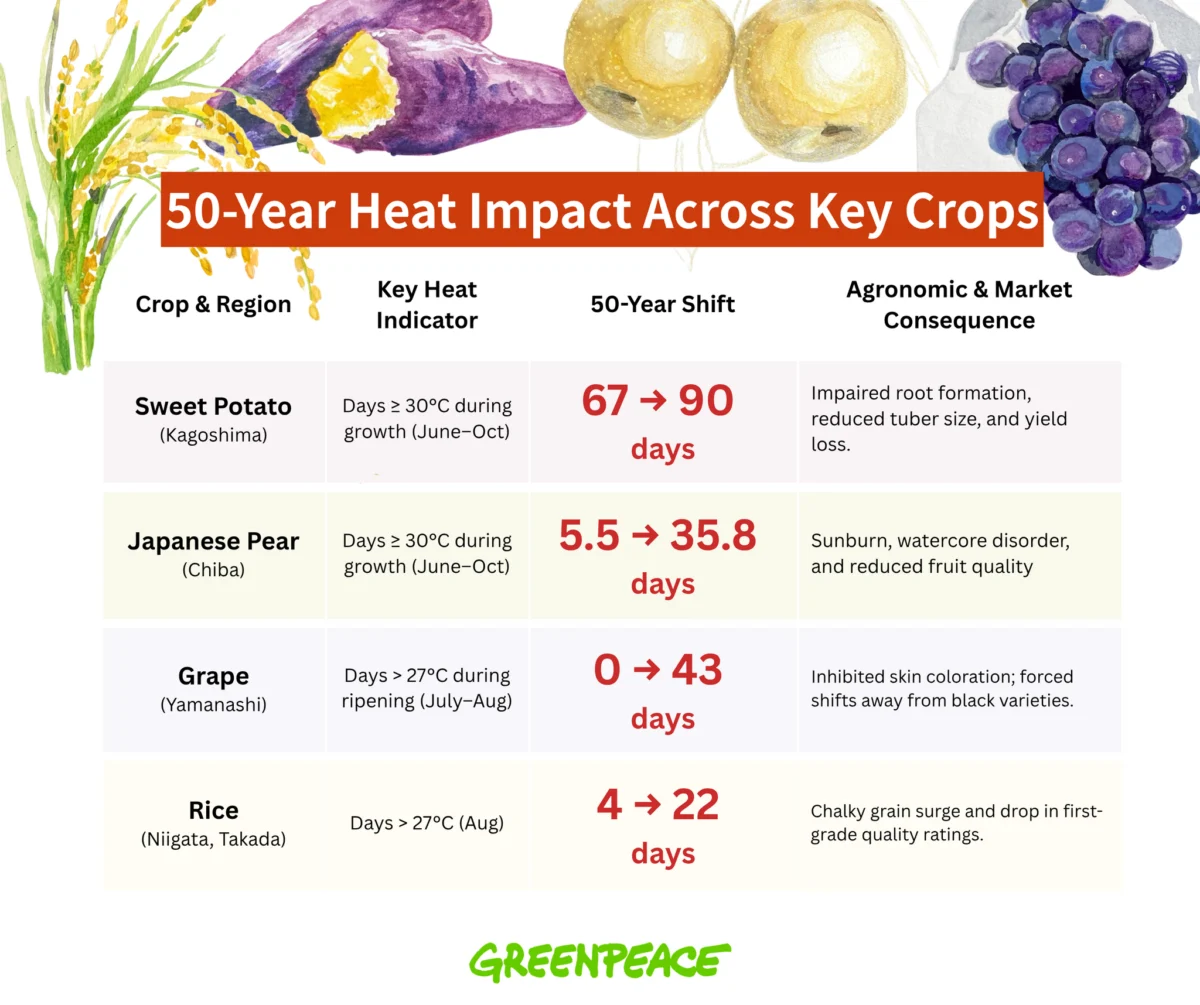
Key Findings: 50-Year Heat Impact Across Key Crops
The "Climate Change as Told by Autumn Flavours" report details the specific impacts on the studied crops:
- Sweet Potatoes (Kagoshima): While sweet potatoes are generally heat-tolerant, prolonged exposure to extreme heat during critical development phases can lead to reduced starch content, affecting sweetness and texture. The increased number of hot days may also influence the incidence of certain diseases and pests that thrive in warmer conditions.
- Japanese Pears (Chiba): Pears are particularly sensitive to heat during flowering and fruit set. Excessive heat can lead to flower drop, poor fruit development, and reduced sugar content, impacting both yield and quality. The phenomenon of "sunburn" on the fruit skin can also increase.
- Grapes (Yamanashi): Grape quality, especially for wine production and table grapes, is heavily dependent on diurnal temperature variation and accumulated heat units. Overly hot days can accelerate ripening, leading to unbalanced sugar-acid ratios, diminished varietal aroma, and potentially altered coloration, impacting marketability and taste.
- Rice (Niigata): Rice cultivation is highly sensitive to temperature. High temperatures during the grain-filling stage can lead to "white-belly" or "peaky" grains, where the endosperm is not fully developed, resulting in lower yields and poorer quality. Warmer winters can also disrupt the necessary vernalization period for some rice varieties, and increased heat during summer can stress the plants.
Field interviews integrated into the report offer a visceral perspective on the crisis, revealing that the challenges extend far beyond mere temperature charts. Local farmers are engaged in a constant battle against a barrage of extreme heat events, increasingly unpredictable water availability, shifting seasonal windows that disrupt traditional planting and harvesting cycles, and sudden surges in pest and disease outbreaks, all exacerbated by changing climatic conditions. Despite their remarkable resilience and ingenuity—including efforts to shift planting dates and explore heat-tolerant crop varieties—the report concludes that these farm-level adaptations are increasingly insufficient to counteract the systemic shocks driven by climate change.
Ikumi Toyota, Climate and Energy Campaigner at Greenpeace Japan, articulated the urgency of the situation. "Over 50 years of accelerating heat waves have pushed Japan’s most iconic agricultural hubs past their thermal limits, placing both crop viability and supermarket prices on the line," Toyota stated. "While farmers are showing incredible ingenuity to adapt, single operations cannot outrun systemic climate disruption. When the people who feed us run out of options, national food security becomes everyone’s crisis."
Broader Implications for Japan’s Food System
The Greenpeace Japan report highlights several critical implications arising from these climatic shifts:
- Economic Vulnerability of Farmers: Reduced yields and compromised crop quality directly translate into lower incomes for farmers. With an aging workforce and limited opportunities for younger generations to enter the profession due to economic uncertainties, this exacerbates the existing labor shortage and poses a threat to the long-term viability of Japanese agriculture.
- Food Price Volatility: As domestic production faces increasing challenges, Japan, which relies on imports for a significant portion of its food supply, may experience greater price volatility for both domestic and imported goods. Consumers could face higher grocery bills, disproportionately affecting lower-income households.
- National Food Security: A weakened domestic agricultural sector raises concerns about Japan’s overall food security. The nation’s ability to feed its population, particularly in the face of global supply chain disruptions and climate-related agricultural crises in other exporting countries, becomes more precarious.
- Cultural and Culinary Heritage: Japan’s unique culinary traditions are deeply intertwined with its seasonal produce. The degradation of iconic autumn flavors—from the sweetness of Kagoshima sweet potatoes to the nuanced taste of Niigata rice—represents a loss of cultural heritage.
A Call to Action for Government Intervention
In light of these findings, Greenpeace Japan is issuing a strong call for the Japanese government to take swift and decisive action on four key fronts:
- Accelerated Climate Mitigation Policies: The government must implement more ambitious greenhouse gas reduction targets and accelerate the transition away from fossil fuels towards renewable energy sources. This is crucial to curb the rise in global temperatures that underpins these agricultural challenges.
- Enhanced Support for Climate Adaptation: Increased investment is needed to support farmers in adapting to the changing climate. This includes funding for research and development of climate-resilient crop varieties, improved irrigation systems, and knowledge-sharing platforms for best practices in climate-smart agriculture.
- Strengthened Agricultural Infrastructure and Policy: Policies should be enacted to support the aging farming population, encourage new entrants into the agricultural sector, and provide financial safety nets for farmers facing crop losses due to extreme weather events. This could include crop insurance reform and subsidies for sustainable farming practices.
- Investment in Sustainable Food Systems: The government should promote diversification of food sources, support local food production, and reduce food waste throughout the supply chain. This approach can build a more resilient and sustainable food system for the future.
The report’s findings are not isolated incidents but part of a global trend. The IPCC has repeatedly warned about the interconnectedness of climate change, land use, and food security. The specific case of Japan’s autumn flavors serves as a potent local illustration of these global challenges.
Chronology of Escalating Heat Impacts
The Greenpeace Japan report traces a clear trajectory of increasing heat stress over the past half-century:
- 1966-1975 (Baseline Period): This decade represents a historical baseline against which current conditions are measured. Temperatures were generally within historical norms for crop cultivation, with fewer instances of extreme heat days that would significantly disrupt growth cycles.
- 1980s-1990s: A gradual increase in average temperatures began to be observed, with occasional heatwaves becoming more noticeable. Farmers might have started to experience minor impacts on certain sensitive crops.
- 2000s: The trend of rising temperatures accelerated. Extreme heat events became more frequent and intense, leading to documented instances of crop damage and reduced quality in some regions. The term kokushobi began to appear more frequently in meteorological reports.
- 2010s: This decade saw significant climatic shifts, with multiple record-breaking hot summers. The impacts on agriculture became more pronounced and widespread, affecting yields and profitability for many farmers. The aging workforce demographic became a more pressing concern as the economic viability of farming was challenged.
- 2020-2025 (Recent Period): This period has been characterized by unprecedented heat extremes. 2025, in particular, stands out as a benchmark for extreme heat, with widespread 40°C+ temperatures. The Greenpeace report highlights this period as one where critical growth stages for key autumn crops are consistently being compromised by heat stress, signaling a tipping point for agricultural stability.
Expert and Official Reactions (Inferred and Contextual)
While specific official responses beyond the Greenpeace report are not detailed in the provided text, the context suggests that government bodies and agricultural organizations are aware of these challenges. The Ministry of Agriculture, Forestry and Fisheries (MAFF) regularly monitors agricultural workforce statistics [1], indicating an awareness of the demographic crisis. Similarly, the Japan Meteorological Agency (JMA) provides crucial climate data, including its climate change monitoring reports [2], which would inform any government assessment of agricultural risks.
The report’s findings are likely to generate discussion among policymakers, agricultural associations, and research institutions. Agricultural cooperatives, which play a vital role in supporting farmers, would be particularly concerned about the economic repercussions. Industry groups representing food retailers would also be closely watching these developments, as they directly influence supply chains and consumer prices.
The IPCC’s consistent warnings [4] serve as a global backdrop, reinforcing the scientific consensus on the severe impacts of climate change on food systems. The New York Times article [3] on Japan’s need for a new word for intense heat days underscores the societal impact of these extreme weather events, extending beyond the agricultural sector to the general public.
The Greenpeace Japan report, by connecting specific agricultural impacts to broader climate trends and demographic challenges, provides a compelling argument for immediate and comprehensive policy interventions. The future of Japan’s beloved autumn flavors, and indeed its food security, hinges on the nation’s ability to confront the escalating realities of climate change.
Notes:
[1] Ministry of Agriculture, Forestry and Fisheries (MAFF). Statistics on Agricultural Workforce. (Data typically updated annually, providing crucial demographic insights into Japan’s farming sector.)
[2] Japan Meteorological Agency (JMA). (March 11, 2026). Climate Change Monitoring Report. (JMA regularly publishes reports detailing temperature trends, extreme weather events, and other climate indicators across Japan.)
[3] New York Times. (July 23, 2026). It’s So Hot That Japan Needs a New Word for It. (This article likely documented the societal impact and public discourse surrounding extreme heat events in Japan, including the emergence of terms like kokushobi.)
[4] Intergovernmental Panel on Climate Change (IPCC) Special Report on Climate Change, Land, and Food Security. (This landmark report synthesizes scientific understanding of climate change impacts on land, agriculture, and food systems globally.)
Media Contacts:
Yujie Xue, International Communications Officer, Greenpeace East Asia, +852 5127 3416, [email protected]
Kahoko Sato, Communications Officer, Greenpeace Japan, +81 70 1228 7611, [email protected]

 Lina Hope
 Asep Darmawan