 Jia Lissa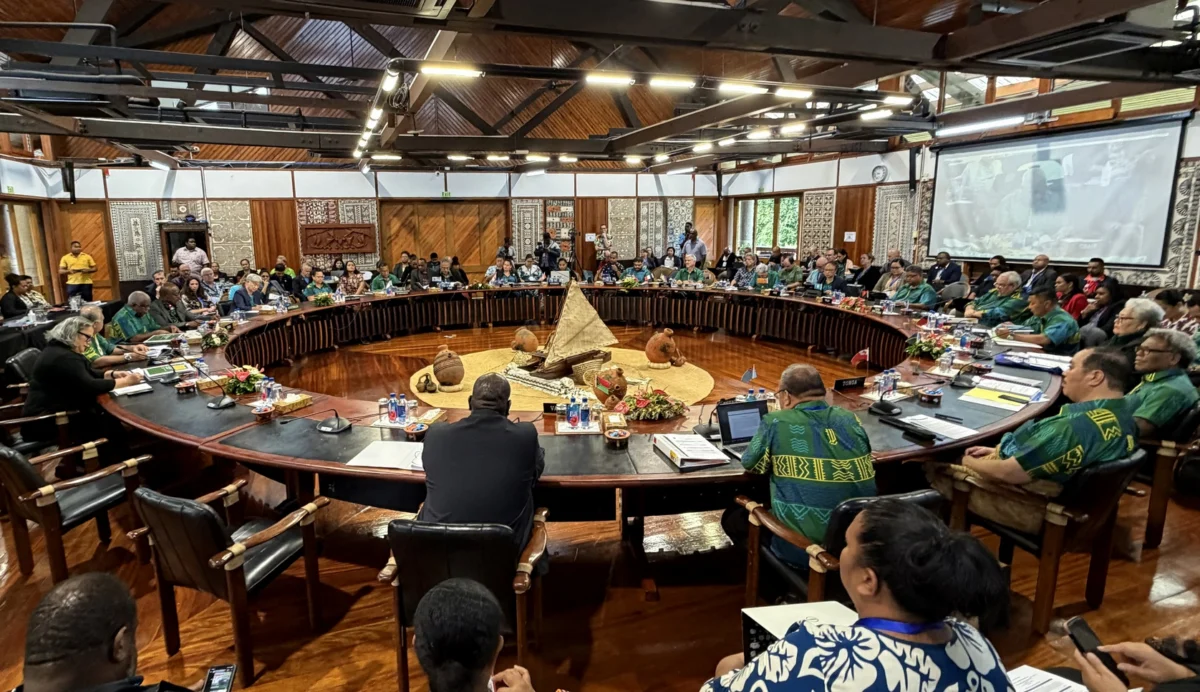
The failure of the Pacific Islands Forum (PIF) foreign ministers to issue a unified condemnation highlights the growing geopolitical fault lines fracturing regional consensus amidst increasing great power competition. The contentious meeting, held in Fiji’s capital, Suva, revealed the profound challenges faced by the 18-member bloc in presenting a united front, particularly when confronting the strategic interests of major global powers like China.
The diplomatic impasse stems from China’s test-firing of an intercontinental ballistic missile (ICBM) last month, an event that Beijing had only given a select few nations short notice about. This assertive display of military might by China, a rising power with long-standing ambitions to expand its influence across the Pacific, immediately raised alarms among some regional states and their traditional Western allies. Monitors tracking the missile’s trajectory indicated that its dummy warhead appeared to land in an expanse of ocean situated strategically between the sovereign territories of Solomon Islands, Nauru, and Tuvalu.

Despite the obvious security implications and the perceived disregard for regional stability, the PIF, which serves as the premier political and economic policy organization for the Pacific Islands, has yet to formulate a formal, collective response to the test. This delay and ultimate failure to agree on a statement underscore the complex web of economic dependencies, diplomatic allegiances, and strategic calculations that define contemporary Pacific geopolitics.
Diplomatic Divisions and Outspoken Condemnation
New Zealand’s Foreign Minister, Winston Peters, a veteran diplomat known for his candid assessments, confirmed the breakdown in consensus after an hours-long, tense meeting. He expressed deep disappointment that the group could not agree on a joint statement condemning the missile launch. While Peters refrained from explicitly naming the two member states that obstructed the statement, diplomatic sources quickly pointed to Kiribati and Nauru, two nations that have cultivated increasingly close economic and diplomatic ties with Beijing, as having shown little appetite for formally criticising a significant development partner.
Peters did not mince words, telling journalists, "They didn’t actually lay out any reasons apart from their disagreement." He then sharply criticised the dissenting nations, accusing them of "appeasing outside partners’ wishes, rather than those that belong to the Pacific Islands Forum." The New Zealand minister’s comments constituted a thinly veiled, yet forceful, rebuke of China’s perceived influence over certain PIF members. "We made it very clear that we do not think that outsiders should be telling the insiders – that’s us who have been here for thousands of years – what our position should be," Peters asserted, emphasizing the importance of regional autonomy and collective self-determination against external pressures.

This sentiment resonates deeply within the Pacific, where the historical legacy of colonialism, nuclear testing by Western powers, and external exploitation of resources has fostered a strong desire for genuine sovereignty and a regional approach to security and development. The concept of the "Blue Pacific Continent," championed by PIF, emphasizes collective ownership and stewardship of the region’s vast oceanic domain.
Tuvalu’s Alarm and Call for Unity
Among the most vocal proponents for a strong, unified statement was Tuvalu, a low-lying island nation particularly vulnerable to rising sea levels and an outspoken diplomatic ally of Taiwan. Tuvalu’s representatives highlighted that their nation had not received any advance notification of the missile test, a clear breach of international protocols for such military exercises.
Pasuna Tuaga, Tuvalu’s Permanent Secretary of Foreign Affairs, Labour, and Trade, articulated his country’s grave concerns on the sidelines of the talks. "We don’t want to be intimidated by any powers," Tuaga declared, underscoring the perceived threat to sovereignty posed by such unannounced military activities. "That’s not the way that we want to be treated. That’s why we want to send a very strong statement from the Pacific as an intercollective, because that would also strengthen our position."

Tuaga revealed the alarming proximity of the missile’s impact, stating it had landed "somewhere very close" to Tuvalu. This perceived direct threat prompted Tuvalu to request assistance from multiple international powers, including both the United States and China, in locating the dummy warhead. The request itself underscores the dualistic foreign policy many Pacific nations must navigate, seeking aid and security assurances from various players while trying to maintain neutrality.
The Missile Test: A Strategic Provocation
The intercontinental ballistic missile test by China represents a significant escalation in military posturing within the Indo-Pacific. While Beijing frequently conducts military exercises, an ICBM test capable of delivering a nuclear warhead to distant targets, carried out without comprehensive prior notification, is a powerful signal. China possesses one of the world’s largest and most rapidly modernizing missile arsenals, including advanced ICBMs like the DF-41, which boasts a range of up to 15,000 kilometers and is capable of carrying multiple independent re-entry vehicles (MIRVs). Such a missile can reach any target in the United States and Europe, showcasing China’s global strike capabilities.
The decision to test such a weapon in the central Pacific, an area historically significant for its strategic maritime routes and rich natural resources, sends a clear message of China’s expanding reach and willingness to project power far beyond its immediate coastline. The lack of adequate warning to all regional states raises questions about flight safety, maritime navigation, and potential environmental impacts. For nations like Tuvalu, which are highly dependent on healthy marine ecosystems and unhindered sea lanes for trade and sustenance, such tests represent a direct threat to their security and economic well-being.

Broader Geopolitical Context: A Battle for Influence
The failed PIF statement is not an isolated incident but rather a symptom of the intensifying geopolitical competition for influence in the Pacific. For decades, Australia, New Zealand, and the United States have been the dominant external players in the region, providing aid, security, and diplomatic support. However, China’s economic rise and strategic ambitions have dramatically reshaped this landscape.
Beijing’s "Belt and Road Initiative" (BRI) has seen significant investment in Pacific infrastructure projects, ranging from ports and airports to government buildings and telecommunications networks. While these projects are often welcomed by developing island nations eager for economic growth, they also come with concerns about debt sustainability and potential strategic leverage for China. For example, China has become a major trading partner and source of development finance for several PIF members, including Kiribati and Nauru, which reportedly blocked the joint statement. Their economic reliance on China often translates into diplomatic deference. Kiribati, for instance, switched diplomatic recognition from Taiwan to Beijing in 2019, followed by the Solomon Islands.
The Western powers, particularly the United States and Australia, have responded by stepping up their own engagement. Australia’s "Pacific Step-up" policy and New Zealand’s "Pacific Reset" involve increased aid, defense cooperation, and diplomatic outreach. The US has also intensified its diplomatic presence, reopened embassies, and increased funding for development projects. The AUKUS security pact between Australia, the UK, and the US, while focused on submarine technology, is part of a broader strategy to counter China’s growing military presence in the Indo-Pacific.

The Pacific Islands are strategically vital due to their location along crucial shipping lanes and their vast exclusive economic zones (EEZs), rich in marine resources. Control or influence over these islands could significantly alter the balance of power in the Indo-Pacific, impacting everything from global trade to military logistics.
The PIF’s Internal Struggles and the Future
The PIF itself has been grappling with internal divisions for years, exacerbated by the external pressures of great power rivalry. The principle of consensus-based decision-making, while intended to foster unity, can also empower a few dissenting members to derail collective action, particularly when those members are under the sway of external powers.
Australia’s Foreign Minister Penny Wong, a prominent voice for regional stability, acknowledged the complexity of the situation. Before the meeting, she expressed hope that China would take note of the "very clear response" already communicated by the majority of Pacific nations concerning the test. Following the failed statement, Wong reiterated, "The majority of the Pacific Islands Forum did express concerns over China’s ballistic missile test." This highlights a significant majority opinion within the forum, even if it couldn’t be formally codified.

The current foreign ministers’ meeting in Suva serves as a precursor to the full leaders’ meeting scheduled for September 2026 in Palau. Palau, an archipelago of hundreds of islands located approximately 800 kilometers west of the Philippines, is another of Taiwan’s few remaining diplomatic allies. This makes the upcoming leaders’ summit in Palau another potential flashpoint for geopolitical maneuvering.
A precedent for such tension was set last year when the Solomon Islands, which signed a controversial security pact with China in 2022, controversially banned all "partner nations" from attending the leaders’ meeting in Honiara. This move was widely seen as a direct response to China’s insistence that Taiwan be excluded from the proceedings. New Zealand’s Winston Peters had similarly accused "outsiders" of meddling in that summit, reflecting a consistent concern about external influence undermining regional autonomy.
Implications for Regional Security and Sovereignty
The failure to condemn China’s missile test carries several significant implications for the Pacific:

- Undermining Regional Unity: It exposes and deepens the cracks within the PIF, making it harder for the forum to act as a cohesive bloc on critical security and environmental issues. This weakens the region’s collective bargaining power on the global stage.
- Challenging the Nuclear-Free Pacific: The PIF has historically championed a "nuclear-free Pacific," enshrined in the 1985 Treaty of Rarotonga. An ICBM test, especially one with nuclear capabilities, directly challenges this fundamental principle, potentially normalizing military activities that contradict the region’s long-held aspirations for peace and demilitarization.
- Erosion of Sovereignty: The accusation of "appeasing outsiders" suggests that some member states may be prioritizing external interests over the collective security and sovereign rights of the PIF. This raises concerns about the genuine independence of decision-making among smaller island nations.
- Precedent for Future Actions: The lack of a unified condemnation might be interpreted by external powers as a green light for similar military activities in the future, further militarizing a region that has historically suffered from the consequences of great power competition.
- Environmental and Safety Risks: Unannounced missile tests pose immediate dangers to maritime traffic and potential long-term environmental consequences from debris. The Pacific Ocean, a vital resource for island nations, must be protected from such risks.
The diplomatic setback in Suva underscores the immense pressure faced by Pacific island nations as they navigate a complex geopolitical landscape. Balancing economic development needs with the imperative to maintain sovereignty, environmental integrity, and regional stability remains their paramount challenge. As the world’s major powers vie for influence, the Pacific Islands Forum faces an uphill battle to assert its collective voice and safeguard the future of the Blue Pacific Continent. The upcoming leaders’ meeting in Palau will be another crucial test of the region’s ability to unite against external pressures and uphold its foundational principles.


 Ali Ikhwan
 Raul Delapena Setiawan