Azzam Bilal Chamdy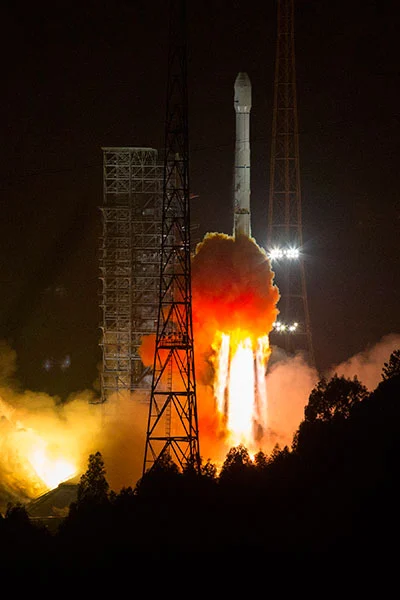
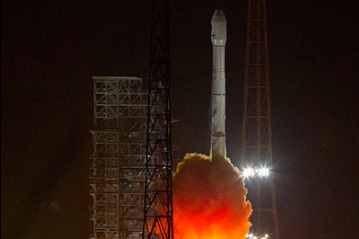
China’s prowess in space technology reached a new zenith on Monday with the successful launch of Alcomsat-1, Algeria’s inaugural communications satellite, from the Xichang Satellite Launch Center in Sichuan province. This historic mission not only signifies Algeria’s entry into the satellite era but also marks a significant milestone in China’s ambition to become a leading global exporter of space technology, particularly within the Arab world. The launch, conducted aboard a powerful Long March 3B carrier rocket, saw the satellite smoothly placed into a geostationary transfer orbit approximately 26 minutes after liftoff at 12:40 am, ushering in a new chapter of technological advancement and international collaboration.
A New Era for Algeria and a Testament to Sino-Algerian Partnership
The successful deployment of Alcomsat-1 is more than just a technological achievement; it represents a substantial leap forward for Algeria in its pursuit of enhanced public services and economic development. The satellite, designed and manufactured by the China Academy of Space Technology, a subsidiary of the China Aerospace Science and Technology Corporation, is built upon the robust DFH-4 satellite platform. This platform is known for its reliability and advanced capabilities, ensuring Alcomsat-1 is equipped to meet Algeria’s diverse communication needs for its projected 15-year lifespan.
The implications of Alcomsat-1 are far-reaching for Algeria. Its capabilities will empower the nation to significantly improve television broadcasting, offering wider coverage and enhanced quality to its citizens. Crucially, it will bolster emergency communication networks, providing a reliable lifeline during natural disasters or other critical situations. Furthermore, the satellite will be instrumental in expanding remote education initiatives, bridging geographical divides and democratizing access to learning resources across the country. Satellite-based signal augmentation will also contribute to improved navigation and positioning services, benefiting various sectors.
Diplomatic Acclaim and the Deepening of Strategic Ties
The significance of this joint endeavor was underscored by the exchange of congratulatory messages between Chinese President Xi Jinping and his Algerian counterpart, President Abdelaziz Bouteflika. President Xi hailed the satellite project as a "important manifestation of the China-Algeria comprehensive strategic partnership" and a "good example of space cooperation between China and Arab countries." He emphasized the satellite’s vital role in promoting Algeria’s economic and social development and expressed Beijing’s willingness to further strengthen exchanges and cooperation across various fields, aiming to deepen the bilateral partnership for the mutual benefit of both nations and their peoples.
President Bouteflika echoed these sentiments, describing Alcomsat-1 as a "remarkable achievement in space cooperation" that "reflects the deep traditional friendship between the two sides." He affirmed Algeria’s commitment to working with China to enhance their collaborative efforts, highlighting the enduring bond between the two countries. These high-level acknowledgments signify the strategic importance both nations place on this partnership, extending beyond mere technological transfer to encompass a broader vision of shared progress and mutual support.
The Genesis and Development of Alcomsat-1
The journey of Alcomsat-1 from concept to orbit began with the signing of the contract in December 2013 between the Algerian Space Agency and China Great Wall Industry Corp (CGWIC). CGWIC, China’s largest space contractor in the international market, played a pivotal role in managing the project, underscoring China’s growing confidence and capability in exporting its advanced space technologies. The design and manufacturing process, spearheaded by the China Academy of Space Technology, focused on delivering a satellite that could compete with Western counterparts in terms of technological sophistication and operational capacity.
The DFH-4 platform, upon which Alcomsat-1 is based, is a testament to China’s advancements in satellite engineering. It typically features a modular design, enabling customization for various mission requirements. The satellite’s liftoff weight of 5.2 metric tons indicates a substantial payload capacity, allowing for the integration of multiple transponders and advanced communication payloads. The 15-year design life signifies a commitment to long-term service, providing sustained benefits to Algeria.
A Booming Sector: China’s Space Exports and Global Ambitions
The successful launch of Alcomsat-1 is a significant feather in China’s cap within the increasingly competitive global space market. The nation has been strategically investing in its space program, aiming to transition from a domestic-focused entity to a major global player in space technology exports. This ambition is not limited to communications satellites; China is also making strides in satellite navigation systems (like BeiDou), remote sensing, and even lunar exploration, with plans for future Mars missions.
Fu Zhiheng, vice-president of China Great Wall Industry Corp, stated that Alcomsat-1 is technologically and in terms of capacity comparable to Western communications satellites. This assertion is crucial, as it addresses potential concerns about the quality and reliability of Chinese space hardware. The company also hinted at other ongoing contracts with Arab nations, suggesting that Alcomsat-1 is likely the first of many such collaborations, signaling a strategic expansion of China’s influence in the Middle East and North Africa’s burgeoning space sectors.
The global market for satellite manufacturing and launch services is substantial and projected to grow. According to various industry reports, the commercial satellite market alone is expected to reach hundreds of billions of dollars in the coming decade. China’s entry into this market with competitive offerings positions it to capture a significant share, especially among developing nations seeking cost-effective and reliable solutions. The Belt and Road Initiative, China’s ambitious global infrastructure development strategy, often includes space cooperation as a key component, further facilitating such partnerships.
The Technical Backbone: Long March 3B and the Xichang Launch Site
The Long March 3B carrier rocket, responsible for placing Alcomsat-1 into orbit, is a workhorse of China’s launch vehicle fleet. It is a heavy-lift rocket capable of launching significant payloads into various Earth orbits, including geostationary transfer orbit, which is ideal for communications satellites. The Xichang Satellite Launch Center, one of China’s primary launch facilities, has a long history of successful missions, providing a reliable and experienced base for critical launches. The center’s location in a relatively remote area of southwestern China also offers advantages in terms of safety and reduced risk to populated areas during launches.
The geostationary transfer orbit (GTO) is an elliptical orbit that serves as a stepping stone to geostationary orbit (GEO). From GTO, the satellite’s onboard propulsion system is used to circularize its orbit at an altitude of approximately 35,786 kilometers above the Earth’s equator, where it will appear to remain stationary over a specific point on the Earth’s surface. This is the preferred orbit for communications satellites as it allows for continuous coverage of a fixed geographical area.
Broader Implications for International Space Cooperation
The successful launch of Alcomsat-1 has several broader implications for international space cooperation:
- Democratization of Space Access: It demonstrates that advanced space capabilities are becoming more accessible to nations beyond the traditional space powers. This can foster greater participation from developing countries in space-based initiatives.
- Shifting Geopolitics of Space: China’s growing role as a space technology provider challenges the long-standing dominance of Western nations and Russia in this sector, potentially leading to a more diversified and competitive global landscape.
- Economic Opportunities: The success of this project opens doors for further commercial opportunities for Chinese space companies, not only in Algeria but across the wider African continent and the Middle East.
- Technological Exchange and Capacity Building: Such collaborations foster knowledge transfer and capacity building within the partner nation. Algeria’s Space Agency will gain invaluable experience in satellite operations and management, contributing to the development of its indigenous space capabilities.
Future Outlook and Potential for Growth
The success of Alcomsat-1 is likely to serve as a catalyst for future Sino-Algerian space collaborations and potentially inspire other Arab nations to consider Chinese-made satellites for their own telecommunications and Earth observation needs. As China continues to invest heavily in its space program, aiming for ambitious goals such as establishing a permanent space station and conducting crewed lunar missions, its expertise and technological offerings will only continue to advance. This positions China as a formidable competitor and a valuable partner in the global pursuit of space exploration and utilization. The story of Alcomsat-1 is a clear indication that the future of space technology is increasingly globalized, with new players and partnerships shaping its trajectory.


 Nana Wu
 Suro Senen