Nana
Nana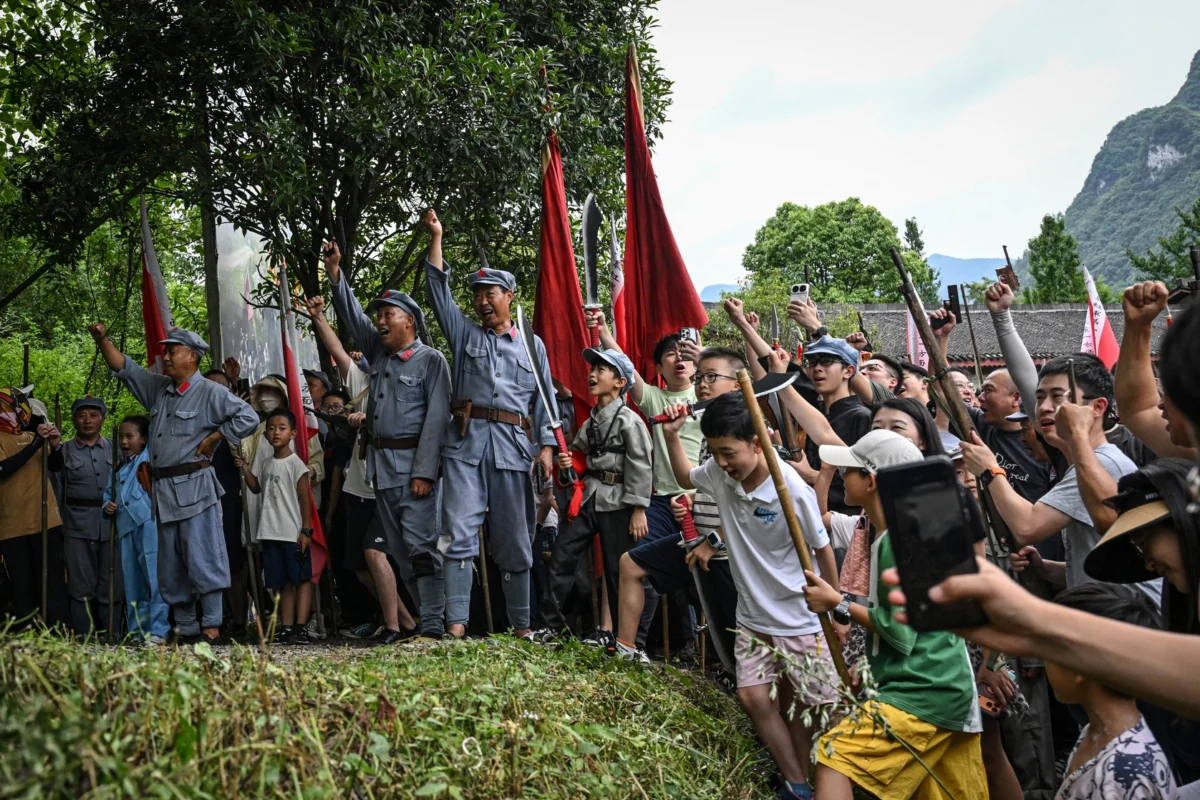
In a vivid spectacle of historical remembrance and patriotic education, scores of tourists, many clad in Red Army uniforms and brandishing prop weapons, recently stormed a strategic mound at Loushan Pass in southwestern China’s Guizhou Province. As pyrotechnics erupted across the hillside, illuminating the dramatic landscape, participants engaged in a meticulously staged reenactment of a pivotal 1935 battle, bringing to life a defining moment in Chinese Communist history. This immersive event, captured on July 25, 2026, has rapidly gained traction across Chinese social media platforms, drawing over 1,000 visitors to the mountainous site over a single weekend and underscoring the enduring appeal and strategic importance of China’s "red tourism" initiatives.
The Historic Significance of Loushan Pass
The Battle of Loushan Pass, fought in February 1935, stands as a critical juncture within the larger narrative of the Long March—a monumental military retreat undertaken by the Chinese Red Army, the precursor to the People’s Liberation Army, to escape the encirclement campaigns of the Nationalist Kuomintang army. At this stage of the Long March, the Communist forces, led by Mao Zedong, were in a precarious position, having suffered heavy losses and facing relentless pursuit from Chiang Kai-shek’s Nationalist troops. The pass itself, a formidable strategic choke point nestled between towering peaks, offered a crucial gateway for the Red Army to break through Nationalist lines and secure a temporary respite.

The Red Army’s audacious victory at Loushan Pass was not merely a tactical triumph; it represented their first major military success against the Nationalists following the arduous commencement of the Long March. This victory significantly bolstered the morale of the weary Communist soldiers and affirmed Mao Zedong’s leadership, especially in the wake of the Zunyi Conference in January 1935, where Mao consolidated his power within the Party. The battle’s strategic importance was so profound that Mao Zedong himself immortalized the event in a famous poem, "Tapu: Loushan Pass" (忆秦娥·娄山关), reflecting its symbolic weight in the revolutionary struggle. The poem vividly depicts the harsh winter conditions and the fierce fighting, culminating in the Red Army’s resolute determination and ultimate success, transforming the geographical landmark into an enduring symbol of revolutionary spirit and resilience.
The Long March: A Foundation of Modern China
To fully appreciate the Loushan Pass reenactment, one must understand the broader context of the Long March (1934-1936). This epic odyssey, spanning over 9,000 kilometers (approximately 5,600 miles) and lasting over a year, saw various Red Army factions traverse some of China’s most treacherous terrain—from vast grasslands and snow-capped mountains to raging rivers and arid deserts. It began in October 1934, when the First Red Army, facing annihilation during the Fifth Encirclement Campaign launched by the Nationalists in Jiangxi Province, decided to break out and relocate its base.
The march was characterized by unimaginable hardships, including starvation, disease, constant skirmishes with Nationalist forces, and extreme weather conditions. Despite these trials, the Long March became a crucible for the Chinese Communist Party, forging a resilient and ideologically unified force. Key events like the Zunyi Conference were pivotal, marking Mao Zedong’s emergence as the undisputed leader, shifting the Party’s strategic direction, and ultimately ensuring the survival of the Communist movement. The successful conclusion of the Long March in Shaanxi Province in October 1936, though with a drastically reduced fighting force, laid the groundwork for the eventual Communist victory in the Chinese Civil War and the establishment of the People’s Republic of China in 1949. Consequently, the Long March is revered as a foundational myth in contemporary China, embodying the spirit of self-sacrifice, perseverance, and revolutionary idealism.

The Rise of "Red Tourism"
The Loushan Pass reenactment is a prime example of China’s "red tourism" initiative, a government-backed program that has been systematically developed over decades to draw tourists to sites of historical significance related to the Chinese Communist Revolution. This unique form of tourism combines patriotic education with economic development, encouraging both domestic and, to a lesser extent, international visitors to explore the origins and evolution of the Communist Party.
The push for "red tourism" intensified in the early 2000s, with significant investments in infrastructure, interpretive centers, and commemorative events at sites like Jinggangshan (the first revolutionary base), Yan’an (the Red Army’s wartime capital), and Zunyi. The objectives are multi-faceted:
- Patriotic Education: To instill a sense of national pride, reinforce core socialist values, and educate younger generations about the sacrifices made during the revolutionary period.
- Historical Preservation: To maintain and develop revolutionary sites, ensuring their accessibility and integrity for future generations.
- Economic Development: To boost local economies in often rural and historically impoverished areas by attracting tourists, creating jobs in hospitality, retail, and cultural services, and stimulating infrastructure improvements.
- Narrative Control: To present a unified and officially sanctioned interpretation of history, emphasizing the legitimacy and historical inevitability of Communist rule.
According to data from China’s Ministry of Culture and Tourism, "red tourism" has seen substantial growth, particularly in recent years, with tens of millions of visits annually contributing billions of yuan to local economies. These sites frequently host educational programs for schools, Party cadres, and the general public, often incorporating interactive elements like the Loushan Pass reenactment to make history more engaging and memorable.

An Immersive Historical Experience
The reenactment at Loushan Pass offers an intensely immersive experience designed to transport participants back to the heart of the 1935 conflict. Dressed in authentic-looking Red Army uniforms, complete with caps, jackets, and trousers, visitors are equipped with prop rifles and toy swords, blurring the lines between spectator and participant. The sound of distant gunfire, the smell of gunpowder from carefully orchestrated pyrotechnics, and billows of smoke create a battlefield atmosphere that engages multiple senses.
Children, some as young as five, enthusiastically join the ranks, raising their toy swords and charging up the hill to "capture" positions held by actors portraying Nationalist forces. Their victorious shouts and the waving of bright red flags atop the "conquered" mound symbolize the Red Army’s triumph. The experience is meticulously curated by actors playing historical figures, who narrate key moments of the battle, providing context and enhancing the dramatic effect.
One 40-year-old tourist, Jiang Jun, articulated the profound impact of the event to AFP, stating, "It was truly awe-inspiring – it felt as though I was actually right there in the thick of the battle. I felt as though I could experience what those martyrs must have felt back then." This sentiment is precisely what "red tourism" aims to evoke: a deep emotional connection to the past, fostering empathy and admiration for the revolutionary heroes. Another participant, Xu, who traveled from neighboring Guangxi province, underscored the contemporary relevance, telling AFP, "If Mao’s forces had not broken through nationalist lines at Loushan Pass, we wouldn’t have the new China that we have today and our standard of living wouldn’t be so good." Such statements highlight how these reenactments link historical struggles directly to present-day prosperity and national pride.

Economic and Societal Ripples
The success of events like the Loushan Pass reenactment has significant economic and societal implications for the region and the nation.
Local Economic Boost: For Zunyi city and Guizhou province, these attractions are vital economic drivers. The influx of over a thousand visitors in a single weekend translates into increased revenue for local hotels, restaurants, transportation services, and souvenir shops. This creates employment opportunities for local residents, from tour guides and historical interpreters to hospitality staff. The continuous development of "red tourism" infrastructure, including improved roads, visitor centers, and accommodation, further stimulates regional growth and raises the standard of living for communities historically reliant on agriculture.
Reinforcing National Identity and Patriotism: Beyond economics, the primary purpose of "red tourism" is ideological. By immersing citizens in the narratives of the revolution, the government seeks to strengthen national identity, promote a sense of collective memory, and instill loyalty to the Communist Party. The participation of children in these reenactments is particularly significant, as it serves as a powerful tool for early patriotic education, shaping their understanding of history and their role within the nation. The heroic portrayal of the Red Army and the sacrifices made reinforces the legitimacy of the current political system and fosters a sense of gratitude for the "new China."

Social Media Amplification: The fact that the Loushan Pass reenactment became a "hit on Chinese social media" is crucial in its broader impact. Platforms like Weibo, Douyin (TikTok), and WeChat enable rapid dissemination of videos and photos from the event, reaching millions who might not visit in person. This digital amplification extends the reach of the patriotic message, generating buzz and encouraging more people to explore "red tourism" sites. It also transforms historical education into an engaging, shareable cultural phenomenon, particularly appealing to younger generations who are digitally native.
Balancing Historical Accuracy with Spectacle
While "red tourism" aims to educate and inspire, it also navigates the delicate balance between historical accuracy and dramatic spectacle. Reenactments, by their nature, simplify complex events, often focusing on heroic narratives and dramatic action rather than the nuanced realities of warfare and political struggle. Critics occasionally raise concerns about the potential for oversimplification or romanticization of history, arguing that such events might prioritize emotional impact over detailed factual representation.
However, proponents argue that these immersive experiences serve as an accessible entry point for understanding history, sparking curiosity that can lead to deeper study. The Loushan Pass reenactment, with its blend of theatrical performance and participatory elements, strives to create a memorable and impactful educational experience that resonates deeply with its audience, fulfilling the dual mandate of commemorating the past and shaping national consciousness for the future.

Conclusion: A Living Legacy
The reenactment at Loushan Pass is more than just a tourist attraction; it is a vibrant manifestation of China’s commitment to keeping its revolutionary history alive and relevant. By transforming battlefields into interactive classrooms and solemn memorials into dynamic stages, "red tourism" initiatives like this ensure that the stories of the Long March and the pivotal victory at Loushan Pass continue to inspire and educate new generations. As participants like Jiang Jun and Xu attest, these experiences foster a profound connection to the nation’s past, reinforcing the narrative that the struggles of yesteryear directly paved the way for the prosperity and stability of modern China, thereby solidifying the enduring legacy of the revolution in the national psyche.


 Nila Kartika Wati
 Muslim