Lina Irawan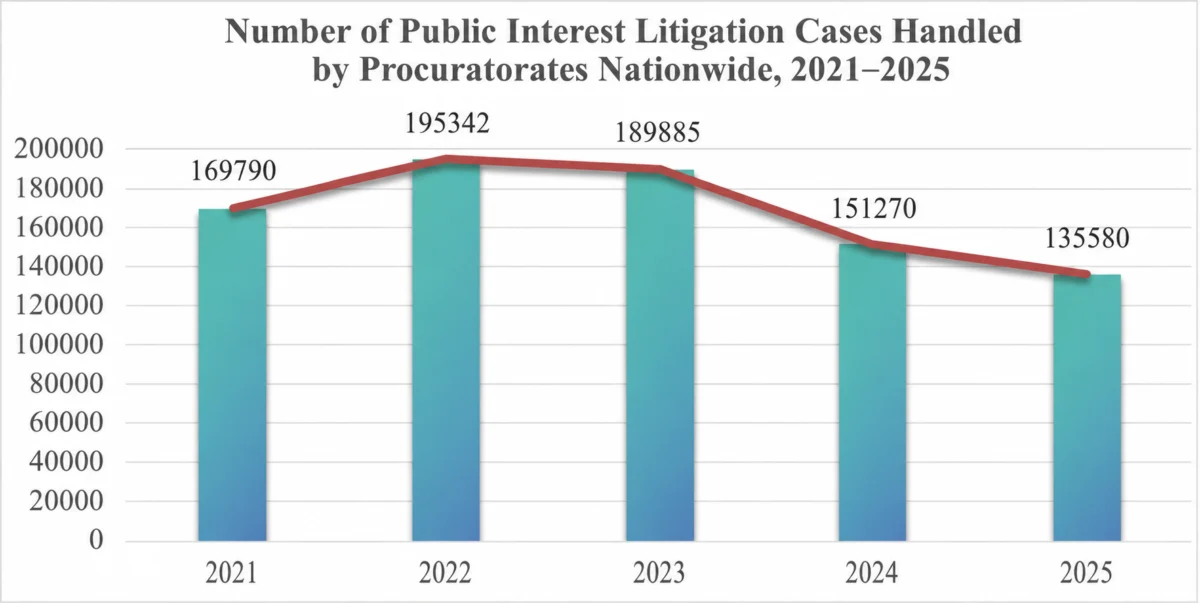
The recent release of the second reading draft of China’s Procuratorate Public Interest Litigation Law (PPIL) marks a significant milestone in the country’s efforts to codify and expand its unique system of state-led public interest law. Following the release of the initial draft, this second iteration introduces refined procedural requirements and clarifies the scope of authority granted to the People’s Procuratorate—the state organ responsible for legal supervision. As the draft moves toward finalization, legal scholars and international observers are closely examining how this standalone law will reshape the relationship between the state, administrative agencies, and private entities, including foreign organizations operating within Chinese jurisdiction.
The Foundations of Procuratorate Public Interest Litigation
To understand the significance of the new draft law, one must first examine the unique nature of the Chinese Procuratorate. Unlike a standard prosecutor’s office in many Western jurisdictions, the People’s Procuratorate in China is constitutionally defined as a "legal supervision organ." This mandate grants it the authority to oversee the "correct implementation" of laws by administrative agencies and even the courts.
The PPIL system was born out of a specific socio-legal necessity. During the early 2010s, China faced a series of high-profile "mass harm" scandals, particularly in the realms of environmental degradation and food safety. While existing laws technically allowed for public interest lawsuits, the hurdles for non-governmental organizations (NGOs) and private citizens were nearly insurmountable. China’s civil society remained relatively small and underfunded, and the government maintained a cautious stance toward organized citizen movements that might challenge state-owned enterprises (SOEs) or government agencies.
In 2014, the Fourth Plenary Session of the 18th Central Committee of the Communist Party of China (CPC) formally proposed the establishment of a public interest litigation system led by the procuratorate. By 2017, the Civil Procedure Law and the Administrative Procedure Law were amended to provide a preliminary legal basis for this system. The current move to create a standalone, comprehensive PPIL Law represents the culmination of a decade of pilot programs and incremental expansion.

Chronology of Development: From Pilot to Codification
The trajectory of the PPIL system reflects a phased approach to legal reform:
- 2014: The CPC Fourth Plenum issues a decision to explore a procuratorate-led public interest litigation system.
- 2015–2017: A two-year pilot program is launched in 13 provincial-level regions, focusing on environmental protection and food safety.
- 2017: The National People’s Congress (NPC) Standing Committee amends the Civil and Administrative Procedure Laws, officially authorizing the procuratorate to file public interest lawsuits nationwide.
- 2018: A pivotal shift occurs as the procuratorate loses its authority to investigate corruption cases to the newly formed National Supervision Commission. In response, the Supreme People’s Procuratorate (SPP) prioritizes PPIL as one of its "four pillars" of work, alongside criminal, civil, and administrative supervision.
- 2021–2023: The scope of PPIL is expanded via specific legislation to include personal information protection, heroes and martyrs’ rights, and telecommunications fraud.
- 2024: The first reading draft of the standalone Procuratorate Public Interest Litigation Law is released for public comment.
- 2025: The second reading draft is published, incorporating feedback and refining the "extraterritoriality" provisions.
Statistical Overview: The Reality of "Litigation" Without Trials
Data from the Supreme People’s Procuratorate highlights a startling trend: while the number of "cases handled" has skyrocketed, the number of actual court trials remains a small fraction of the total. In 2025, the procuratorate handled approximately 135,580 public interest litigation cases. However, lawsuits were filed in only 7,305 of those instances—roughly 5.4%.
This discrepancy is explained by the structure of the system, which emphasizes administrative correction over judicial confrontation. The PPIL system is divided into two primary tracks:
1. Administrative Public Interest Litigation
This track accounts for approximately 91% of all cases. It targets government agencies that have failed to perform their statutory duties, leading to harms against the national or public interest. The process is governed by a "pre-litigation" phase where the procuratorate issues a formal "Recommended Correction" to the agency. Because administrative agencies generally prefer to avoid the public scrutiny and political embarrassment of a court trial, the vast majority of these recommendations are adopted, and the case is closed without a lawsuit.
2. Civil Public Interest Litigation
This track targets private individuals, businesses, and organizations that have committed torts affecting the public interest. These cases are much more likely to proceed to a full court hearing, as they involve compensation for damages, ecological restoration, or public apologies. Common areas include environmental pollution and violations of consumer rights in the food and drug sectors.

The Expanded Scope of the Second Draft
Article 3 of the second reading draft delineates the specific fields where the procuratorate is authorized to act. Over the last several years, the list of protected interests has grown from four core areas to nearly a dozen.
The current draft identifies "shared" areas where both administrative and civil actions can be taken, including:
- Environmental Protection: The largest category, focusing on air, water, and soil pollution.
- Food and Drug Safety: Targeting the production and sale of harmful products.
- Work Safety: Addressing systemic negligence in industrial and construction sectors.
- Protection of Vulnerable Groups: Including the rights of the elderly, disabled, and minors.
- National Defense and Soldiers’ Rights: Protecting the dignity and legal interests of military personnel.
- Cultural Heritage: Overseeing the preservation of historical sites and artifacts.
- Ethnic Unity: A new addition to the draft law, reflecting the government’s heightened focus on social cohesion and national security.
Certain areas remain exclusive to one track. For instance, cases involving the loss of State-owned Assets or State Land-use Rights are purely administrative, as they involve government mismanagement. Conversely, Monopolistic Conduct, Large-scale Labor Violations, and Personal Information Protection are categorized as civil matters, though they often involve significant corporate defendants.
The Question of Extraterritoriality and Foreign Defendants
One of the most debated aspects of the second reading draft is Article 51, a supplemental provision that explicitly addresses foreign entities. The article states: “The people’s procuratorates may lawfully initiate public interest litigation against foreign organizations and individuals that carry out unlawful conduct that infringes on our nation’s lawful interests or societal public interest.”
This provision has sparked concern among international legal analysts and foreign chambers of commerce. Some observers fear that Article 51 could serve as a broad mandate to target foreign firms for actions taken outside of China, provided those actions are perceived to harm China’s "national interest."

However, a technical analysis of the law suggests a more restrained interpretation. Article 51 is situated within the supplemental provisions, which typically clarify the scope of a law rather than overriding its core articles. It is highly probable that the procedural safeguards and the specific categories listed in Article 3 still apply to foreign defendants. Furthermore, the standard of "harm to the national interest or societal public interest" is not a new standard created for foreigners; it is the foundational requirement for all PPIL cases.
The Supreme People’s Procuratorate has begun to define "public interest" in its Guiding Cases, emphasizing that the harm must be "substantial," "wide-ranging," and "difficult to resolve through private litigation." While the inclusion of "Ethnic Unity" and "National Defense" creates a potential for politically sensitive litigation, the primary focus remains on tangible harms such as environmental damage or large-scale data breaches.
Implications for the Business Community and Civil Society
The formalization of the PPIL Law carries profound implications for both domestic and international stakeholders. For the Chinese government, the law provides a standardized tool to ensure local bureaucrats adhere to central directives, particularly regarding environmental and safety standards. It acts as a "supervisory safety valve" that allows the state to address public grievances without encouraging independent grassroots activism.
For businesses, the law increases the "cost of non-compliance." Unlike traditional private litigation, where a company might settle quietly with a small group of plaintiffs, a procuratorate-led case brings the full weight of the state’s investigative resources. The procuratorate has the power to access corporate records, interview employees, and demand extensive remediation measures.
For foreign firms, the risk is twofold. First, there is the operational risk of being caught in an administrative crackdown where a local government agency, under pressure from a procuratorate recommendation, may take aggressive enforcement action against a high-profile foreign entity to demonstrate its "rectification" efforts. Second, there is the reputational risk associated with being the subject of a civil public interest lawsuit, which is often publicized by state media as a means of "legal education."

Conclusion: A New Era of State-Led Litigation
As China moves toward the final passage of the Procuratorate Public Interest Litigation Law, the legal landscape is shifting toward a model where the state is the primary arbiter of the "public interest." While the system has successfully addressed thousands of environmental and safety violations that might otherwise have gone unpunished, it also reinforces a top-down approach to justice.
The second reading draft clarifies the "rules of the game," but it also leaves significant room for interpretation regarding what constitutes a "national interest." For foreign organizations and individuals, the law serves as a reminder that compliance in China is no longer just a matter of avoiding private disputes or administrative fines; it is now a matter of navigating a complex system of state-led legal supervision that has the power to act as both investigator and plaintiff. The coming months will be critical as the NPC Standing Committee reviews final comments before the law is officially enacted into the Chinese statute books.

 Iffa Jayyana
 Ammar Sabilarrohman