Muslim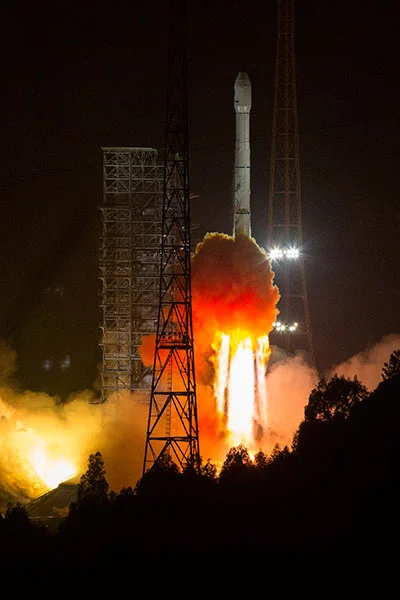
China’s burgeoning space program has achieved another significant milestone with the successful launch of Algeria’s first communications satellite, Alcomsat-1, on Monday. The launch, conducted from the Xichang Satellite Launch Center in Sichuan province, not only signifies a landmark achievement for Algeria in bolstering its telecommunications infrastructure but also underscores China’s growing prowess as a global provider of advanced space technology and services to international partners. This successful mission marks the first instance of China exporting a communications satellite to an Arab nation, opening new avenues for collaboration in the burgeoning space sector.
A Historic Launch for Algeria and China
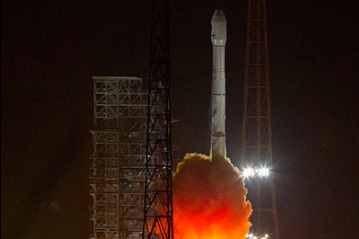
The Alcomsat-1 satellite was propelled into orbit by a powerful Long March 3B carrier rocket, which lifted off precisely at 12:40 am Beijing time. The launch vehicle soared for approximately 26 minutes before successfully deploying the satellite into a geostationary transfer orbit. This critical orbital placement is the precursor to the satellite eventually reaching its operational geostationary orbit, from where it will provide vital communication services to Algeria and potentially wider regions. The successful mission was confirmed by China Great Wall Industry Corp, the state-owned enterprise that served as the project contractor, highlighting the intricate coordination and technological expertise involved in such complex endeavors.
The significance of this achievement was promptly recognized at the highest levels of both nations. Presidents Xi Jinping of China and Abdelaziz Bouteflika of Algeria exchanged congratulatory messages on Monday morning, celebrating the successful culmination of this ambitious space project.
President Xi, in his message, emphasized the profound implications of the Alcomsat-1 mission, characterizing it as a "important manifestation of the China-Algeria comprehensive strategic partnership." He further lauded the project as a "good example of space cooperation between China and Arab countries," predicting its "significant role in promoting Algeria’s economic and social development." Xi articulated Beijing’s commitment to fostering deeper bilateral ties, stating China’s willingness to "strengthen exchanges and cooperation in various fields, deepening the bilateral partnership so as to benefit the two countries and peoples."
Echoing these sentiments, President Bouteflika described Alcomsat-1 as a "remarkable achievement in space cooperation" that "reflects the deep traditional friendship between the two sides." He affirmed Algeria’s dedication to enhancing its collaborative relationship with China, underscoring a shared vision for future endeavors.
Genesis of a Landmark Partnership: The Alcomsat-1 Journey
The journey to Alcomsat-1’s successful launch began with the signing of the contract in December 2013. This agreement was established between the Algerian Space Agency (ASAL) and China Great Wall Industry Corp, an entity that has solidified its position as China’s preeminent space contractor in the international market. The multi-year development and manufacturing process that followed involved meticulous design, rigorous testing, and sophisticated integration of various space-grade components.
The satellite itself was meticulously designed and manufactured by the China Academy of Space Technology (CAST), a key subsidiary of the China Aerospace Science and Technology Corp (CASC). CAST utilized the robust and proven DFH-4 satellite platform as the foundation for Alcomsat-1. This platform, developed by China, is known for its reliability and adaptability for various communication satellite missions, having been employed in previous successful satellite deployments.
Alcomsat-1 boasts a substantial liftoff weight of 5.2 metric tons, indicating its advanced capabilities and payload capacity. With a designed operational lifespan of 15 years, the satellite is engineered to provide a wide spectrum of public services. These services are slated to encompass crucial areas such as television broadcasting, enabling wider access to media and information; emergency communications, vital for disaster response and public safety; remote education, bridging geographical divides and enhancing learning opportunities; and satellite-based signal augmentation, improving the accuracy and reliability of navigation systems.
Technological Prowess and Global Ambitions
Fu Zhiheng, a vice-president at China Great Wall Industry Corp, expressed confidence in Alcomsat-1’s technological capabilities, asserting that it is "as good as Western communications satellites in terms of technology and capacity." This statement highlights China’s ambition to compete with established international players in the global satellite market. While declining to elaborate, Zhiheng also alluded to the existence of "other contracts between his firm and Arab countries," suggesting that Alcomsat-1 may be the vanguard of a broader wave of Sino-Arab space collaborations.
The DFH-4 platform, on which Alcomsat-1 is based, is a testament to China’s indigenous space technology development. It is designed to accommodate various payloads and can be configured for a range of missions, including telecommunications, broadcasting, and earth observation. The platform’s modular design allows for efficient customization to meet specific client requirements, a key factor in its growing international appeal. The 15-year lifespan expectation is a standard benchmark for modern communication satellites, reflecting the durability and advanced engineering incorporated into the design.
Broader Implications: A New Era of Space Diplomacy and Development
The successful launch of Alcomsat-1 carries significant implications beyond the immediate benefits to Algeria. For China, it reinforces its position as a reliable and capable partner in the global space industry, challenging the long-standing dominance of Western aerospace companies. This export success is not merely a commercial transaction; it is a strategic move that enhances China’s geopolitical influence and soft power, particularly within the developing world and the Arab region.
For Algeria, the acquisition of its first dedicated communications satellite represents a leap forward in its national development strategy. Improved telecommunications are fundamental to economic growth, fostering digital inclusion, enhancing business connectivity, and enabling more efficient public services. The ability to broadcast television signals, provide educational resources remotely, and ensure reliable emergency communications will directly impact the lives of Algerian citizens, particularly those in remote or underserved areas.
The "comprehensive strategic partnership" mentioned by President Xi signifies a deepening of the overall relationship between China and Algeria, extending beyond space cooperation to encompass economic, political, and cultural ties. This launch serves as a tangible symbol of this multifaceted partnership, fostering mutual trust and opening doors for further collaboration across various sectors.
The reference to space cooperation between China and "Arab countries" suggests a broader strategy by China to engage with nations in the Middle East and North Africa through its space programs. This region is characterized by significant demand for telecommunications, earth observation, and satellite navigation services. China’s willingness to offer competitive technological solutions and financing packages positions it as an attractive partner for these nations. This aligns with China’s broader Belt and Road Initiative, which aims to foster infrastructure development and economic connectivity across Eurasia and Africa.
A Chronology of the Alcomsat-1 Mission:
- December 2013: Contract signed between the Algerian Space Agency (ASAL) and China Great Wall Industry Corp for the Alcomsat-1 satellite.
- Post-2013: Design, manufacturing, and rigorous testing phases undertaken by the China Academy of Space Technology (CAST) based on the DFH-4 platform.
- Early December 2017: Satellite transported to the Xichang Satellite Launch Center for pre-launch preparations.
- December 26, 2017, 12:40 am (Beijing Time): Long March 3B carrier rocket successfully launches Alcomsat-1 from Xichang.
- Approximately 26 minutes post-launch: Alcomsat-1 successfully deployed into geostationary transfer orbit.
- Monday morning (December 26, 2017): Presidents Xi Jinping and Abdelaziz Bouteflika exchange congratulatory messages on the successful mission.
- Following weeks/months: Alcomsat-1 to undergo orbital maneuvers to reach its final geostationary operational orbit and undergo in-orbit testing before becoming fully operational.
Supporting Data and Context:
- Long March 3B Rocket: A heavy-lift launch vehicle developed by China, capable of placing substantial payloads into orbit. Its reliability has been a key factor in China’s launch capabilities.
- DFH-4 Satellite Platform: A modular and versatile platform developed by China Academy of Space Technology (CAST). It has been used for several domestic and international satellite missions, demonstrating its maturity and adaptability.
- Geostationary Transfer Orbit (GTO): An elliptical orbit from which a satellite can be maneuvered into a geostationary orbit. Geostationary orbit allows a satellite to remain above a fixed point on Earth’s equator, ideal for continuous communication services.
- Global Satellite Market: The global market for commercial satellites is a multi-billion dollar industry, with significant growth projected in the coming years driven by demand for broadband internet, earth observation, and navigation services. China’s entry and expansion in this market are reshaping the competitive landscape.
- China’s Space Program: China has been rapidly advancing its space capabilities, with ambitious goals including lunar exploration, Mars missions, and the establishment of its own space station. The export of satellites is a crucial component of its commercial space strategy.
- Algeria’s Digital Agenda: Like many developing nations, Algeria has prioritized digital transformation and improved connectivity as key drivers of economic and social progress. The Alcomsat-1 mission directly supports these national objectives.
Future Outlook and Challenges
The success of Alcomsat-1 is likely to pave the way for further collaborations between China and other Arab nations. As China continues to develop more advanced satellite platforms and launch capabilities, its appeal as a strategic partner in space is expected to grow. However, the international space market is highly competitive, and China will need to consistently deliver high-quality products and services, coupled with competitive pricing and strong after-sales support, to maintain its momentum.
Furthermore, geopolitical considerations and the desire for technological independence among nations may also influence future partnerships. While Alcomsat-1 represents a significant achievement, ongoing global dynamics will continue to shape the trajectory of international space cooperation. Nevertheless, this launch unequivocally marks a new chapter in the global space arena, highlighting the growing influence of China and the potential for mutually beneficial partnerships in the pursuit of space-enabled development.


 Nana Wu
 Suro Senen