Ammar Sabilarrohman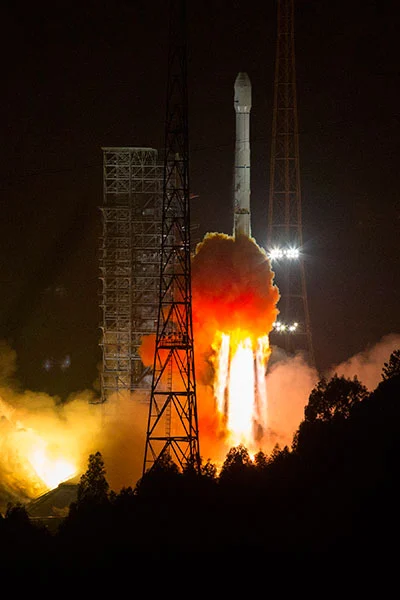
The successful launch of Algeria’s first communications satellite, Alcomsat-1, by China on Monday represents a significant achievement for both nations, underscoring a deepening strategic partnership and highlighting China’s growing prowess in the global satellite export market. The Alcomsat-1, a testament to China-Algeria space collaboration, was lofted into orbit aboard a Long March 3B carrier rocket from the Xichang Satellite Launch Center in Sichuan province, commencing a new era of advanced communication services for the North African nation.
A New Dawn for Algerian Communications
The pre-dawn hours of Monday, at 12:40 am local time, saw the powerful roar of the Long March 3B rocket as it ascended from the Xichang Satellite Launch Center. Approximately 26 minutes later, the rocket successfully deployed Alcomsat-1 into a geostationary transfer orbit, a crucial step before the satellite reaches its operational geostationary orbit. This mission, meticulously managed by China Great Wall Industry Corp (CGWIC), the project’s prime contractor, marks a pivotal moment for Algeria, granting it independent access to sophisticated satellite-based communication capabilities.
The significance of this achievement was recognized at the highest levels of government. Presidents Xi Jinping of China and Abdelaziz Bouteflika of Algeria exchanged congratulatory messages on Monday morning, acknowledging the successful culmination of this ambitious space project. President Xi lauded the satellite project as a "manifestation of the China-Algeria comprehensive strategic partnership" and an exemplary model of space cooperation between China and Arab nations. He emphasized the satellite’s vital role in fostering Algeria’s economic and social development and reiterated China’s commitment to strengthening bilateral exchanges and cooperation across various sectors for the mutual benefit of both countries and their peoples.
President Bouteflika echoed these sentiments, describing Alcomsat-1 as a "remarkable achievement" that solidifies the "deep traditional friendship" between Algeria and China. He expressed Algeria’s eagerness to further enhance its collaborative efforts with China, reinforcing the strong diplomatic ties that underpin this technological advancement.
A Collaborative Journey: From Contract to Orbit
The Alcomsat-1 project’s genesis can be traced back to December 2013, when the Algerian Space Agency (ASAL) and China Great Wall Industry Corp inked the pivotal contract. This agreement laid the groundwork for a multi-year endeavor that would see China’s leading aerospace entities collaborate to deliver a cutting-edge communications satellite tailored to Algeria’s specific needs.
The design and manufacturing of Alcomsat-1 were entrusted to the China Academy of Space Technology (CAST), a key subsidiary of China Aerospace Science and Technology Corp (CASC). CAST, renowned for its expertise in satellite development, based the Alcomsat-1 on the robust and versatile DFH-4 satellite platform. This platform, a workhorse in China’s satellite program, has been a cornerstone of its domestic and international space ventures.
The Alcomsat-1 boasts a liftoff weight of 5.2 metric tons and is engineered for a mission life of 15 years. Its capabilities are extensive, designed to support a broad spectrum of public services. These include enhanced television broadcasting, critical emergency communications, expanded remote education initiatives, and the vital augmentation of satellite-based navigation signals. These functionalities are poised to revolutionize communication infrastructure across Algeria, bridging geographical divides and improving access to essential services.
China’s Expanding Footprint in the Global Satellite Market
The successful launch of Alcomsat-1 is not merely a bilateral triumph; it signifies a significant stride for China’s burgeoning satellite export industry. Fu Zhiheng, Vice-President of China Great Wall Industry Corp, expressed confidence in the satellite’s technological parity with its Western counterparts, stating that Alcomsat-1 is "as good as Western communications satellites in terms of technology and capacity." This assertion underscores China’s ambition to compete and excel in the highly competitive global market for space technology.
While Fu Zhiheng remained discreet about further details, he alluded to the existence of "other contracts between his firm and Arab countries," suggesting that Alcomsat-1 may be the vanguard of a broader expansion of Chinese satellite technology into the Middle East and North Africa. This development aligns with China’s broader Belt and Road Initiative, which seeks to foster economic and infrastructural development through international cooperation.
The Technical Backbone: DFH-4 Platform and Its Capabilities
The DFH-4 satellite platform, upon which Alcomsat-1 is built, is a well-established and reliable bus developed by CAST. It is designed to accommodate a range of payloads and missions, making it a flexible choice for various applications. Key features of the DFH-4 platform include:
- Payload Capacity: Capable of carrying substantial payloads, enabling the integration of advanced communication transponders, scientific instruments, or Earth observation equipment.
- Power Generation: Equipped with robust solar arrays and batteries to ensure continuous power supply throughout the satellite’s operational life.
- Attitude Control: Features sophisticated attitude determination and control systems (ADCS) to maintain precise orientation in orbit, crucial for communication link stability and Earth observation.
- Thermal Control: Incorporates advanced thermal management systems to maintain optimal operating temperatures for onboard electronics in the harsh environment of space.
- Communication Systems: Designed to support a variety of communication frequencies and protocols, allowing for flexible data transmission and reception.
The specific configuration for Alcomsat-1 would have been tailored to Algeria’s unique requirements, likely including a significant number of transponders for broadcasting and telecommunications, as well as dedicated payloads for emergency response and educational services. The 15-year design life indicates a commitment to long-term service provision, providing Algeria with a stable and reliable communication backbone for years to come.
Broader Implications: Geopolitics, Development, and Technological Advancement
The successful launch of Alcomsat-1 carries multifaceted implications, extending beyond the immediate technological and developmental benefits for Algeria.
Geopolitical Significance
In the realm of international relations, this achievement solidifies China’s position as a key player in the global space arena, challenging the long-standing dominance of Western powers. It demonstrates China’s capacity to not only develop advanced space technology but also to successfully export it, fostering strategic partnerships with developing nations. For Algeria, this partnership offers an alternative to traditional suppliers of space technology, potentially reducing reliance on Western markets and fostering greater autonomy in its technological development. This aligns with a broader trend of increasing technological sovereignty among emerging economies.
Economic and Social Development
The primary impact of Alcomsat-1 will be felt at the grassroots level in Algeria. Improved television broadcasting can bring entertainment and information to remote regions, fostering national unity and cultural exchange. The enhanced emergency communications capabilities are crucial for disaster response, enabling faster and more effective coordination during natural calamities or crises. Remote education, powered by satellite connectivity, can revolutionize access to learning opportunities for students in underserved areas, contributing to a more educated and skilled workforce. Furthermore, satellite-based signal augmentation can improve the accuracy and reliability of existing navigation systems, benefiting transportation, logistics, and various other sectors.
China’s Space Ambitions and Capabilities
For China, this export success is a vital step in its ambitious space program. It validates the quality and competitiveness of its satellite technology and manufacturing capabilities. The Long March 3B rocket, a proven launch vehicle, has once again demonstrated its reliability in placing heavy payloads into orbit. This success is likely to fuel further demand for Chinese launch services and satellite platforms from international clients. It also bolsters China’s narrative of peaceful use of space and its commitment to contributing to global space exploration and utilization through cooperation.
The Future of Space Cooperation
The Alcomsat-1 mission serves as a compelling case study for future international space collaborations. It highlights the potential for mutually beneficial partnerships between nations with different levels of technological development, where one provides advanced technology and the other benefits from its application. As the global demand for satellite-based services continues to grow, driven by advancements in telecommunications, Earth observation, and navigation, such collaborations are likely to become increasingly prevalent. China’s willingness to engage in such partnerships, offering competitive solutions and fostering long-term relationships, positions it as a significant future partner in the global space economy. The success of Alcomsat-1 is a clear indicator that the era of Chinese-made satellites making significant inroads into the international market has truly begun.


 Nana Wu
 Suro Senen