Dwi Wanna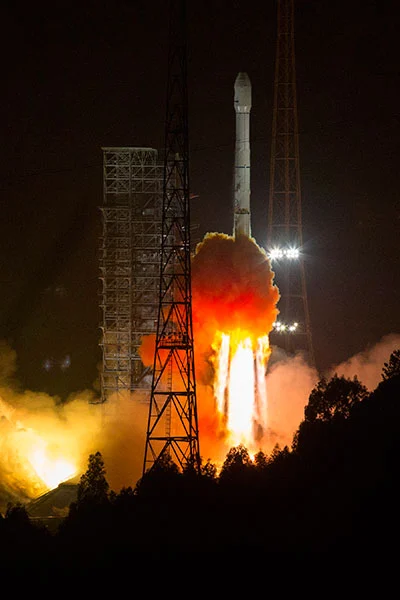
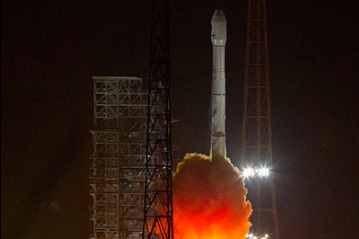
A groundbreaking moment in international space collaboration unfolded in the early hours of Monday with the successful launch of Algeria’s first communications satellite, Alcomsat-1, by China from the Xichang Satellite Launch Center in Sichuan province. This milestone marks not only Algeria’s entry into the satellite communications era but also represents China’s significant stride in exporting its advanced satellite technology to Arab nations, solidifying its position as a key player in the global space industry. The launch, carried out by a powerful Long March 3B carrier rocket, precisely placed Alcomsat-1 into its intended geostationary transfer orbit, a crucial step in its journey to providing vital communication services for the North African nation.
A New Era for Algerian Communications and Connectivity
The successful deployment of Alcomsat-1 heralds a new chapter for Algeria, promising to revolutionize its telecommunications infrastructure and enhance the delivery of essential public services. The satellite, designed and manufactured by the China Academy of Space Technology, a subsidiary of the China Aerospace Science and Technology Corporation, is built upon the robust DFH-4 satellite platform. This platform is renowned for its reliability and advanced capabilities, mirroring the technological prowess of leading Western counterparts.
With a substantial liftoff weight of 5.2 metric tons and a projected operational lifespan of 15 years, Alcomsat-1 is poised to become a cornerstone of Algeria’s national development strategy. Its diverse service portfolio will encompass critical areas such as television broadcasting, enabling wider reach and improved quality for Algerian media. Furthermore, it will bolster emergency communications, ensuring rapid and reliable connectivity during natural disasters or other critical events, a vital asset for a nation prone to various environmental challenges. The satellite’s capabilities will also extend to remote education, bridging geographical divides and bringing educational opportunities to underserved regions, and satellite-based signal augmentation, enhancing the precision of navigation and positioning systems.
Diplomatic Endorsement and Strategic Partnership
The significance of this successful mission was underscored by the exchange of congratulatory messages between the heads of state of both nations. Chinese President Xi Jinping and Algerian President Abdelaziz Bouteflika acknowledged the successful launch as a testament to the deepening bilateral relationship between their countries.
President Xi emphasized that the Alcomsat-1 project is a concrete manifestation of the comprehensive strategic partnership between China and Algeria. He highlighted its role as a prime example of space cooperation between China and Arab countries, projecting its substantial contribution to Algeria’s economic and social development. Xi further expressed Beijing’s readiness to enhance exchanges and cooperation across various sectors, aiming to deepen the bilateral partnership for the mutual benefit of both nations and their peoples.
President Bouteflika echoed these sentiments, describing Alcomsat-1 as a remarkable achievement in space cooperation and a reflection of the profound traditional friendship between Algeria and China. He affirmed Algeria’s commitment to strengthening this cooperative bond. This diplomatic endorsement underscores the strategic importance placed on this endeavor by both governments, recognizing its potential to foster economic growth, technological advancement, and enhanced national security.
A Chronology of Collaboration and Technical Prowess
The journey to Alcomsat-1’s successful launch involved several years of dedicated effort and collaboration. The foundational agreement for this ambitious project was signed in December 2013 between the Algerian Space Agency and China Great Wall Industry Corp. This marked the formal commencement of a significant collaboration aimed at equipping Algeria with advanced space capabilities.
China Great Wall Industry Corp, a prominent entity in the international space market and China’s largest space contractor, played a pivotal role as the project contractor. Their expertise in managing complex space missions and their established relationship with international partners were instrumental in bringing the project to fruition. The satellite itself was a product of the China Academy of Space Technology, showcasing China’s indigenous capabilities in satellite design and manufacturing.
The selection of the DFH-4 platform was a strategic decision, reflecting its proven track record and adaptability for various mission requirements. This platform is a testament to China’s ongoing investment in its space program and its commitment to developing sophisticated, exportable satellite technology.
Supporting Data and Technological Comparisons
The technical specifications of Alcomsat-1 place it firmly within the competitive global satellite market. Its 5.2-metric-ton liftoff weight is comparable to many modern communications satellites, indicating a substantial payload capacity. The 15-year designed life suggests a long-term commitment to providing uninterrupted services, a crucial factor for national infrastructure.
Fu Zhiheng, vice-president of China Great Wall Industry Corp, provided further insight into the satellite’s capabilities, asserting that Alcomsat-1 is technologically and capacity-wise on par with Western communications satellites. This assertion is significant, as it directly addresses potential concerns about the performance and reliability of Chinese-manufactured space assets compared to those from established Western providers. While not elaborating on specific contracts, Fu Zhiheng’s statement also hints at a broader strategy by China Great Wall Industry Corp to expand its reach within the Arab world, suggesting that Alcomsat-1 may be the first of many such collaborations.
The global satellite market is a highly competitive arena, with key players like Thales Alenia Space, Airbus Defence and Space, and Maxar Technologies dominating the landscape. China’s increasing success in exporting satellites like Alcomsat-1 signifies a shift in this dynamic, offering competitive pricing, reliable technology, and a strategic partnership approach that appeals to emerging spacefaring nations. The value of the global satellite manufacturing market was estimated to be around $25 billion in 2022, with significant growth projected in the coming years driven by demand for telecommunications, Earth observation, and navigation services. Algeria’s investment in Alcomsat-1 is a strategic move to tap into these global trends and leverage space technology for national advancement.
Broader Implications for Space Diplomacy and Economic Development
The successful launch of Alcomsat-1 has far-reaching implications beyond the immediate benefits to Algeria. For China, it represents a significant step in its "Belt and Road Initiative," particularly its "Digital Silk Road" component, which aims to expand digital infrastructure and connectivity globally. By providing advanced satellite technology, China is not only fostering economic ties but also enhancing its geopolitical influence and establishing itself as a reliable partner in space exploration and application.
For Algeria, this partnership offers a path to leapfrog technological barriers and accelerate its development trajectory. Access to reliable satellite communications can stimulate economic growth by facilitating e-commerce, improving financial services, and supporting emerging industries. In the realm of public services, it can revolutionize healthcare delivery through telemedicine, enhance educational outreach, and improve disaster management capabilities, all of which are crucial for a nation striving for sustained development.
The success of Alcomsat-1 also serves as a model for other Arab nations looking to develop their own space capabilities. It demonstrates that sophisticated space technology is accessible through international cooperation, fostering a sense of shared progress and ambition within the region. This collaborative approach can lead to a more interconnected and technologically advanced Middle East and North Africa.
Furthermore, the launch underscores the increasing democratization of space technology. As costs decrease and technological capabilities advance, more nations are able to participate in the space sector, moving beyond the traditional dominance of a few spacefaring superpowers. This trend promises to unlock new avenues for innovation, scientific discovery, and global problem-solving.
The Alcomsat-1 mission is more than just the launch of a satellite; it is a symbol of evolving international relations, technological prowess, and a shared vision for a more connected and developed future. As Alcomsat-1 begins its operational life, its success will undoubtedly pave the way for further collaborations, strengthening the bonds between China, Algeria, and the broader Arab world in the exciting domain of space.


 Nana Wu
 Suro Senen