Reynand Wu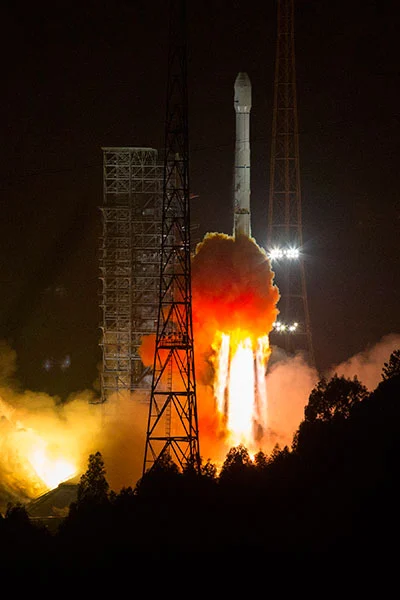
A pivotal moment in international space cooperation and Algeria’s national development unfolded on Monday, December 11, 2017, as China successfully launched Alcomsat-1, Algeria’s first communications satellite. This historic event, carried out from the Xichang Satellite Launch Center in the southwestern province of Sichuan, not only marked a significant technological leap for the North African nation but also solidified China’s position as a leading provider of advanced space technology to the global market, particularly within the Arab world. The launch, executed by a Long March 3B carrier rocket, placed the 5.2-metric-ton satellite into geostationary transfer orbit after a flight lasting approximately 26 minutes, ushering in a new era of digital connectivity and strategic autonomy for Algeria.
The Historic Launch: A New Era of Connectivity
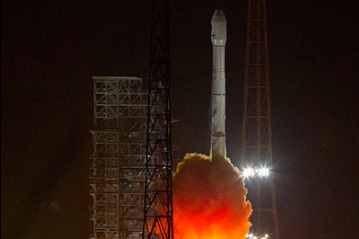
The launch sequence commenced precisely at 12:40 AM Beijing time, as the towering Long March 3B rocket ignited its powerful engines, illuminating the night sky over Xichang. Spectators and mission control personnel watched intently as the rocket ascended, carrying the meticulously engineered Alcomsat-1. The successful deployment into geostationary transfer orbit was confirmed shortly thereafter by the China Great Wall Industry Corp (CGWIC), the primary contractor for the project. This critical phase involved the satellite reaching an elliptical orbit where it would then use its own propulsion system to maneuver into its final geostationary position approximately 36,000 kilometers above the equator. Once operational in this orbit, Alcomsat-1 would appear stationary relative to the Earth’s surface, providing continuous coverage to its designated service areas.
The mission’s success was not merely a technical triumph but a testament to years of collaborative effort between Chinese and Algerian engineers and space agencies. For Algeria, a nation with vast geographical expanses and a significant portion of its population residing in remote areas, a dedicated communications satellite represented a crucial step towards bridging the digital divide and enhancing national infrastructure. The project underscored a shared vision for technological advancement and mutual development, becoming a tangible symbol of the "comprehensive strategic partnership" between the two nations.
Alcomsat-1: Technical Specifications and Capabilities
Alcomsat-1 is a state-of-the-art communications satellite, designed and manufactured by the China Academy of Space Technology (CAST), a subsidiary of the larger China Aerospace Science and Technology Corp (CASC). Its architecture is based on the highly reliable DFH-4 (Dongfanghong-4) satellite platform, a well-proven bus that has been the backbone for numerous Chinese and international communication satellites. The DFH-4 platform is renowned for its high power, long lifespan, and versatile payload capabilities, making it suitable for a wide range of telecommunications services.
Weighing 5.2 metric tons at liftoff, Alcomsat-1 was engineered for a robust operational life of 15 years, a standard duration for modern geostationary communication satellites, ensuring long-term service provision. Its payload includes a combination of Ku-band and Ka-band transponders, frequencies optimized for high-throughput data transmission. These capabilities enable Alcomsat-1 to support a diverse array of public services, critical for Algeria’s socio-economic development:
- Television Broadcasting: Providing direct-to-home (DTH) television services, expanding access to national and international content, particularly in regions where terrestrial broadcasting infrastructure is limited or non-existent.
- Emergency Communications: Establishing resilient communication channels during natural disasters, critical for coordinating relief efforts, search and rescue operations, and maintaining contact with affected populations. This capability is vital for a country susceptible to various environmental challenges.
- Remote Education: Facilitating distance learning programs, extending educational opportunities to students in rural and underserved areas, and supporting the establishment of virtual classrooms. This has significant implications for human capital development.
- Telemedicine: Enabling remote medical consultations, diagnostics, and data transfer, improving healthcare access and quality for communities far from major medical centers.
- Satellite-Based Signal Augmentation: Enhancing the accuracy and reliability of navigation systems (like GPS) through augmentation signals, crucial for applications in aviation, maritime transport, and precision agriculture.
- Broadband Internet Access: Providing essential internet connectivity to regions lacking terrestrial fiber optic or cellular infrastructure, fostering digital inclusion and economic participation.
- National Security and Defense: Offering secure and independent communication channels for government and military operations, enhancing national sovereignty and strategic autonomy.
Fu Zhiheng, Vice-President of China Great Wall Industry Corp, emphasized that Alcomsat-1 stands technologically on par with Western communications satellites in terms of both capacity and performance. This assertion underscores China’s competitive edge in the global satellite market, challenging the traditional dominance of European and American manufacturers.
A Strategic Partnership: China and Algeria in Space
The successful launch of Alcomsat-1 is deeply rooted in the long-standing and robust diplomatic relationship between China and Algeria. The two nations share a history of strong ties, dating back to Algeria’s war of independence, where China was one of the first non-Arab countries to recognize the Provisional Government of the Algerian Republic. This historical bond has evolved into a "comprehensive strategic partnership," a high-level diplomatic designation that signifies extensive cooperation across political, economic, and cultural spheres.
Space cooperation, specifically the Alcomsat-1 project, serves as a prime example of this deepening partnership. The satellite contract was officially signed in December 2013 between the Algerian Space Agency (ASAL) and China Great Wall Industry Corp (CGWIC), signifying a deliberate and strategic decision by Algeria to partner with China for this critical national infrastructure project. This choice reflected not only China’s competitive pricing and advanced technological offerings but also the trust built over decades of bilateral engagement. The project was not merely a commercial transaction but a collaborative endeavor involving significant knowledge transfer and training for Algerian personnel, contributing to the development of Algeria’s indigenous space capabilities.
Algeria’s Digital Ambitions and Space Strategy
For Algeria, the acquisition and operation of Alcomsat-1 represents a cornerstone of its national development strategy and a significant step towards achieving digital sovereignty. Prior to this launch, Algeria largely relied on foreign-owned or leased satellite capacity to meet its telecommunications needs. This dependence carried implications for cost, security, and the ability to tailor services precisely to national requirements.
The Algerian Space Agency (ASAL), established in 2002, has been instrumental in shaping the nation’s long-term space strategy. ASAL’s mandate includes developing national space capabilities, promoting scientific research, and utilizing space technology for socio-economic development. Alcomsat-1 aligns perfectly with these objectives, providing an independent platform to:
- Enhance National Sovereignty: Reducing reliance on foreign providers for critical communications infrastructure.
- Bridge the Digital Divide: Extending internet and communication services to remote and rural areas, fostering inclusive growth.
- Boost Economic Development: Supporting sectors such as e-banking, e-commerce, and logistics through improved connectivity.
- Improve Public Services: Revolutionizing education, healthcare, and disaster management through reliable satellite communication.
- Foster Local Expertise: The collaborative nature of the project involved training Algerian engineers and technicians in satellite operations, ground station management, and data utilization, building a foundation for future indigenous space endeavors.
The satellite is expected to play a transformative role in Algeria’s vision for a connected and digitally empowered society, providing direct benefits to millions of citizens and facilitating government and commercial operations across its vast territory.
China’s Ascendance in Commercial Space
The Alcomsat-1 launch is also a significant milestone for China’s burgeoning commercial space industry and its broader geopolitical objectives. China has aggressively pursued a strategy of becoming a major player in the global space market, offering competitive, high-quality satellite and launch services. This initiative is closely tied to its ambitious Belt and Road Initiative (BRI), which seeks to connect countries through infrastructure development, trade, and technological cooperation. Space infrastructure, including communication satellites, earth observation satellites, and navigation systems, forms a crucial component of the "Space Silk Road" aspect of the BRI.
China’s space program, historically focused on domestic needs and scientific exploration, has increasingly pivoted towards commercialization and international partnerships. The DFH-4 platform, in particular, has become a flagship export product, demonstrating China’s ability to compete with established Western satellite manufacturers like Boeing, Airbus, and Thales Alenia Space. The success of Alcomsat-1, being the first "export" of such a spacecraft to an Arab country, serves as a powerful demonstration of China’s technological maturity and reliability.
This success is expected to open doors for further space cooperation with other nations in the Middle East and Africa, regions where China is actively expanding its economic and diplomatic influence. Fu Zhiheng’s cryptic remark about "other contracts between his firm and Arab countries" further hints at a growing pipeline of such projects, signaling China’s strategic intent to become a dominant force in these emerging space markets.
Project Timeline: From Contract to Orbit
The journey of Alcomsat-1 from concept to operational satellite was a multi-year endeavor, characterized by meticulous planning, design, manufacturing, and testing:
- December 2013: The contract for Alcomsat-1 is officially signed between the Algerian Space Agency (ASAL) and China Great Wall Industry Corp (CGWIC) in Beijing, formalizing the partnership and setting the project in motion. This marked the beginning of detailed requirements definition and preliminary design phases.
- 2014-2016: The design and manufacturing phase takes place at the China Academy of Space Technology (CAST) facilities. This period involves extensive engineering work, component procurement, assembly, and rigorous testing of the satellite’s various subsystems, including the structural, thermal, power, propulsion, and payload modules. Algerian engineers reportedly participated in various stages, fostering knowledge transfer.
- Early 2017: The fully assembled Alcomsat-1 undergoes comprehensive environmental testing, including thermal vacuum tests, vibration tests, and acoustic tests, to simulate the harsh conditions of launch and space. These tests are crucial to ensure the satellite’s resilience and operational integrity.
- Late 2017 (Pre-Launch): The satellite is transported to the Xichang Satellite Launch Center. Here, it undergoes final checks, fueling operations, and integration with the Long March 3B carrier rocket. Ground control segments in Algeria are simultaneously being finalized and tested to ensure readiness for satellite operations.
- December 11, 2017: The Long March 3B rocket, carrying Alcomsat-1, successfully blasts off from Xichang, placing the satellite into geostationary transfer orbit.
- Post-Launch (Weeks following): Alcomsat-1 performs a series of critical orbital maneuvers, using its own thrusters to raise its perigee and circularize its orbit until it reaches its final geostationary position. This is followed by a period of in-orbit testing (IOT) to verify the performance of all its communication payloads and subsystems before it is declared fully operational and handed over to ASAL.
Presidential Endorsement and Diplomatic Significance
The successful launch elicited immediate and high-level diplomatic reactions, underscoring the strategic importance of the project. Chinese President Xi Jinping and his Algerian counterpart, Abdelaziz Bouteflika, exchanged congratulatory messages on the day of the launch, highlighting the profound significance of the achievement for bilateral relations.
President Xi Jinping, in his message, emphasized that the Alcomsat-1 project was "an important manifestation of the China-Algeria comprehensive strategic partnership." He lauded it as "a good example of space cooperation between China and Arab countries" and predicted its "significant role in promoting Algeria’s economic and social development." Xi reiterated China’s commitment to strengthening exchanges and cooperation with Algeria across various fields, with the aim of deepening the bilateral partnership for the mutual benefit of both countries and their peoples. His statement positioned the satellite not just as a technological artifact but as a cornerstone of deeper diplomatic and economic ties, aligning with China’s broader "community of shared future for mankind" vision.
President Bouteflika, in his reciprocal message, hailed Alcomsat-1 as a "remarkable achievement in space cooperation" and a reflection of the "deep traditional friendship" between Algeria and China. His words conveyed Algeria’s profound appreciation for China’s partnership and expressed a willingness to further strengthen cooperation. For Algeria, the satellite symbolized national pride, technological advancement, and a strategic investment in its future.
These presidential exchanges underscore that the Alcomsat-1 project transcends a mere commercial transaction; it is a geopolitical statement, demonstrating a deepening alignment between China and Algeria and setting a precedent for future South-South cooperation in advanced technological domains.
Broader Implications: Economic, Social, and Geopolitical
The successful deployment and operation of Alcomsat-1 carry far-reaching implications for Algeria, China, and the broader region.
For Algeria:
- Economic Growth: Enhanced connectivity is a catalyst for economic diversification, supporting the growth of digital industries, improving logistics, and attracting foreign investment.
- Social Development: Improved access to education, healthcare, and information empowers citizens, particularly in remote areas, contributing to a more equitable society.
- National Security: Independent and secure communication channels are vital for defense, border control, and internal stability, enhancing national sovereignty.
- Regional Leadership: Alcomsat-1 positions Algeria as a leader in space technology within North Africa, potentially fostering regional collaboration and expertise.
For China:
- Market Penetration: Alcomsat-1 serves as a strong reference for China’s satellite export capabilities, boosting its credibility and competitiveness in the global market, especially in developing economies.
- Belt and Road Initiative: The project strengthens the "Space Silk Road" component of the BRI, deepening technological and economic ties with partner countries.
- Technological Validation: It validates the performance and reliability of Chinese-designed satellite platforms like DFH-4, enhancing China’s reputation as a high-tech provider.
- Geopolitical Influence: By providing critical infrastructure, China solidifies its influence and goodwill in key regions like North Africa and the Arab world, complementing its economic and diplomatic outreach.
Regional and Global Impact:
- African Space Market: The success of Alcomsat-1 could inspire other African nations to pursue similar independent satellite programs, potentially increasing demand for Chinese space services.
- South-South Cooperation: It reinforces the model of technology transfer and capacity building between developing nations, challenging traditional North-South dynamics in space technology.
- Competition in Space Industry: China’s growing capabilities intensify competition within the global commercial space industry, potentially leading to more innovation and competitive pricing for satellite services worldwide.
Future Prospects and Market Dynamics
The Alcomsat-1 project represents more than just a single satellite launch; it is a foundational step in a long-term strategic partnership. Algeria is likely to continue investing in its space program, building upon the expertise gained from this collaboration. Future endeavors could include additional communication satellites, earth observation satellites for resource management and environmental monitoring, or even participation in regional space initiatives.
For China, the success of Alcomsat-1 is a powerful marketing tool. The "DFH-4 platform" has become a brand synonymous with reliability and advanced capabilities in the international market. The insights gained from the Alcomsat-1 project, particularly in tailoring solutions for specific national needs and navigating international regulatory frameworks, will be invaluable as China seeks to expand its footprint in the global satellite export market. The company’s vice-president’s hint about other contracts with Arab countries suggests a clear strategy to replicate this success across the region and beyond, further cementing China’s role as a pivotal player in the commercial space arena of the 21st century. The launch of Alcomsat-1 is thus not an isolated event but a significant indicator of evolving global technological landscapes and international partnerships.


 Muslim
 Laily UPN