
 Ammar Sabilarrohman
China has taken a significant step toward codifying its judicial oversight framework with the release of the draft Law on Procuratorial Public Interest Litigation, a comprehensive legislative effort designed to safeguard national interests and the collective rights of the public. This draft law, which originates from constitutional principles, aims to standardize the roles of the People’s Procuratorates and People’s Courts in handling cases ranging from environmental protection to data privacy. By establishing a dedicated legal structure, the Chinese government seeks to bridge gaps in existing procedural laws while providing a robust mechanism for administrative accountability and social justice.
The legislation arrives at a pivotal moment in China’s legal evolution. For nearly a decade, public interest litigation has operated as a subset of broader civil and administrative procedure laws. This new standalone law marks the transition from a pilot-driven experimental phase to a mature, specialized system of governance. It explicitly defines the boundaries of prosecutorial power, ensuring that while the state acts as a "guardian of the public interest," it does so without infringing upon the lawful rights of individuals, businesses, or the functional autonomy of administrative agencies.
A New Framework for Public Interest Protection
The draft law is structured into six chapters, covering general provisions, jurisdiction, investigation procedures, trial standards, enforcement, and supplementary rules. At its core, Article 1 emphasizes that the law is grounded in the Constitution, with the dual purpose of protecting the national interest and regulating the activities of the procuratorate. This underscores a balanced approach: empowering prosecutors to act against illegality while imposing strict procedural limits to prevent overreach.
Article 3 of the draft provides an expansive list of areas where the People’s Procuratorate is mandated to intervene. These are divided into administrative and civil categories. Under administrative public interest litigation, the procuratorate may sue government organs that fail to perform their regulatory duties or exercise their authority unlawfully. The scope includes:
- Ecological environment and resource protection
- Food and drug safety
- State-owned asset protection and land usage rights
- Production safety and workplace standards
- The rights of vulnerable groups, including minors, women, the elderly, and the disabled
- National defense interests and the rights of military personnel
- Telecommunications fraud and cultural heritage protection
- The promotion of ethnic unity
In the civil sphere, the law targets natural and legal persons whose actions harm the public interest. Notably, it expands the procuratorate’s reach into modern challenges such as anti-monopoly enforcement, large-scale labor rights violations, and personal information protection. By including these "new areas," the legislation reflects the complexities of a digital and market-oriented economy.
Chronology of the Public Interest Litigation System
The development of this draft law is the culmination of a decade-long legal journey. Understanding the timeline is essential to grasping the significance of the current legislative push:
- 2015: The Pilot Phase. The Standing Committee of the National People’s Congress (NPC) authorized a two-year pilot program for procuratorial public interest litigation in 13 provincial-level regions. This period tested the feasibility of prosecutors suing administrative organs.
- 2017: Codification in Procedural Laws. Following the success of the pilot, the Civil Procedure Law and the Administrative Litigation Law were amended to officially grant procuratorates the power to initiate public interest lawsuits.
- 2018–2022: Incremental Expansion. Special provisions were added to various substantive laws, such as the Heroes and Martyrs Protection Law (2018) and the Personal Information Protection Law (2021), allowing prosecutors to intervene in these specific domains.
- 2023–2024: The Standalone Law Initiative. Recognizing that scattered provisions led to procedural inconsistencies, the NPC prioritized the creation of a unified Law on Procuratorial Public Interest Litigation to provide a "one-stop" procedural manual for courts and prosecutors.
Strengthening Investigation and Procedural Rigor
One of the most critical aspects of the draft law is Chapter III, which outlines the powers and limitations of the procuratorate during the investigation phase. Article 16 grants prosecutors the power to collect evidence, but Article 17 sets a firm boundary: they may not employ "compulsory measures" such as physical detention or the freezing of assets. This distinction is vital, as it separates public interest litigation—a restorative and corrective process—from criminal prosecution.
The draft emphasizes a "protection first" and "coordinated governance" approach. Article 14 introduces a significant "administrative first" principle: if the public interest can be effectively protected by urging an administrative organ to perform its duties, the procuratorate should not file a civil lawsuit against a private party. This encourages the government to fix problems internally before resorting to the courtroom.
The pre-litigation process is further refined in Articles 22 and 23. Before filing an administrative lawsuit, the procuratorate must issue a "procuratorial recommendation" to the relevant government agency. The agency then has a set period—usually 60 days, though reduced to 15 days in emergencies—to correct its behavior. Only if the agency refuses to act or the harm persists does the case proceed to trial. Data from the Supreme People’s Procuratorate suggests that over 90% of public interest issues are resolved at this "recommendation" stage, highlighting the efficiency of this non-adversarial mechanism.
Judicial Standards and the Burden of Proof
When cases do reach the courtroom, the draft law establishes clear trial standards. Article 36 distributes the burden of proof: in administrative cases, the procuratorate must prove the agency’s illegality or inaction. In civil cases, they must prove the defendant’s unlawful conduct and the resulting harm to the public.
A unique feature of the trial process is the inclusion of mediation. Article 38 allows for mediated settlements in civil public interest cases, provided they are voluntary and do not harm the public interest. To ensure transparency, any mediation agreement must be publicized for at least 30 days to allow for public feedback. This "sunlight" provision prevents "backroom deals" that might sacrifice the public good for the sake of a quick settlement.
Furthermore, the law addresses the protection of "Heroes and Martyrs." Article 28 requires prosecutors to consult with the families of the deceased before initiating litigation. If the family wishes to sue personally, the procuratorate may "support" the litigation rather than lead it, respecting the private rights of the kin while maintaining a state-backed safety net.
Enforcement and Global Reach
The draft law introduces "teeth" to ensure that court judgments are not merely symbolic. Article 48 allows the court to appoint third-party institutions to perform remediation work (such as environmental cleanup) if the defendant refuses to do so, with the defendant bearing all costs. Article 49 permits the court to use media announcements and public apologies as a form of civil liability, particularly in cases involving reputation or honor.
In a move reflecting China’s increasing legal assertiveness on the global stage, Article 51 extends the law’s reach to foreign organizations and individuals. If foreign entities carry out acts that infringe upon China’s national interest or social public interest, the People’s Procuratorate is empowered to initiate litigation. This provision aligns with international trends where states seek to protect their interests against cross-border environmental damage or digital fraud.
Analysis of Implications and Stakeholder Reactions
The release of this draft has prompted reactions from legal scholars and administrative bodies. Most experts agree that the law provides much-needed clarity. By defining the "9+5" scope of cases (nine specific areas plus five civil categories), the law reduces the risk of "procedural drift" where prosecutors might intervene in areas beyond their expertise.
However, some administrative organs have raised concerns regarding Article 19, which mandates that all units and individuals must cooperate with procuratorial investigations. The draft attempts to mitigate this by allowing agencies to report "assistance disputes" to higher-level authorities or supervision organs, creating a system of internal checks and balances.
From a social perspective, the inclusion of "legally designated groups" like the elderly and disabled (Article 3) is seen as a major victory for social welfare advocates. It allows the state to step in when systemic failures—such as inaccessible public infrastructure or widespread consumer fraud targeting the elderly—occur, providing a level of protection that individual litigation often fails to achieve due to high costs and limited resources.
Conclusion and Future Outlook
The Law on Procuratorial Public Interest Litigation represents a sophisticated evolution of the Chinese legal system. By codifying the "China Model" of public interest litigation—which emphasizes administrative self-correction followed by judicial intervention—the draft law seeks to create a more harmonious relationship between the state, the public, and the law.
As the draft moves through the final stages of review by the National People’s Congress, its impact is expected to be profound. It will likely lead to an increase in high-quality litigation in complex fields like anti-monopoly and data privacy, while streamlining the resolution of environmental and resource disputes. For businesses and administrative organs, the message is clear: the era of "public interest blindness" is ending, replaced by a rigorous, transparent, and constitutionally-grounded system of accountability. The final enactment of this law will provide the definitive legal blueprint for protecting the "common wealth" of the Chinese people in the 21st century.


 Asep Darmawan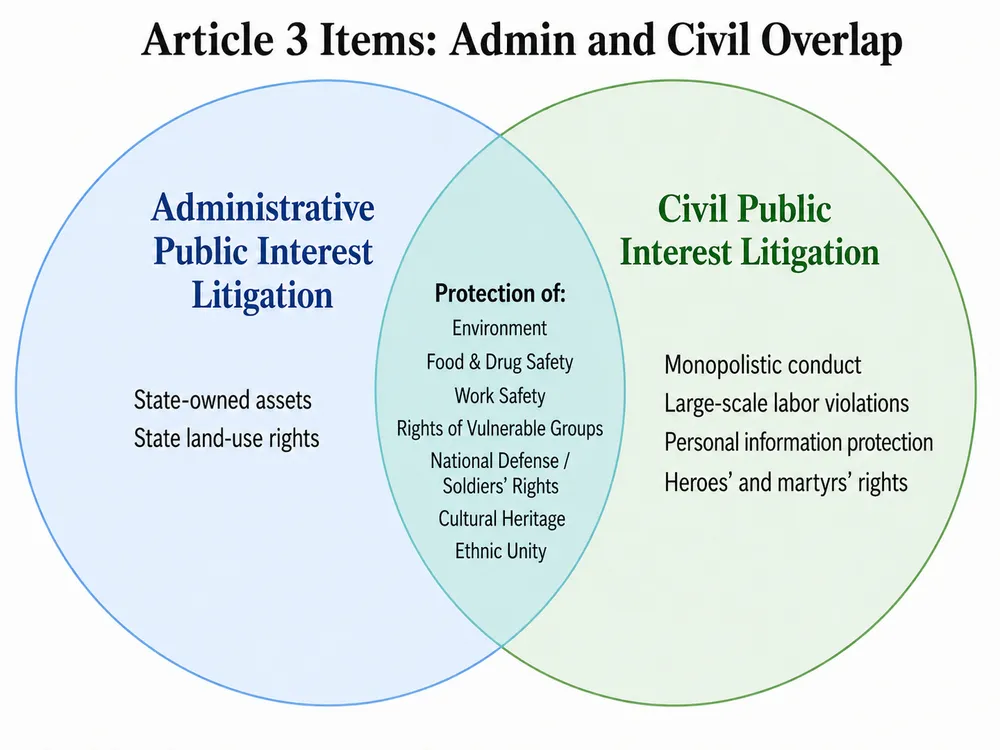
 Suro Senen