Laily UPN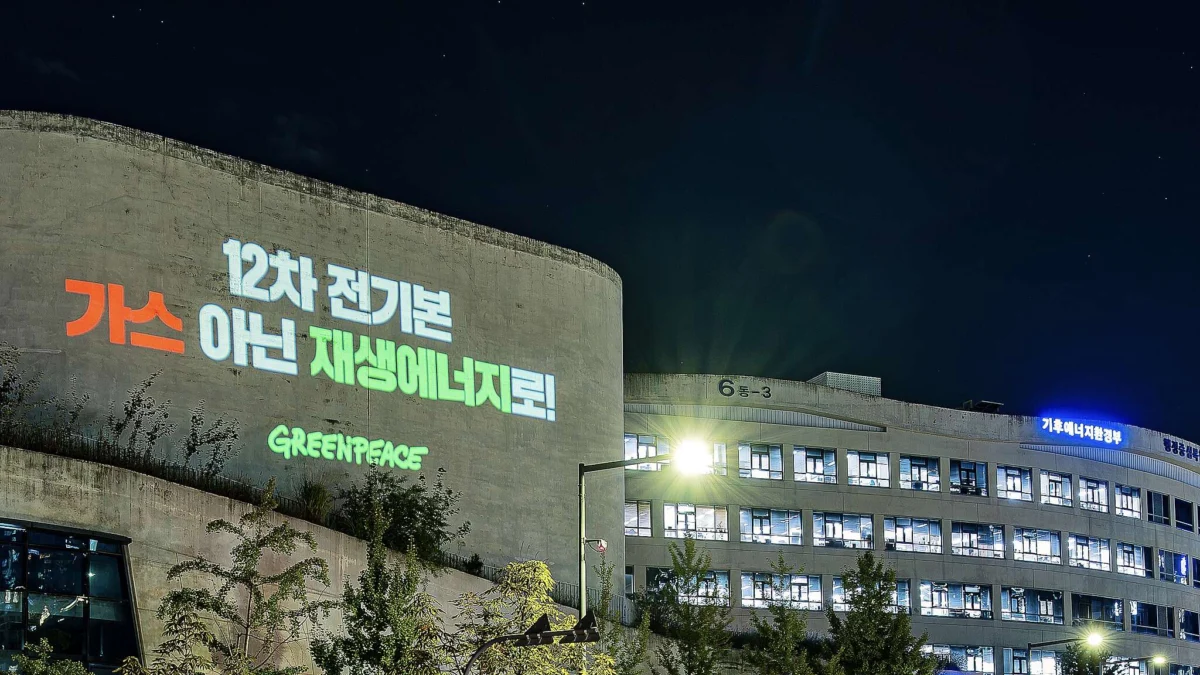
Despite South Korea’s ambitious target to expand its renewable energy capacity to 220 gigawatts (GW) by 2040, a new report indicates that incorporating the substantial power demand from upcoming industrial mega-projects into the nation’s 12th Basic Plan for Electricity Supply and Demand will render the achievement of its Nationally Determined Contribution (NDC) carbon reduction goals virtually impossible. The findings highlight a critical juncture for the country’s energy transition, suggesting that current planning may inadvertently lead to increased reliance on fossil fuels, particularly natural gas, thereby undermining climate commitments.
The comprehensive study, titled Alternative Scenarios for Power Sector Decarbonization, was released by the international environmental organization Greenpeace East Asia in collaboration with the civil society network Korea Beyond Fossil Fuels (KBF). Conducted by the energy research institute PLANIT, the analysis employed the open-source Python for Power System Analysis (PyPSA) model to meticulously examine various power sector pathways. By optimizing grid operations and buildout costs against the backdrop of the 11th Basic Plan for Electricity Supply and Demand, the study assessed the potential emissions impacts of different development scenarios.
Key Findings and Emissions Projections
The core of the report’s alarming conclusions lies in its projection that integrating the significant power demands of mega-projects will cause power sector emissions to far exceed South Korea’s NDC target cap of 56 million tonnes of carbon dioxide equivalent (MtCO2e). This grim outlook persists even under the assumption of a complete phase-out of coal-fired power plants. The study’s modeling indicates that natural gas generation would need to be heavily expanded to compensate for the retirement of coal power and to meet the additional load from these large-scale industrial developments.
The PLANIT analysis modeled two specific demand increase scenarios, reflecting projections from the 12th Basic Plan Committee’s August announcement. This announcement anticipated a demand increase of between 26.6 and 26.8 GW over prior baselines, largely driven by the new industrial initiatives. The report’s scenarios considered an additional demand of 20 GW and 30 GW, respectively.
| Scenario | Gas Capacity (GW) | Gas Generation (TWh) | Renewable Capacity (GW) | Renewable Generation (TWh) | Emissions (MtCO2e) | Comparison to NDC Target |
|---|---|---|---|---|---|---|
| Coal Phaseout (No mega demand, 15% gas utilization cap) | 33 | 44 | 249 | 359 | 37 | Two-thirds of target |
| + 20GW Mega Demand | 33 | 208 (▲164) | 280 | 363 (▲4) | 84 | 1.5 times the target |
| + 30GW Mega Demand | 33 | 224 (▲180) | 344 | 441 (▲82) | 90 | 1.6 times the target |
Note: ▲ indicates increase from the "Coal Phaseout" baseline scenario.
The data clearly illustrates a dramatic surge in gas power generation under both mega-project demand scenarios. When a 30 GW demand surge is factored in, gas power generation is projected to skyrocket nearly fivefold, from 44 TWh in the baseline coal phaseout scenario to an estimated 224 TWh. This represents an increase of approximately 180 TWh. Consequently, greenhouse gas emissions are forecast to reach around 90 MtCO2e, which is a staggering 1.6 times the NDC target. This outcome necessitates lifting the 15% capacity factor restriction on gas power plants to meet the immense demand. Even under a less extreme 20 GW additional demand scenario, gas generation still sees a substantial 4.7-fold increase to 208 TWh, pushing emissions to 84 MtCO2e, or 1.5 times the targeted limit.
Expert Analysis and Urgent Policy Recommendations
Jahyeon Kim, Energy Transition Team Lead at PLANIT, underscored the critical findings, stating, "The finding that additional mega-project demand is met primarily by gas power demonstrates that expanding renewables alone won’t deliver real carbon reductions without strict regulations on gas generation. To prevent the phase-out of aging coal plants from simply leading to reliance on gas—another fossil fuel—a decisive policy shift is urgently required, such as halting the construction of new gas-fired power plants and capping gas utilization rates to redefine gas power strictly as a peaking resource."
Kim’s statement highlights a crucial paradox: the move away from coal, a primary goal for decarbonization, could be inadvertently replaced by an increased dependence on natural gas, which, while cleaner than coal, remains a significant source of greenhouse gas emissions. The report advocates for a fundamental reclassification of gas power’s role, positioning it strictly for intermittent peak demand rather than as a consistent baseload or intermediate load source.
Background: South Korea’s Energy Policy Landscape
South Korea has been actively pursuing a transition towards cleaner energy sources. The 11th Basic Plan for Electricity Supply and Demand (2020-2034) outlined a strategy to reduce reliance on coal and nuclear power while significantly increasing the share of renewables. This plan aimed to achieve a substantial reduction in greenhouse gas emissions from the power sector, aligning with international climate agreements. The target of 220 GW of renewable energy capacity by 2040 is a testament to this commitment.
However, the emergence of large-scale industrial projects, often referred to as "mega-projects," has introduced a new layer of complexity. These projects, which could include semiconductor manufacturing complexes, data centers, or advanced manufacturing facilities, are expected to require immense and continuous power supply. The planning process for the upcoming 12th Basic Plan for Electricity Supply and Demand is currently underway, and how it accounts for this projected surge in demand is of paramount importance.

Environmental Organizations’ Criticism and Calls to Action
Greenpeace East Asia and Korea Beyond Fossil Fuels have been vocal critics of the current trajectory, warning that the government’s reliance on gas expansion is antithetical to its climate goals. Minju Shin, Climate and Energy Campaigner at Greenpeace East Asia, expressed strong reservations about the government’s stated intentions.
"Despite the government’s target of expanding 220GW of renewables by 2040, mega-project demand has flashed a red light for carbon reduction goals," Shin stated. "In particular, remarks by Climate, Energy and Environment Minister Kim Sung-hwan claiming that gas expansion is unavoidable contradict both the 11th Basic Plan’s decision to reduce LNG reliance from 26.8% to 10.6%, as well as the NDC itself."
Shin’s criticism points to a potential policy drift, where perceived immediate needs for industrial development are overriding long-term climate objectives. The contradiction with the 11th Basic Plan’s stated aim to reduce LNG reliance is particularly concerning, suggesting a possible backsliding on established decarbonization strategies.
Furthermore, Shin urged for a more rigorous and transparent approach to the 12th Basic Plan’s development. "To prevent the upcoming 12th Basic Plan from deteriorating into a blueprint for megaproject-driven carbon emissions, it is imperative to rigorously examine whether the projected demand for these megaprojects has been overstated," she added. "Expanding gas power must not be accepted as a foregone conclusion without verifying demand forecasts and assessing alternative scenarios utilizing renewables and energy storage systems (ESS). The 12th Basic Plan must be thoroughly grounded in actionable pathways for renewable energy expansion and carbon neutrality to ensure the NDC targets are achieved."
This call for a thorough re-evaluation of demand forecasts and the exploration of alternatives like renewable energy and advanced energy storage systems (ESS) is central to the environmental groups’ advocacy. They emphasize that a robust energy transition requires not just increased renewable capacity but also strategic planning that prioritizes emissions reduction and minimizes reliance on fossil fuels, even for bridging gaps.
Implications for South Korea’s Climate Commitments
The findings of the Greenpeace and KBF report carry significant implications for South Korea’s international climate standing and its domestic energy security. Failure to meet NDC targets could result in reputational damage and potential pressure from international bodies. Domestically, a continued reliance on fossil fuels, even natural gas, could lead to increased price volatility, dependence on imported fuels, and slower progress towards a sustainable energy future.
The report’s analysis suggests that the country is at a critical juncture. The decisions made regarding the 12th Basic Plan for Electricity Supply and Demand will likely shape South Korea’s energy landscape for decades to come. The challenge lies in balancing the imperative for industrial growth and energy security with the urgent need to decarbonize the economy and combat climate change. The call for stringent regulations on gas generation, a halt to new gas plant construction, and a thorough verification of demand forecasts presents a clear pathway for policymakers to consider as they navigate this complex energy transition.
Visual Representation of Concerns
Illustrating the urgency of their message, Greenpeace projected a powerful visual onto the exterior wall of the Ministry of Climate, Energy and Environment at the Government Complex Sejong. The projection, featuring an image of a smog-filled sky, served as a stark reminder of the potential environmental consequences of continued reliance on fossil fuels and a direct appeal for a more aggressive expansion of renewable energy and a reduction in gas-fired power generation within the framework of the 12th Basic Plan for Long-Term Electricity Supply and Demand. This public demonstration underscores the growing public and environmental pressure on the government to align its energy policies with its stated climate ambitions.
Media Contact Information
For further information or media inquiries regarding this report and its findings, please contact:
Euihyun Choi, Communications Officer, Greenpeace Korea
Email: [email protected]
Phone: +82 10-5950-0369

 Evan Lee Salim
 Ammar Sabilarrohman