Lina Irawan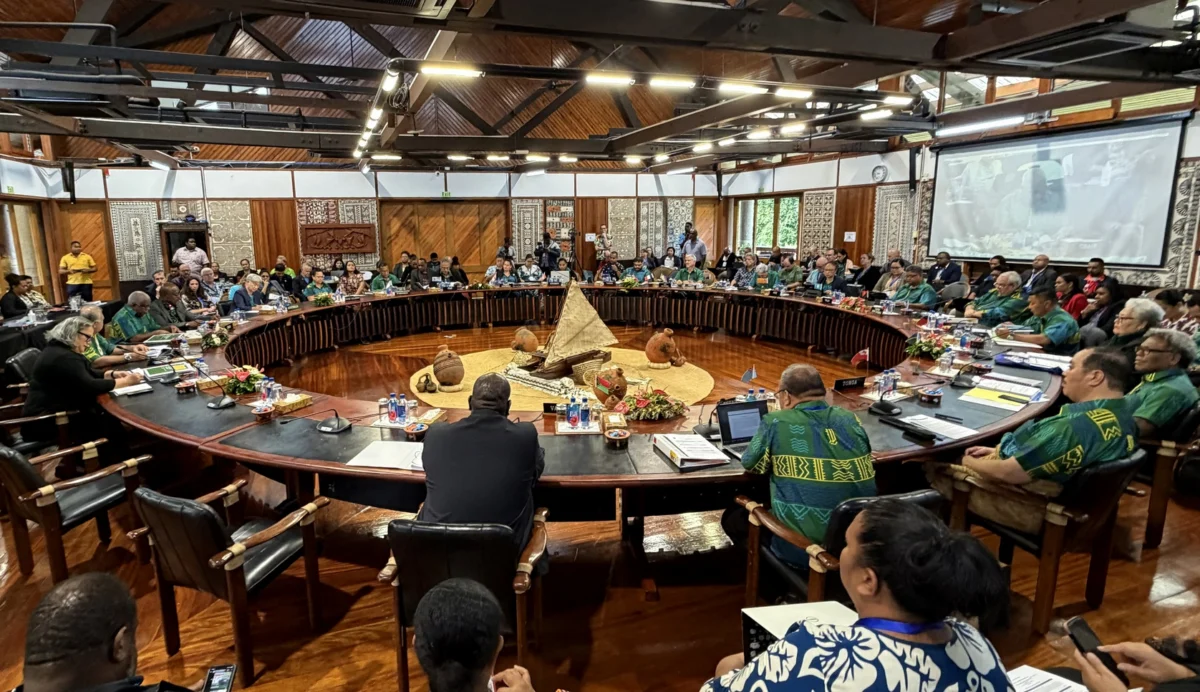
Pacific diplomats gathered in Fiji failed on Friday to agree on a joint statement condemning China’s recent test of a nuclear-capable missile in the region, exposing deep divisions within the 18-member Pacific Islands Forum (PIF) and drawing sharp criticism from New Zealand’s foreign minister, who accused some nations of appeasing "outsiders." The inability to forge a unified response underscores the complex geopolitical landscape of the Pacific, where traditional allies and an assertive China are vying for influence, placing immense pressure on smaller island nations. The contentious meeting, held in Suva, Fiji, highlighted the delicate balance member states must strike between economic partnerships and regional security concerns, particularly in the wake of a provocative display of military might by a major global power.
The recent test, involving an intercontinental ballistic missile (ICBM), saw Beijing provide only a handful of nations with short notice before the launch, a move that has been widely interpreted as a flexing of its military capabilities and a clear signal of its expanding strategic reach into a critical maritime domain. Monitors reported that the rocket appeared to land in an expanse of ocean situated between the Solomon Islands, Nauru, and Tuvalu. This location, within the exclusive economic zones (EEZs) of sovereign Pacific nations, immediately triggered alarm bells for several regional leaders, who viewed the act as a potential infringement on sovereignty and a direct threat to regional stability. Despite these individual condemnations, the PIF, the region’s premier political and economic policy organization, found itself deadlocked, unable to issue a formal collective response.
New Zealand’s outspoken Foreign Minister, Winston Peters, emerged from the hours-long meeting to confirm the failure to achieve a consensus on a joint statement. While he refrained from explicitly naming the two member states that had reportedly blocked the statement, diplomatic sources indicated that China-friendly nations, specifically Kiribati and Nauru, were understood to have expressed little interest in formally criticising one of their significant economic and development partners. Peters did not mince words, telling journalists, "They didn’t actually lay out any reasons apart from their disagreement." He went on to accuse these nations of capitulating to the "wishes of outside partners, rather than those that belong to the Pacific Islands Forum." In a thinly veiled but pointed criticism directed at China, Peters added, "We made it very clear that we do not think that outsiders should be telling the insiders — that’s us who have been here for thousands of years — what our position should be." This statement encapsulated the growing sentiment among some traditional Pacific powers that external actors are increasingly dictating the regional agenda, undermining the forum’s autonomy and collective interests.

Background and Geopolitical Stakes in the Pacific
The Pacific Islands region, often described as a "great ocean," holds immense strategic value due to its vast maritime territories, critical shipping lanes, and abundant natural resources. For decades, it has been a sphere of influence for Western powers, particularly Australia, New Zealand, and the United States, which have strong historical, cultural, and economic ties to the island nations. These traditional relationships have largely shaped the region’s security architecture and development pathways. However, in recent years, China has significantly increased its engagement across the Pacific, offering substantial aid, infrastructure development loans, and security cooperation, leading to what many analysts describe as a new "Great Game" for influence. This intensified geopolitical competition forms the backdrop for the PIF’s current internal struggles and its difficulty in presenting a unified front.
China’s growing footprint includes investments in ports, communication networks, and other critical infrastructure projects, which, while offering much-needed development to small island developing states (SIDS), also raise concerns among Western nations about potential debt traps and the creation of dual-use facilities that could serve military purposes. The 2022 security pact between China and the Solomon Islands, for instance, sent ripples of apprehension across Canberra, Wellington, and Washington, highlighting the potential for Beijing to establish a military presence in the South Pacific, disrupting the existing regional balance of power. This evolving dynamic means that issues of sovereignty, resource control, and regional security are increasingly intertwined with the economic lifelines offered by competing global powers. The PIF, established in 1971, aims to foster regional cooperation and address common challenges, but its consensus-based decision-making process makes it particularly vulnerable to external pressures and internal divisions, especially when powerful non-member states exert influence through economic or political leverage.
Moreover, the Pacific Islands nations are on the frontline of climate change, facing existential threats from rising sea levels and extreme weather events. This vulnerability often means they are desperate for development assistance and infrastructure, which China is readily providing, sometimes with fewer strings attached than traditional donors. This economic imperative can sometimes overshadow security concerns, creating a complex decision-making environment for island leaders. The historical legacy of nuclear testing in the Pacific by former colonial powers further amplifies sensitivities around any military activity involving nuclear-capable weapons, making China’s recent missile test particularly resonant and alarming for many.

The Missile Test: A Timeline of Provocation and Impact
The missile test occurred "last month," preceding the August 7, 2026, PIF meeting in Suva. While specific details about the exact date of the launch were not widely disseminated, the nature of the weapon – a nuclear-capable intercontinental ballistic missile – and its trajectory across vast swathes of the Pacific Ocean underscore its strategic significance. Such tests are typically conducted to validate missile systems, improve targeting accuracy, and demonstrate a nation’s military readiness. For China, it represents a clear signal of its growing long-range strike capabilities, a key component of its military modernization efforts aimed at projecting power globally.
Crucially, the rocket’s impact zone, "somewhere between Solomon Islands, Nauru and Tuvalu," placed it in close proximity to the sovereign territories and maritime zones of these island nations. Tuvalu, a low-lying atoll nation with a population of approximately 11,000, explicitly stated that it had not received prior notification of the test, raising serious questions about maritime safety, environmental impact, and adherence to international protocols. Pasuna Tuaga, Tuvalu’s Permanent Secretary of Foreign Affairs, Labour and Trade, articulated the nation’s distress on the sidelines of the Fiji talks. "We don’t want to be intimidated by any powers," Tuaga asserted, emphasizing, "That’s not the way that we want to be treated." He stressed Tuvalu’s desire for a robust, collective statement from the Pacific as an "intercollective," believing such a unified stance would "strengthen our position" against future unilateral actions by external powers. Tuaga further revealed that the missile had landed "somewhere very close" to Tuvalu and that his country had already requested assistance from multiple powers, including the United States and China, in locating the dummy warhead. This request highlights both the immediate practical concerns for maritime safety and the broader implications for international cooperation and accountability following such an event.
The lack of comprehensive pre-notification for a missile test of this magnitude, particularly one that traverses international waters adjacent to sovereign nations, is a contentious issue under international law. While states generally have the right to conduct military exercises in international waters, customary international law and various conventions emphasize the need for due regard for the interests of other states, including safety of navigation and fishing. China’s decision to provide only limited notice to a "handful of nations" suggests a calculated move that prioritized military objectives over regional diplomatic sensitivities and established international norms. This action is perceived by many as a challenge to the established rules-based international order and an assertion of unilateral power.

Official Responses and Regional Discord
The failure of the PIF to issue a joint condemnation has exposed the fault lines within the regional body, illustrating the challenges of achieving consensus in a geopolitically charged environment. New Zealand’s Foreign Minister Winston Peters’s strong denunciation of "outsiders meddling" in Pacific affairs resonates with a segment of the forum that views China’s increasing influence with apprehension. Peters’s reference to "us who have been here for thousands of years" underscores a narrative of indigenous Pacific identity and sovereignty, contrasting it with external pressures that threaten the region’s autonomy. New Zealand, along with Australia, has historically played a significant role in Pacific security and development, often advocating for a "Pacific-led" approach to regional issues, a principle that they believe is undermined by such external interference.
Australia’s Foreign Minister Penny Wong, while acknowledging the PIF’s internal dynamics, expressed hope that China would take note of the "very clear response" already sent from the Pacific concerning the test. She noted that "the majority of the Pacific Islands Forum did express concerns over China’s ballistic missile test," indicating that while a formal joint statement was blocked, a significant number of member states were indeed troubled by China’s actions. This suggests that the opposition to a joint statement was limited to a few key members, rather than a widespread endorsement of China’s test, reflecting a broader regional unease even if it couldn’t be formally articulated.
The motivations of Kiribati and Nauru in blocking the statement are complex and multifaceted. Both nations have significant and growing economic ties with China. Kiribati, for example, switched diplomatic recognition from Taiwan to Beijing in 2019, a move that was followed by substantial Chinese investment and aid packages. Nauru also benefits from Chinese development projects and economic engagement. For these smaller nations, the economic benefits and diplomatic leverage offered by Beijing can often outweigh the geopolitical concerns raised by larger regional players or the potential for alienating a powerful and generous partner. Their calculus likely involves a careful balancing act between maintaining sovereignty and securing much-needed development assistance, even if it means diverging from a unified regional stance on sensitive security matters that could jeopardize those partnerships.

Tuvalu’s position as a diplomatic ally of Taiwan further complicates the situation. Taiwan maintains official diplomatic relations with a dwindling number of sovereign states globally, with several of these being in the Pacific (including Palau, Marshall Islands, and Tuvalu). For these nations, a strong stance against Beijing’s actions, particularly those that directly impact their territory or security, is often seen as a reflection of their broader foreign policy alignment and a commitment to democratic values, frequently supported by Taiwan and its allies like the U.S. This alignment makes them less amenable to Chinese pressure and more inclined to seek collective security responses.
Broader Impact and Future Implications
The inability of the Pacific Islands Forum to present a united front on a significant security issue like China’s missile test carries several profound implications for the region and its geopolitical future.
Firstly, it highlights the fragmentation of regional unity. The PIF’s strength lies in its ability to speak with a collective voice on issues of common concern, whether it be climate change, maritime security, or sustainable development. When this unity is fractured, it weakens the forum’s leverage on the international stage and makes individual member states more susceptible to bilateral pressures from external powers. This division could embolden China to continue its assertive actions, perceiving a lack of unified regional opposition and potentially encouraging further bilateral agreements that bypass regional consensus.

Secondly, it underscores the intensity of geopolitical competition. The incident serves as a stark reminder of the ongoing rivalry between China and Western powers (primarily the US, Australia, and New Zealand) in the Pacific. The failure to condemn China could be interpreted by Beijing as a diplomatic victory, or at least a sign that its influence is sufficient to prevent a collective regional backlash. Conversely, it will likely prompt Western allies to redouble their efforts to engage with and support Pacific island nations, emphasizing shared democratic values, security partnerships, and alternative development pathways to counter China’s growing footprint.
Thirdly, there are significant implications for regional security and sovereignty. A nuclear-capable missile test in the vicinity of sovereign island nations, even without a live warhead, raises legitimate fears about environmental contamination, disruption to traditional fishing grounds, and the potential for miscalculation or accidental debris impact. The lack of adequate notification is a direct challenge to the principle of state sovereignty and the expectation of transparency in international military activities. Tuvalu’s call for assistance in locating the dummy warhead illustrates the practical security challenges posed by such tests, requiring resources and expertise that many small island nations do not possess.
Looking ahead, the divisions manifested in Suva will undoubtedly cast a long shadow over the upcoming full leaders’ meeting of the Pacific Islands Forum, scheduled for September 2026 in Palau. Palau, an archipelago of hundreds of islands approximately 800 kilometers (497 miles) west of the Philippines, is one of the few nations that maintains diplomatic relations with Taiwan. This makes the host nation itself a potential flashpoint for China-Taiwan diplomatic maneuvering, reminiscent of past controversies. Last year, the Solomon Islands banned all partner nations from attending the leaders’ meeting in Honiara in response to China demanding Taiwan be excluded. New Zealand’s Peters had, at that time, also accused "outsiders" of meddling in the summit. The current impasse over the missile test suggests that the debate over which key partners should be allowed to attend future meetings will remain highly contentious, further testing the forum’s cohesion and its ability to chart an independent course.
The incident also highlights the enduring legacy of nuclear issues in the Pacific. The region has a painful history of nuclear testing by colonial powers, leaving behind environmental scars and health crises that persist to this day. Any activity involving nuclear-capable weapons, even a test of a delivery system, inevitably stirs deep-seated anxieties and sensitivities among Pacific peoples. The desire for a nuclear-free Pacific, a long-standing aspiration articulated in treaties like the Treaty of Rarotonga (South Pacific Nuclear Free Zone Treaty), is directly challenged by such displays of power, forcing the region to confront a renewed era of strategic competition.

Ultimately, the failure of the PIF to issue a joint condemnation of China’s missile test is more than a diplomatic hiccup; it is a symptom of the profound transformations underway in the Pacific. It reveals the growing difficulty for small island nations to navigate the competing demands of global powers, balancing their sovereign interests with the imperative for economic development and regional stability. The "Pacific family" rhetoric, often invoked to emphasize unity and shared values, faces its sternest tests as external pressures continue to reshape the region’s political and security landscape. The path forward for the PIF will require careful diplomacy, a renewed commitment to consensus, and potentially, a re-evaluation of how it addresses the challenges posed by an increasingly assertive world.

 Iffa Jayyana
 Jia Lissa