Sagoh
Sagoh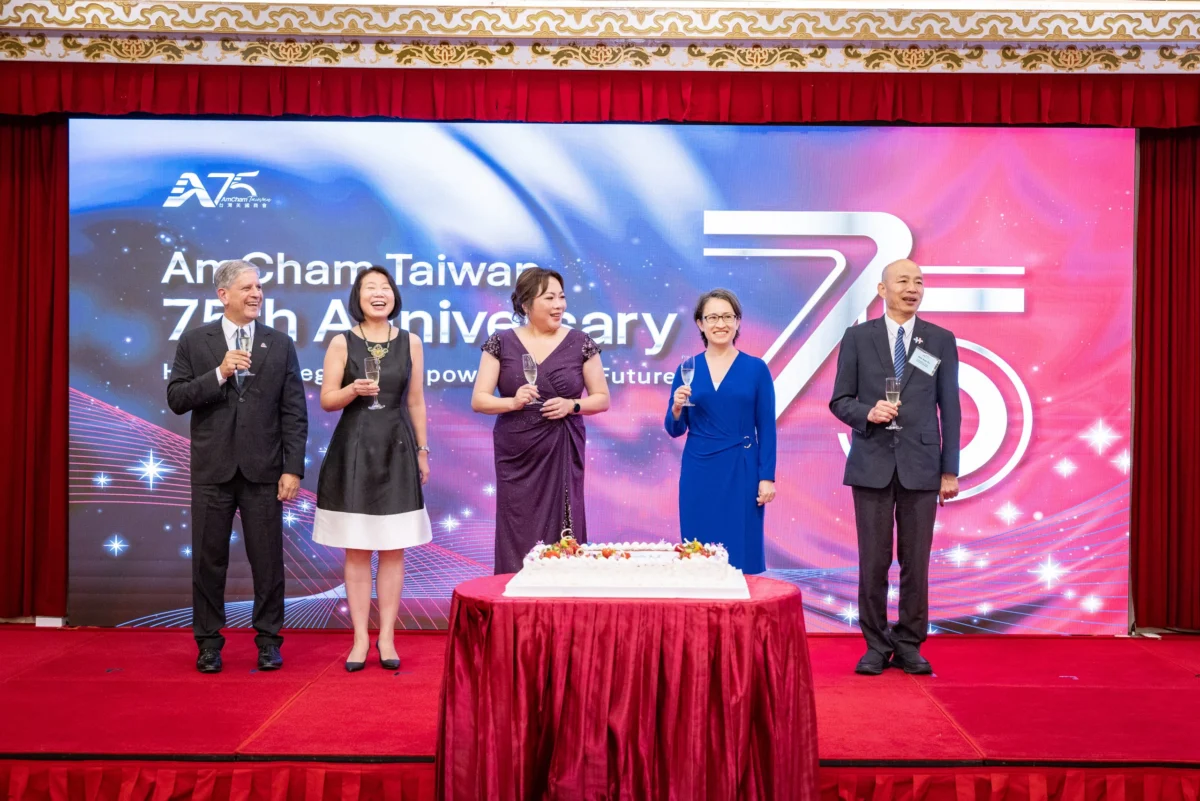
The American Chamber of Commerce in Taiwan (AmCham Taiwan) reached a historic milestone this week, marking three-quarters of a century as a cornerstone of the island’s economic landscape. The 75th-anniversary celebration, held at the prestigious International Reception Room of the Taipei Grand Hotel, served as both a reflection on decades of shared prosperity and a strategic roadmap for the future of U.S.-Taiwan commercial relations. Under the theme “Honoring the Legacy, Empowering the Future,” the event drew a distinguished assembly of nearly 200 guests, including senior government officials, diplomatic representatives, and captains of industry, all gathering to acknowledge the Chamber’s pivotal role in transforming Taiwan into a global economic powerhouse.
Since its inception in 1951, AmCham Taiwan has evolved from a small collective of American business pioneers into one of the most influential and respected international business organizations in the world. Today, it represents roughly 1,150 members from more than 540 companies, spanning sectors from semiconductor manufacturing and financial services to green energy and digital technology. The anniversary event highlighted how this membership base has not only witnessed Taiwan’s "Economic Miracle" but has actively participated in the regulatory and structural reforms that made such growth possible.
A Legacy of Economic Diplomacy and Advocacy
The 75th-anniversary proceedings were anchored by a sense of historical gravity. Guests were greeted by a "75th Anniversary History Wall," an expansive installation featuring rare photographs and archival materials that traced the Chamber’s journey. The timeline began in 1951, a period when Taiwan was primarily an agrarian society recovering from the aftermath of World War II. In those early years, AmCham served as a vital link for American firms navigating a nascent market, providing the ground-level intelligence and networking necessary for the first wave of foreign direct investment.

As the decades progressed, the Chamber’s role shifted from basic networking to sophisticated advocacy. In the 1990s, AmCham launched two of its most enduring and impactful initiatives: the annual "Washington Doorknock" and the "Taiwan White Paper." The Washington Doorknock involves high-level delegations of business leaders traveling to the U.S. capital to brief members of Congress, the State Department, and the Department of Commerce on the strategic importance of the Taiwan-U.S. economic relationship. Simultaneously, the annual White Paper has become a definitive guide for the Taiwan government, offering constructive recommendations on regulatory transparency, labor laws, and industry-specific hurdles.
AmCham’s advocacy reached a high-water mark in the early 2000s when it vigorously supported Taiwan’s accession to the World Trade Organization (WTO) in 2002. This move was instrumental in integrating Taiwan into the global rules-based trading system, paving the way for the island to become the indispensable link in global technology supply chains it is today.
High-Level Recognition: Vice President Bi-khim Hsiao’s Address
The significance of the occasion was underscored by the presence of Vice President Bi-khim Hsiao, whose participation highlighted the deep institutional ties between the Chamber and the highest levels of the Taiwan government. In her special address, Vice President Hsiao praised AmCham for its proactive approach to problem-solving. She noted that the Chamber has never merely been a bystander but has consistently identified systemic challenges and proposed viable, market-oriented solutions that benefit both foreign investors and domestic enterprises.
“Our relationship is strong because it is built on shared interests, shared values, and increasingly, shared investments in each other’s future,” Hsiao remarked to the gathered delegates. She emphasized a fundamental shift in the nature of U.S.-Taiwan cooperation. “We are no longer simply buying or selling from each other, because we are actually building together.”

This "building together" philosophy refers to the deepening integration of supply chains, particularly in the semiconductor and high-tech sectors. As major Taiwanese firms like TSMC expand their manufacturing footprint in the United States, and American tech giants like Google, Microsoft, and NVIDIA increase their R&D investments in Taiwan, the two economies have become functionally inseparable. Hsiao’s remarks suggested that the next 75 years will be defined by "co-production" and joint innovation in emerging fields such as Artificial Intelligence (AI) and renewable energy.
The "Golden Age" of U.S.-Taiwan Relations
Adding to the official accolades, Raymond Greene, Director of the American Institute in Taiwan (AIT), provided pre-recorded video remarks. Director Greene, who represents the de facto U.S. embassy in Taipei, characterized the current state of bilateral economic ties as a “golden age.” He credited AmCham’s tireless engagement for creating a business environment that is increasingly attractive to American capital and talent.
“Over these decades, AmCham Taiwan has grown from a small group of business leaders into one of the most dynamic and respected chambers of commerce anywhere in the world,” Greene stated. He emphasized that the Chamber’s work transcends mere commerce, contributing directly to Taiwan’s global competitiveness and its status as a secure, reliable partner in an increasingly volatile geopolitical landscape.
The sentiment of a "golden age" is supported by recent trade data. Total bilateral trade in goods between the United States and Taiwan reached approximately $127.5 billion in 2023, with the U.S. maintaining its position as one of Taiwan’s most critical trading partners and a primary source of foreign investment. Furthermore, the ongoing negotiations under the U.S.-Taiwan Initiative on 21st-Century Trade signify a formal effort to standardize customs, regulatory practices, and anti-corruption measures, further solidifying the economic bridge that AmCham helped build.

Vision for the Future: Continuity and Transformation
AmCham Chairperson Anita Chen, in her welcoming speech, reflected on the Chamber’s resilience through various geopolitical and economic cycles. From the challenges of the 1970s to the digital revolution of the 2020s, the Chamber has remained a constant advocate for market liberalisation and the rule of law.
“From the launch of our annual Washington Doorknock visit and Taiwan White Paper in the 1990s, to our strong support for Taiwan’s accession to the World Trade Organization in 2002, to our push to revive trade and investment talks with the U.S., AmCham has both witnessed and helped shape some of the most consequential moments in Taiwan’s modern economic history,” Chen told the audience.
However, Chen was quick to note that the 75th anniversary is not merely a retirement party for old ideas. “Now, even on our 75th anniversary, AmCham has no intention of slowing down. We will continue to advocate vigorously for a better business environment and deeper U.S.-Taiwan relations.”
The future agenda for AmCham Taiwan is expected to focus on several key pillars:

- Energy Transition: Assisting Taiwan in meeting its "Net Zero 2050" goals by advocating for policies that support offshore wind, solar power, and smart grid technology.
- Digital Transformation: Promoting data privacy standards and cybersecurity frameworks that allow for the seamless flow of digital services between the U.S. and Taiwan.
- Talent Acquisition: Addressing the demographic challenges facing Taiwan by advocating for immigration reforms and education initiatives that attract and retain global talent.
- Regional Stability: Ensuring that Taiwan remains a central node in the "friend-shoring" strategies of democratic nations, thereby enhancing supply chain resilience.
Cultural Symbolism and Community Spirit
The event was not solely focused on policy and economics; it also celebrated the cultural and community ties that bind the American and Taiwanese people. A performance by the Taipei American School’s Opus Choir provided a poignant interlude, symbolizing the passing of the Chamber’s legacy to the next generation. The inclusion of the choir served as a reminder that the business community is part of a broader social fabric that includes educators, families, and students.
The choice of the Taipei Grand Hotel as a venue was also significant. Built in the 1950s—the same decade AmCham was founded—to host foreign dignitaries, the hotel’s traditional Chinese architectural style combined with its history as a hub for international diplomacy mirrored the "East meets West" nature of the Chamber itself.
Analysis: The Strategic Importance of the 75th Milestone
The 75th anniversary of AmCham Taiwan comes at a time of unprecedented global scrutiny of the Taiwan Strait. In this context, the Chamber serves a role that extends beyond traditional business lobbying; it acts as a stabilizing force. By maintaining a robust, transparent, and profitable business environment, AmCham ensures that the international community has a tangible stake in Taiwan’s continued security and autonomy.
The enrichment of the Taiwan-U.S. partnership, as described by Vice President Hsiao and Director Greene, is a multi-layered phenomenon. On one level, it is about the "hard" economics of semiconductor chips and trade balances. On another, it is about the "soft" power of institutional alignment. AmCham’s 75-year history is a record of Taiwan’s successful adoption of international best practices, which has made it a preferred destination for American companies looking to diversify away from more restrictive markets.

As the celebration concluded, the message from the Chamber was clear: the first 75 years were about building a foundation of trust and prosperity; the next 75 will be about navigating a complex, technology-driven future where the U.S.-Taiwan bond is more critical than ever. With a membership that continues to grow in both number and influence, AmCham Taiwan remains the vital bridge between Taipei and Washington, ensuring that the "Golden Age" of economic relations is not just a temporary peak, but a lasting plateau of cooperation.

 Lina Hope
 Evan Lee Salim