Lina Hope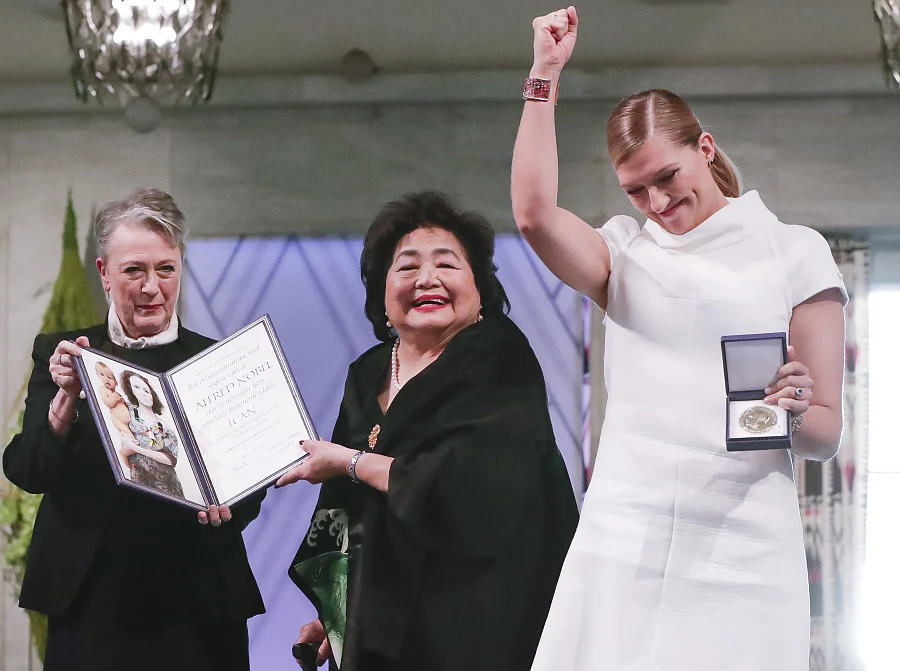
The International Campaign to Abolish Nuclear Weapons (ICAN) was honored with the prestigious 2017 Nobel Peace Prize on Sunday, December 10th, at a solemn ceremony held at the Oslo City Hall. The award recognized ICAN’s significant contributions in revitalizing global efforts towards the complete abolition of nuclear weapons. The ceremony saw Beatrice Fihn, the Executive Director of ICAN, and Setsuko Thurlow, a revered survivor of the 1945 atomic bombing of Hiroshima, accept the medal and diploma on behalf of the organization.
Berit Reiss-Andersen, the chairperson of the Norwegian Nobel Committee, articulated the committee’s rationale during her address. She stated that ICAN was being recognized for its "work to draw attention to the catastrophic humanitarian consequences of any use of nuclear weapons and for its ground-breaking efforts to achieve a treaty-based prohibition of such weapons." Reiss-Andersen emphasized that this year’s prize continued a long-standing tradition of Nobel Peace Prize awards that have championed the cause of non-proliferation and nuclear disarmament.
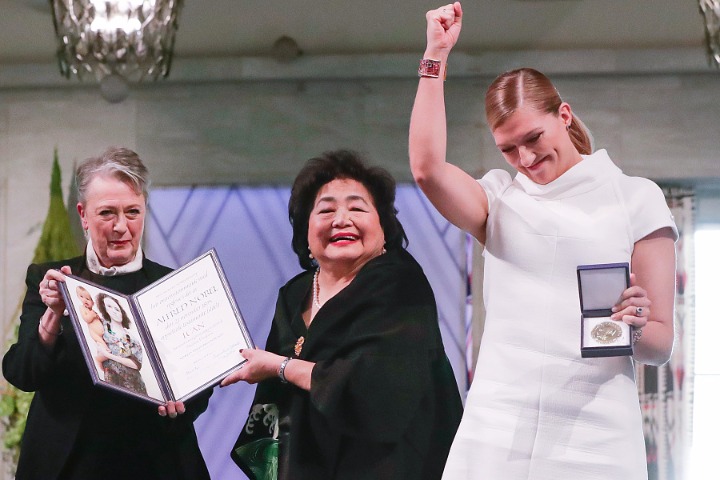
In their joint Nobel lecture, delivered with profound gravitas, Beatrice Fihn issued a compelling plea to all nations to actively contribute to the realization of a world free from nuclear weapons. She painted a stark picture of the current geopolitical landscape, noting that the risk of nuclear weapon use is arguably even greater today than it was at the close of the Cold War. Fihn elaborated on this heightened danger, highlighting the proliferation of nuclear-armed states, the persistent threat posed by terrorist organizations, and the emerging complexities of cyber warfare, all of which exacerbate the potential for catastrophic escalation.
Setsuko Thurlow, an 85-year-old survivor of the Hiroshima bombing, shared her deeply personal and harrowing experiences as a 13-year-old girl caught in the devastation of August 6, 1945. She recounted the immeasurable loss she endured, with eight of her family members and 351 of her schoolmates perishing in the blast and its immediate aftermath. Thurlow’s testimony served as a powerful and poignant reminder of the human cost of nuclear weapons, and she passionately urged for intensified global efforts to "forever eradicate the threat of nuclear annihilation."
ICAN, the recipient of this esteemed award, is a broad coalition comprising non-governmental organizations from approximately 100 countries. The campaign was formally launched in Austria in April 2007, and its operational headquarters are presently located in Geneva, Switzerland.

The Journey to Abolition: A Chronology of ICAN’s Impact
ICAN’s path to the Nobel Peace Prize is the culmination of years of dedicated advocacy, strategic campaigning, and a steadfast commitment to a nuclear-weapon-free world.
-
2007: Genesis of a Global Movement: The International Campaign to Abolish Nuclear Weapons was officially launched in Vienna, Austria, on April 23, 2007. The founding vision was to coordinate and amplify the voices of civil society organizations working towards nuclear disarmament. The initial years were marked by building a global network, raising awareness, and laying the groundwork for more ambitious initiatives.
-
2010-2014: Mobilizing for a Treaty: ICAN played a pivotal role in advocating for a new international treaty to prohibit nuclear weapons. This period saw intensified lobbying efforts directed at governments, highlighting the humanitarian imperative for such a legal instrument. The campaign organized numerous public events, awareness campaigns, and research initiatives to build political momentum.

-
2015: A Landmark Year for Humanitarian Impact: The campaign’s focus on the catastrophic humanitarian consequences of nuclear weapons gained significant traction. ICAN actively participated in and promoted the Oslo Conference on the Humanitarian Impact of Nuclear Weapons, followed by similar conferences in Nayarit, Mexico, and Vienna, Austria. These conferences were instrumental in shifting the discourse around nuclear weapons away from security doctrines and towards their devastating human and environmental implications.
-
2017: The Treaty on the Prohibition of Nuclear Weapons (TPNW): This was a watershed year for ICAN and the global disarmament movement. The United Nations General Assembly adopted the Treaty on the Prohibition of Nuclear Weapons (TPNW) on July 7, 2017, following a diplomatic conference convened at ICAN’s urging. The TPNW, a legally binding instrument, explicitly prohibits nuclear weapons, including their development, testing, production, stockpiling, stationing, transfer, use, and threat of use. ICAN was a driving force behind the negotiations and adoption of this historic treaty, mobilizing widespread support from civil society and a significant number of UN member states.
-
October 2017: Nobel Peace Prize Recognition: On October 6, 2017, the Norwegian Nobel Committee announced ICAN as the recipient of the 2017 Nobel Peace Prize. The committee cited ICAN’s "work to draw attention to the catastrophic humanitarian consequences of any use of nuclear weapons and for its ground-breaking efforts to achieve a treaty-based prohibition of such weapons." This award brought unprecedented global attention to the campaign and the urgent need for nuclear disarmament.

-
December 2017: Formal Award Ceremony: The official awarding ceremony took place on December 10, 2017, in Oslo, where Beatrice Fihn and Setsuko Thurlow accepted the prize, delivering powerful speeches that resonated across the globe.
Supporting Data: The Pervasive Threat of Nuclear Weapons
The awarding of the Nobel Peace Prize to ICAN underscores the persistent and grave threat posed by nuclear weapons to global security and humanity. Despite decades of disarmament efforts, a significant number of nuclear warheads remain in existence, and the risk of their use, whether by design, accident, or miscalculation, remains a tangible concern.
-
Nuclear Arsenals: As of early 2024, an estimated 12,000 nuclear warheads exist globally. The vast majority of these are held by nine states: the United States, Russia, China, France, the United Kingdom, Pakistan, India, Israel, and North Korea. Russia and the United States possess over 90% of the world’s nuclear weapons.

-
Proliferation Concerns: While some countries have dismantled their nuclear arsenals, concerns about nuclear proliferation persist. North Korea continues to develop its nuclear weapons program, and the potential for other states to acquire nuclear capabilities remains a destabilizing factor in international relations.
-
Humanitarian Consequences: The use of even a single nuclear weapon would have catastrophic humanitarian and environmental consequences. A moderate-yield nuclear detonation over a major city could result in hundreds of thousands of immediate deaths and injuries, widespread destruction, and long-term health effects such as radiation sickness and increased cancer rates. A large-scale nuclear exchange could trigger a "nuclear winter," a period of global cooling caused by atmospheric dust blocking sunlight, leading to widespread crop failure and famine.
-
The Treaty on the Prohibition of Nuclear Weapons (TPNW): As of early 2024, the TPNW has been ratified by over 70 states. However, none of the nuclear-armed states or their allies have joined the treaty. This highlights the significant political and diplomatic challenges that remain in achieving universal adherence and the complete elimination of nuclear weapons. The TPNW represents a significant normative shift, stigmatizing nuclear weapons and creating a legal framework for their prohibition, even if its immediate impact on the arsenals of nuclear-armed states is limited.

Official Responses and Reactions
The awarding of the Nobel Peace Prize to ICAN elicited a range of responses from governments and international organizations, reflecting the diverse perspectives on nuclear weapons and disarmament.
-
Supportive Governments: Many states that actively supported the negotiation and adoption of the TPNW welcomed the Nobel Committee’s decision. These nations, often referred to as "non-nuclear states," see the prize as a vindication of their efforts to advance humanitarian disarmament and a powerful endorsement of the TPNW. They often express hope that the award will further pressure nuclear-armed states to engage in disarmament negotiations.
-
Nuclear-Armed States and Allies: The response from nuclear-armed states and their allies has generally been more muted or critical. They often reiterate their reliance on nuclear weapons for deterrence and security and express concerns that the TPNW undermines existing arms control frameworks and NATO’s nuclear-sharing arrangements. Some have criticized the Nobel Committee’s decision, arguing that it does not reflect the complexities of international security and the realities of the current global landscape. For instance, a spokesperson for the U.S. State Department, at the time of the announcement, indicated that the U.S. does not support the TPNW and believes that progress on disarmament is best achieved through existing arms control treaties and through diplomatic engagement with nuclear-armed states.

-
United Nations and International Organizations: The United Nations Secretary-General and other international bodies have often expressed support for ICAN’s mission and the importance of nuclear disarmament. The awarding of the Nobel Peace Prize is typically seen as a positive development that raises global awareness and can galvanize further action.
-
Civil Society: The broader civil society, including peace organizations, humanitarian groups, and disarmament advocates, overwhelmingly celebrated ICAN’s recognition. They viewed the prize as a testament to the power of grassroots activism and a significant boost to the global movement for a nuclear-weapon-free world.
Broader Impact and Implications: A New Era for Disarmament?
The 2017 Nobel Peace Prize awarded to ICAN carries profound implications for the future of nuclear disarmament and international security. It signifies a global recognition of the humanitarian catastrophe that nuclear weapons represent and a powerful endorsement of the legal and normative framework provided by the Treaty on the Prohibition of Nuclear Weapons (TPNW).

The award has undeniably elevated the profile of ICAN and the TPNW on the international stage. It has provided a significant platform for advocating for the treaty’s universalization and for pressuring nuclear-armed states to engage more substantively in disarmament. The symbolic power of the Nobel Peace Prize is immense, lending moral authority to ICAN’s long-standing call for the abolition of nuclear weapons.
However, the path forward remains challenging. The TPNW, while a historic achievement, has not been signed or ratified by any of the nuclear-armed states or their close allies. This division in the international community underscores the deep-seated disagreements regarding the role of nuclear weapons in national security strategies. Critics argue that the TPNW, in isolation, does not adequately address the security concerns that drive states to possess nuclear weapons.
Nonetheless, the TPNW and ICAN’s work have introduced a new dimension to the disarmament discourse. By firmly anchoring the debate in the realm of humanitarian consequences, they have shifted the focus from purely strategic considerations to the existential threat posed by these weapons. This humanitarian approach has resonated with a large number of states and has created a strong normative pressure against nuclear weapons.

The Nobel Peace Prize has, in effect, injected renewed urgency and visibility into the disarmament agenda. It serves as a potent reminder that the continued existence of nuclear weapons represents an unacceptable risk to humanity. The challenge now lies in translating this heightened awareness and the normative power of the TPNW into tangible disarmament actions and a lasting peace. The ongoing efforts of ICAN and its global network of partners will be crucial in navigating the complex political landscape and in striving for a world where the shadow of nuclear annihilation is finally lifted.


 Nana Wu
 Suro Senen