Basiran
Southeast Asia’s automotive market, a long-held bastion of Japanese manufacturers like Toyota and Honda, is undergoing a seismic shift driven by the rapid ascent of electric vehicles (EVs). This dramatic transformation poses a critical question for established automakers: can they adapt swiftly enough to maintain their dominance in a rapidly evolving market? A recent online seminar, hosted by Greenpeace Japan on June 24th, delved into the burgeoning EV market in Indonesia and its profound implications for traditional Japanese automotive players, bringing together key experts to dissect the trends and challenges.
The event featured insights from Aditya Mahalana, a senior researcher at the International Council on Clean Transportation (ICCT), and Achmad Rofiqi, vice chairman of PR & Education at the Indonesian EV Industry Association (PERIKLINDO). Their discussions illuminated the unique trajectory of EV adoption in the region, highlighting Indonesia’s surprising leadership and the strategic imperatives for legacy automakers to navigate this new era of mobility.
Indonesia’s Unconventional EV Surge: A Middle-Income Powerhouse
The electric vehicle boom in Southeast Asia is defying conventional patterns of technological adoption. Typically, clean technologies gain traction first in wealthier economies before filtering into middle-income nations. However, in this instance, countries like Indonesia are embracing EVs at a pace that outstrips many more affluent nations. Mahalana attributed this phenomenon to the absence of deeply entrenched, legacy domestic auto industries in these middle-income economies. This lack of established players often translates into fewer political obstacles and import barriers, creating a more fertile ground for the introduction of affordable green transportation solutions.
Data from the ICCT Market Spotlight starkly illustrates this accelerated adoption. Indonesia’s EV sales have witnessed an extraordinary surge, leaping from fewer than 150 units in 2020 to over 22,000 units by the second quarter of 2025. This remarkable growth has propelled the nation’s total EV fleet beyond the 100,000-unit mark. By the second quarter of 2025, EVs constituted an impressive 15.2% of all passenger car sales, a figure bolstered by a substantial 40% increase in sales from the preceding quarter alone. This rapid expansion suggests a market that is not just adopting EVs but is rapidly integrating them into its mainstream transportation infrastructure.
The momentum behind Indonesia’s EV expansion is significantly fueled by its abundant natural resources. As the world’s largest nickel producer, accounting for approximately 40% of the global supply, Indonesia possesses a distinct advantage in the crucial supply chain for EV batteries. Rofiqi highlighted this strategic position, noting that the nation’s rich nickel reserves provide a natural springboard for developing and manufacturing essential battery components, a cornerstone of electric vehicle technology.
Furthermore, domestic demand is being stimulated by a confluence of factors. The introduction of more affordable EV models, coupled with lower running costs compared to traditional internal combustion engine vehicles, is proving increasingly attractive to consumers. Simultaneously, the expansion of charging infrastructure is addressing a key concern for potential EV buyers. By 2024, Indonesia boasted over 2,300 public charging stations spread across 300 cities, a significant development that has helped to shift EV adoption from a niche interest among early adopters to a viable option for the broader consumer base. This infrastructural development, combined with growing product availability and affordability, signals a maturing EV market in Indonesia.
New Entrants Reshape the Competitive Arena
This swift and transformative shift in consumer preference and technological adoption is fundamentally altering the competitive dynamics of the automotive sector in Southeast Asia. For decades, established Japanese brands such as Toyota, Honda, and Nissan enjoyed unchallenged dominance across the ASEAN market. Their success was built on a foundation of manufacturing prowess, extensive dealer networks, and deeply ingrained brand loyalty among consumers. While these legacy brands continue to hold significant market share in the conventional gasoline-powered vehicle segment, the electric vehicle landscape presents an entirely different narrative.
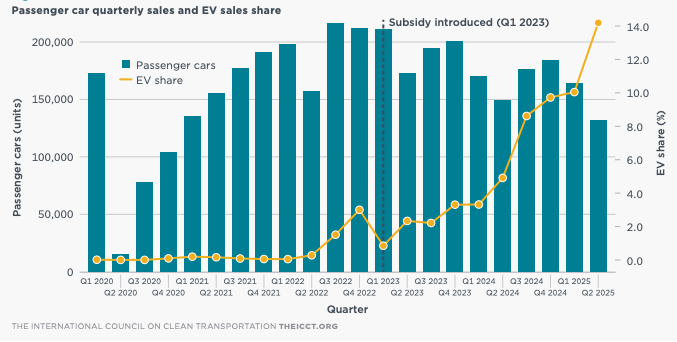
The void left by the slower adaptation of traditional automakers has been rapidly filled by new, agile competitors, most notably from China. Companies like BYD and SAIC’s Wuling have emerged as formidable forces, collectively capturing nearly 60% of all battery electric vehicle (BEV) sales in Indonesia, according to ICCT data. Their competitive edge extends far beyond aggressive pricing strategies. These automakers have invested heavily in vertically integrated battery supply chains, enabling them to control costs and ensure supply stability. They are also at the forefront of integrating advanced digital features and connectivity into their vehicles, appealing to a tech-savvy demographic. Perhaps most critically, they have demonstrated remarkably agile product development cycles, capable of bringing new EV models to market in as little as 12 to 18 months, a pace that traditional automakers often struggle to match. This rapid innovation cycle allows them to quickly respond to market demands and introduce cutting-edge technologies to consumers.
The Imperative for Japanese Automakers to Accelerate Their EV Pivot
"The rules of the competition are evolving. Companies that can adapt quickly will be positioned for long-term success," stated Rofiqi from PERIKLINDO, underscoring the urgent need for strategic recalibration within the established automotive industry.
Japanese automakers still possess considerable strengths, including world-class engineering expertise, a sterling reputation for safety and reliability, and decades of cultivated customer trust. However, to remain relevant in the face of this accelerating EV transition, a fundamental shift in strategy is required. Instead of focusing on defensive lobbying efforts that may seek to delay or dilute electrification mandates, these companies have a significant opportunity to lead the region towards a cleaner, more sustainable automotive future. This leadership can be achieved by prioritizing key areas for accelerated development and investment.
One critical area is the acceleration of EV product development. This involves not only introducing new EV models but also ensuring they meet the specific needs and preferences of the Southeast Asian market, including affordability, range, and suitability for local driving conditions. Secondly, localized strategies are paramount. This means adapting manufacturing, supply chains, and marketing efforts to cater to regional demands and regulatory environments. Deeper engagement with the burgeoning EV ecosystem, including battery manufacturers, charging infrastructure providers, and technology developers, is also crucial. Collaboration and partnership can foster innovation and accelerate the development of comprehensive EV solutions.

Rofiqi concluded by emphasizing that "The opportunity for Japanese automakers remains substantial… But maintaining leadership will require accelerated EV product development, localized strategies, and deeper engagement with the emerging EV ecosystem. The future does not have to be a competition between countries. It can be a collaboration that benefits the entire region." This vision suggests a path forward that prioritizes regional cooperation and shared progress in the transition to sustainable mobility.
Greenpeace’s Perspective: Linking Market Growth to Climate Imperatives
The rapid evolution of the automotive market, as discussed in the Greenpeace-hosted webinar, underscores a critical timeline for global climate action. For nations across Southeast Asia, the opportunity to bypass the long-entrenched internal combustion engine (ICE) paradigm represents a significant chance to prevent decades of future carbon lock-in. The International Energy Agency (IEA) global EV forecast indicates that the transition to electric mobility is no longer a question of "if" but "when," with global EV sales projected to reach an unprecedented 23 million vehicles this year. This massive shift is anticipated to displace up to 5 million barrels of oil per day by 2030, making it an indispensable component of the global effort to mitigate the escalating climate crisis.
Erin Eunseo Choi, Climate and Energy Campaigner at Greenpeace East Asia, articulated the urgency of this transition. "Indonesia’s rapid EV adoption proves the market is ready," Choi stated. "For legacy brands like Toyota, it exposes the real risk of the slow-walk strategies favored by traditional automakers. Relying on a defensive ‘multi-pathway’ approach that protects combustion engines and hybrids is no longer viable and is already costing them market share to faster competitors."
Choi further emphasized the immediate need for action, especially in light of geopolitical oil shocks and severe climate events such as those exacerbated by El Niño. "Amid geopolitical oil shocks and severe El Niño events this year, decarbonizing the transport sector through battery electric vehicles is urgent," she asserted. "Japanese automakers must accelerate their EV strategies and set ambitious greenhouse gas reduction targets to achieve substantial cuts in total emissions." This call to action highlights the interconnectedness of market dynamics, technological advancement, and the pressing need for decisive climate action from major industrial players. The future of automotive mobility in Southeast Asia, and indeed globally, hinges on the ability of all stakeholders to embrace innovation and prioritize sustainability.

 Asro
Asro
 Pevita Pearce