Jia Lissa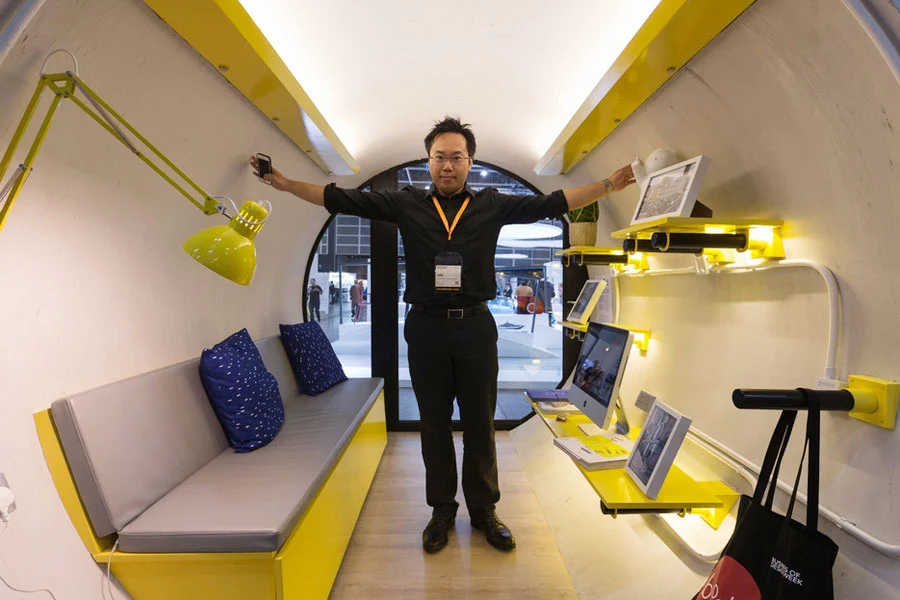
An experimental micro-living housing unit, dubbed the OPod Tube House, garnered significant attention at the Design Inspire exhibition in Hong Kong on December 8, 2017, presenting a novel approach to the city’s severe affordable housing problem. Conceived by James Law Cybertecture, this innovative dwelling reimagines urban living by repurposing large-diameter concrete water pipes into compact, functional homes designed for one or two persons, offering a potential stopgap solution in one of the world’s most unaffordable real estate markets.
The Genesis of an Innovative Solution
The OPod Tube House represents a bold departure from conventional housing models, stemming from the creative vision of James Law Cybertecture, a renowned architectural firm known for its futuristic and socially conscious designs. The firm, led by architect James Law, has consistently explored innovative construction techniques and sustainable design principles to address contemporary urban challenges. The motivation behind the OPod was a direct response to Hong Kong’s escalating housing crisis, which has pushed property prices to astronomical levels and forced many residents into substandard, cramped living conditions. Law’s team sought to develop a solution that was not only cost-effective but also rapidly deployable, adaptable, and respectful of the urban fabric. The choice of concrete water pipes as the primary structural element was deliberate, leveraging their inherent strength, durability, and widespread availability, which promised to significantly reduce construction costs and time. The concept moved from ideation to a tangible prototype relatively quickly, reflecting an urgent need for practical alternatives in the housing sector.
Hong Kong’s Acute Housing Crisis: The Context
To fully appreciate the significance of the OPod Tube House, it is crucial to understand the dire housing situation in Hong Kong. For years, the city has consistently ranked as one of the least affordable housing markets globally. Data from various sources, including the Demographia International Housing Affordability Survey, frequently highlights Hong Kong’s median house price as being more than 20 times the median household income, a stark contrast to the generally accepted "severely unaffordable" threshold of 5.1. This extreme disparity is driven by a confluence of factors: a severely limited land supply in a densely populated metropolitan area, high demand from both local and international investors, and a slow pace of public housing development relative to population growth.
The consequences of this crisis are profound and widespread. Hundreds of thousands of residents are forced to live in subdivided units, "cage homes," or "coffin homes"—tiny, often unsanitary spaces that offer little privacy or comfort. These living conditions raise serious public health concerns, contribute to social inequality, and severely impact the quality of life for a significant portion of the population. The waiting list for public rental housing often stretches to several years, leaving many families in precarious situations. The government has attempted various measures, including land reclamation and increasing public housing quotas, but these efforts have struggled to keep pace with demand, leaving a critical gap that innovative, rapid-deployment solutions like the OPod aim to address. The exhibition of the OPod in December 2017 therefore came at a time when public discourse around housing solutions was particularly fervent, with a strong appetite for any viable alternative.
Unveiling at Design Inspire 2017
The Design Inspire exhibition, an annual international event organised by the Hong Kong Trade Development Council (HKTDC), served as the ideal platform for the debut of the OPod Tube House. Held at the Hong Kong Convention and Exhibition Centre, Design Inspire is renowned for showcasing cutting-edge designs, innovative technologies, and creative solutions across various industries, attracting a diverse audience of professionals, investors, and the general public. Its theme often revolves around smart living, sustainability, and urban innovation, making the OPod a perfectly aligned exhibit.
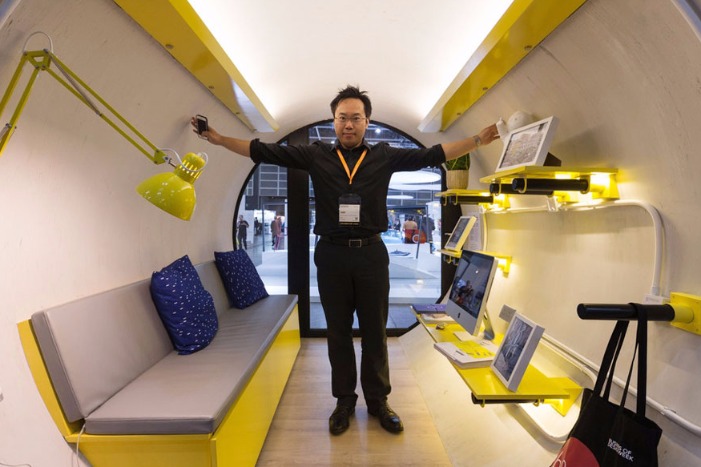
The display of the OPod prototype, complete with a fully furnished interior, drew considerable attention from attendees. Visitors were able to step inside the compact unit, experience its layout, and interact with its features. Jonathan Kong, a design director at James Law Cybertecture, was on hand to demonstrate the unit’s ingenious use of space, showcasing how the seemingly narrow confines of a 2.5-meter diameter pipe could be transformed into a functional living environment. The exhibition provided a crucial opportunity for James Law Cybertecture to gauge public reaction, gather feedback, and present their vision directly to potential stakeholders, including urban planners, government officials, and property developers who might consider adopting such modular housing concepts. The visual impact of the concrete pipe, starkly contrasted with its surprisingly comfortable interior, sparked numerous discussions about the future of compact living and urban density.
Deconstructing the OPod: Design and Functionality
At its core, the OPod Tube House is an ingenious exercise in micro-living design, maximizing utility within a minimal footprint. Each unit is constructed from a readily available 2.5-meter (approximately 8.2 feet) diameter concrete water pipe, which forms the robust exterior shell. These pipes, typically used for drainage or utility conduits, offer exceptional structural integrity and inherent weather resistance, making them a durable and low-maintenance choice. The interior of the 100-square-foot (9.29 square meters) unit is meticulously designed to accommodate the essential functions of daily life for one or two occupants.
The layout typically features a living area that doubles as a sleeping space, often incorporating a fold-down bed or a sofa that converts into a sleeping surface. This flexible furniture is a cornerstone of micro-living, allowing spaces to serve multiple purposes throughout the day. A compact kitchenette is integrated, usually comprising a small sink, a microwave, and limited storage, catering to basic cooking needs. Crucially, each OPod includes a self-contained bathroom, featuring a shower and toilet, a significant upgrade from the shared facilities often found in Hong Kong’s subdivided flats.
Technological integration is another hallmark of the OPod. Each unit is equipped with smartphone-enabled locks, allowing for keyless entry and remote access management—a feature particularly useful for potential modular communities or temporary rental schemes. This smart technology extends to other potential integrations, such as energy management systems or smart lighting, enhancing the living experience despite the compact size.
Perhaps one of the most compelling aspects of the OPod’s design is its modularity and stackability. The robust cylindrical structure allows units to be stacked vertically, forming low-rise modular buildings in a short period. This feature is particularly attractive for urban planners, as it allows for the rapid deployment of housing on vacant or underutilized land parcels, such as interstitial spaces between existing buildings or temporary sites awaiting future development. Furthermore, the units are designed to be easily transported and relocated, offering unprecedented flexibility in urban planning and disaster relief scenarios. This ‘plug-and-play’ approach to housing could revolutionize how temporary or emergency accommodations are provided, or how challenging urban infill sites are developed.
Economic and Social Implications
The primary allure of the OPod Tube House lies in its potential to offer a truly affordable housing option in Hong Kong. While specific pricing details were still under development at the time of its exhibition, the use of repurposed materials and simplified construction methods suggested a significantly lower cost per unit compared to traditional construction. James Law Cybertecture projected that the construction cost could be around HKD 100,000 to HKD 120,000 (approximately USD 12,800 to USD 15,400 at 2017 exchange rates) per unit, making it dramatically more accessible than even the smallest conventional apartments in Hong Kong, which can cost millions of Hong Kong dollars.
This affordability has profound social implications. For individuals and couples struggling with high rents in sub-standard housing, the OPod could represent a stepping stone towards better living conditions and greater financial stability. It offers a degree of privacy, dignity, and personal space often lacking in "cage homes" or shared subdivided flats. While small, the self-contained nature of the OPod with its own kitchen and bathroom provides a significant upgrade in quality of life. The target demographic would likely include young professionals, students, and low-income individuals seeking independent living without the prohibitive costs associated with traditional rental markets. Furthermore, the concept could potentially alleviate some of the social pressures associated with extreme housing inequality, offering a tangible solution that provides a safe and secure dwelling.
Challenges and Regulatory Hurdles
Despite its innovative design and promising potential, the widespread adoption of the OPod Tube House faces several significant challenges. Foremost among these is the perennial issue of land availability in Hong Kong. Even for modular units, securing suitable land parcels, especially in desirable urban areas, remains a formidable obstacle. While the OPods can be stacked, they still require a footprint, and the land for such developments is fiercely contested and highly valued.
Regulatory hurdles also loom large. Existing building codes and zoning laws in Hong Kong are designed for conventional multi-story buildings and may not easily accommodate the unique characteristics of pipe-based modular housing. Issues such as fire safety, structural stability for stacked units, access for emergency services, and provisions for utility connections (water, sewage, electricity, internet) would require careful review and potential amendments to existing regulations. Public acceptance is another crucial factor. While the novelty of the OPod may attract initial interest, convincing a broad segment of the population, including potential residents and existing communities, that micro-living in a pipe is a viable and desirable long-term solution could prove challenging. Concerns about cramped spaces, noise insulation, and the aesthetic impact of such developments on urban landscapes would need to be addressed. Moreover, the integration of these units into existing urban infrastructure requires careful planning to ensure adequate access to public transport, amenities, and community services. Scalability beyond a few prototype units to a significant, impactful number would necessitate overcoming these logistical and bureaucratic complexities.
Perspectives and Reactions
The unveiling of the OPod prompted a range of reactions from various stakeholders. James Law himself, or his representatives like Jonathan Kong, articulated a vision of flexible, sustainable, and affordable urban dwellings that could unlock underutilized urban spaces. They emphasized the project’s humanitarian aspect, aiming to provide dignity through design. "We are not just building houses; we are creating communities and offering a solution to a pressing social issue," a representative might have stated, highlighting the intent beyond mere construction.
Urban planners and housing experts acknowledged the ingenuity of the design but also raised practical concerns. Dr. Lee Chi-ming, a housing policy researcher, might have commented, "While the OPod is a brilliant example of creative problem-solving, its impact on the broader housing crisis will depend on government support for land allocation and streamlined regulatory approvals. It’s a piece of the puzzle, not the entire solution." Some potential residents, particularly younger individuals, expressed cautious optimism. "It’s small, definitely, but if it means I can finally afford a place of my own without sharing with strangers, it’s something I’d seriously consider," remarked a young professional at the exhibition. However, families or those accustomed to more spacious living might find the concept too restrictive. Government officials, while generally welcoming innovative ideas to tackle the housing shortage, would likely adopt a measured approach. A spokesperson from the Housing Authority might have indicated, "The government actively explores all viable options to enhance housing supply. Proposals like the OPod Tube House offer interesting design principles, and we will continue to study their feasibility and alignment with our long-term housing strategies and building safety standards."
The Broader Vision: Micro-Living and Urban Futures
The OPod Tube House is not an isolated phenomenon but rather part of a growing global trend towards micro-living, particularly in high-density urban centers worldwide. Cities like Tokyo, New York, and London have seen a rise in compact apartments and co-living spaces as populations grow and land becomes scarcer. The OPod distinguishes itself through its innovative use of repurposed materials and its modularity, pushing the boundaries of what constitutes ‘home.’
From an environmental perspective, the OPod offers several advantages. By repurposing concrete pipes, it reduces construction waste and the demand for new raw materials. The small footprint inherently encourages a more minimalist lifestyle, potentially leading to reduced energy consumption and a lower carbon footprint per resident. Its adaptability also means it could serve as temporary housing in disaster-stricken areas or as easily deployable worker accommodation, further demonstrating its versatile and sustainable potential.
The ultimate success of the OPod Tube House, or similar micro-housing concepts, will hinge on its ability to navigate the complex interplay of design innovation, economic viability, social acceptance, and regulatory frameworks. It challenges conventional notions of living space and property ownership, forcing urban planners and policymakers to rethink how cities can grow sustainably and equitably. As urban populations continue to swell globally, such radical solutions may become increasingly vital in providing dignified and affordable shelter for all.
In conclusion, the OPod Tube House, as showcased in Hong Kong in late 2017, presented itself as a creative and pragmatic response to an intractable urban problem. While its journey from prototype to widespread adoption is fraught with challenges, its innovative design, affordability potential, and modular flexibility offer a compelling vision for the future of micro-living and contribute significantly to the ongoing global dialogue about sustainable and equitable urban development. It stands as a testament to the power of design thinking in addressing some of society’s most pressing issues.


 Evan Lee Salim
 Suro Senen