Muslim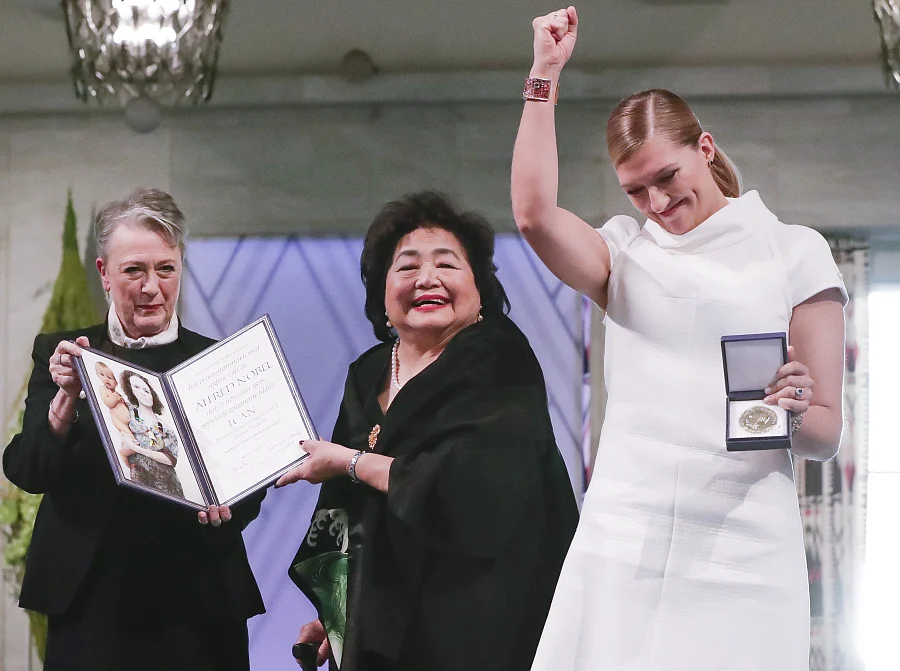
OSLO – The International Campaign to Abolish Nuclear Weapons (ICAN) was awarded the prestigious 2017 Nobel Peace Prize on Sunday, December 10, 2017, at a solemn ceremony held at the Oslo City Hall. The award recognized ICAN’s pivotal role in revitalizing global efforts towards the abolition of nuclear weapons and for its unwavering advocacy for a treaty-based prohibition of these devastating instruments of war. The prize was accepted by Beatrice Fihn, Executive Director of ICAN, and Setsuko Thurlow, a prominent survivor of the 1945 atomic bombing of Hiroshima, who delivered a powerful joint Nobel lecture.

A Decade of Advocacy Culminates in Global Recognition
ICAN, a broad coalition of over 450 non-governmental organizations operating in approximately 100 countries, has dedicated the past decade to raising awareness about the catastrophic humanitarian consequences of nuclear weapons. Its formal launch in April 2007 in Austria marked the beginning of a concerted international effort to stigmatize and ultimately eliminate these weapons of mass destruction. With its main office situated in Geneva, Switzerland, ICAN has been instrumental in lobbying governments and mobilizing civil society to support nuclear disarmament.
The Nobel Committee’s citation highlighted ICAN’s “ground-breaking efforts to achieve a treaty-based prohibition of such weapons,” referring to the Treaty on the Prohibition of Nuclear Weapons (TPNW), a landmark international agreement adopted in July 2017. The Committee underscored that this year’s prize continues a long-standing tradition of Nobel Peace Prizes awarded to those who have championed the cause of nuclear non-proliferation and disarmament, dating back to the early days of the nuclear age.

A Solemn Ceremony and Powerful Testimonies
The award ceremony itself was a profound event, with Berit Reiss-Andersen, chairperson of the Norwegian Nobel Committee, presenting the medal and diploma to Fihn and Thurlow. In her address, Reiss-Andersen emphasized the moral imperative of nuclear disarmament, stating, "The Committee has decided to award the Nobel Peace Prize for 2017 to the International Campaign to Abolish Nuclear Weapons (ICAN). This is because the campaign has been a driving force in efforts to achieve a prohibition of nuclear weapons on a treaty basis. The campaign has, with broad support from a large number of states, succeeded in bringing the issue of nuclear weapons onto the international agenda in a new way."
She further elaborated on the rationale, noting, "The Nobel Committee has wanted to emphasize the importance of nuclear disarmament and the humanitarian consequences of nuclear weapons. It is the hope of the Committee that the award will provide a renewed impetus to the efforts to achieve a world free of nuclear weapons."

The Humanitarian Imperative: Voices from the Brink
In their joint Nobel lecture, Beatrice Fihn and Setsuko Thurlow articulated the urgent need for global action. Fihn issued a stark warning about the current geopolitical landscape, asserting, "The risk for nuclear weapons use is even greater today than at the end of the Cold War. But unlike the Cold War, today we face many more nuclear armed states, terrorists, and cyber warfare." She called upon all nations to actively participate in the collective endeavor to achieve the “end of nuclear weapons,” emphasizing that the current reliance on nuclear deterrence is an unsustainable and perilous gamble.
Setsuko Thurlow, an 85-year-old Hibakusha (survivor of the atomic bombings), delivered a deeply personal and moving account of her experiences. As a 13-year-old girl, she witnessed firsthand the horrific devastation wrought by the U.S. atomic bomb dropped on Hiroshima on August 6, 1945. In that single, catastrophic event, she lost eight members of her family and 351 of her schoolmates. Her testimony served as a visceral reminder of the human cost of nuclear weapons, urging the international community to "forever eradicate the threat of nuclear annihilation." Thurlow’s presence and powerful words underscored the moral authority of the Hibakusha and their relentless pursuit of a world where no one else has to endure such suffering.

The Treaty on the Prohibition of Nuclear Weapons: A New Paradigm
The awarding of the Nobel Peace Prize to ICAN coincides with a significant development in the realm of nuclear disarmament: the adoption of the Treaty on the Prohibition of Nuclear Weapons (TPNW). Negotiated at the United Nations in 2017, the TPNW represents a groundbreaking legal instrument that unequivocally prohibits nuclear weapons, classifying them as illegal under international law. While the treaty has been championed by a large majority of UN member states, it has not been supported by any of the nine nuclear-armed states or their allies, who argue that it does not adequately address the security concerns that underpin nuclear deterrence.
However, for ICAN and its supporters, the TPNW is a crucial step forward. It aims to create a strong international norm against nuclear weapons, similar to the norms that have emerged against chemical and biological weapons. The treaty’s proponents believe that by stigmatizing nuclear weapons and creating legal prohibitions, it will exert moral and political pressure on nuclear-armed states to disarm. The Nobel Committee’s recognition of ICAN can be seen as a powerful endorsement of this treaty-based approach to disarmament.

Historical Context: A Long Road to Abolition
The quest for nuclear disarmament is a decades-long struggle that began in the immediate aftermath of the atomic bombings of Hiroshima and Nagasaki. The Cold War era saw an unprecedented arms race, with the United States and the Soviet Union amassing vast arsenals of nuclear weapons, capable of destroying the world many times over. The existential threat posed by these weapons led to the establishment of various arms control treaties, such as the Partial Test Ban Treaty (1963), the Nuclear Non-Proliferation Treaty (NPT) (1968), and the Strategic Arms Limitation Treaties (SALT).
However, despite these efforts, the complete abolition of nuclear weapons remained an elusive goal. The end of the Cold War brought a temporary thaw in tensions, but the proliferation of nuclear weapons to new states and the persistent threat of non-state actors acquiring them have kept the issue on the global agenda. Organizations like ICAN emerged to fill the void left by the slow pace of official disarmament negotiations, leveraging grassroots activism and international advocacy to push for a more ambitious agenda.

Supporting Data and Global Nuclear Landscape
As of 2017, the world still possessed an estimated 14,900 nuclear warheads, according to the Federation of American Scientists. The United States and Russia together held about 90 percent of these weapons. Other nuclear-armed states include China, France, India, Israel, North Korea, Pakistan, and the United Kingdom. The existence of these arsenals, coupled with the ongoing modernization programs by several nuclear powers, continues to pose a significant threat to global security.
The adoption of the TPNW, with 122 states voting in favor, demonstrated a strong global consensus among non-nuclear-weapon states on the illegitimacy of nuclear weapons. This bloc of nations, often referred to as the "Trio," comprising Austria, Mexico, and South Africa, played a crucial role in the treaty negotiations. Their commitment to humanitarian principles and disarmament served as a moral counterweight to the security arguments presented by nuclear-armed states.

Reactions and Implications: A Divided World on Nuclear Weapons
The awarding of the Nobel Peace Prize to ICAN was met with widespread praise from disarmament advocates and many governments. UN Secretary-General António Guterres congratulated ICAN, stating that the award “shines a spotlight on the urgent need to advance nuclear disarmament and the importance of the Treaty on the Prohibition of Nuclear Weapons.” He added, "The world has witnessed the catastrophic humanitarian consequences of nuclear weapons, and the risks of their use are still too high."
However, the response from nuclear-armed states and their allies was notably muted or critical. Representatives from NATO countries, including the United States, expressed concern that the TPNW undermines existing non-proliferation and disarmament regimes, such as the NPT. They reiterated their commitment to nuclear deterrence as a cornerstone of their security policy.

The implications of the Nobel Prize and the TPNW are multifaceted. For ICAN and its supporters, it represents a significant moral victory and a powerful boost to their ongoing campaign. It is expected to further energize civil society efforts and increase political pressure on nuclear-armed states to engage in meaningful disarmament negotiations.
For the international community, the award highlights the enduring and urgent challenge of nuclear disarmament. It underscores the growing divide between states that view nuclear weapons as an unacceptable humanitarian and legal threat and those that continue to rely on them for their security. The long-term impact of the TPNW and the Nobel recognition will likely depend on the sustained commitment of civil society, the evolving geopolitical landscape, and the willingness of nuclear-armed states to reconsider their positions. The prize serves as a potent reminder that the dream of a world free from nuclear weapons, though distant, remains a vital aspiration for global peace and security.


 Nana Wu
 Suro Senen