Asep Darmawan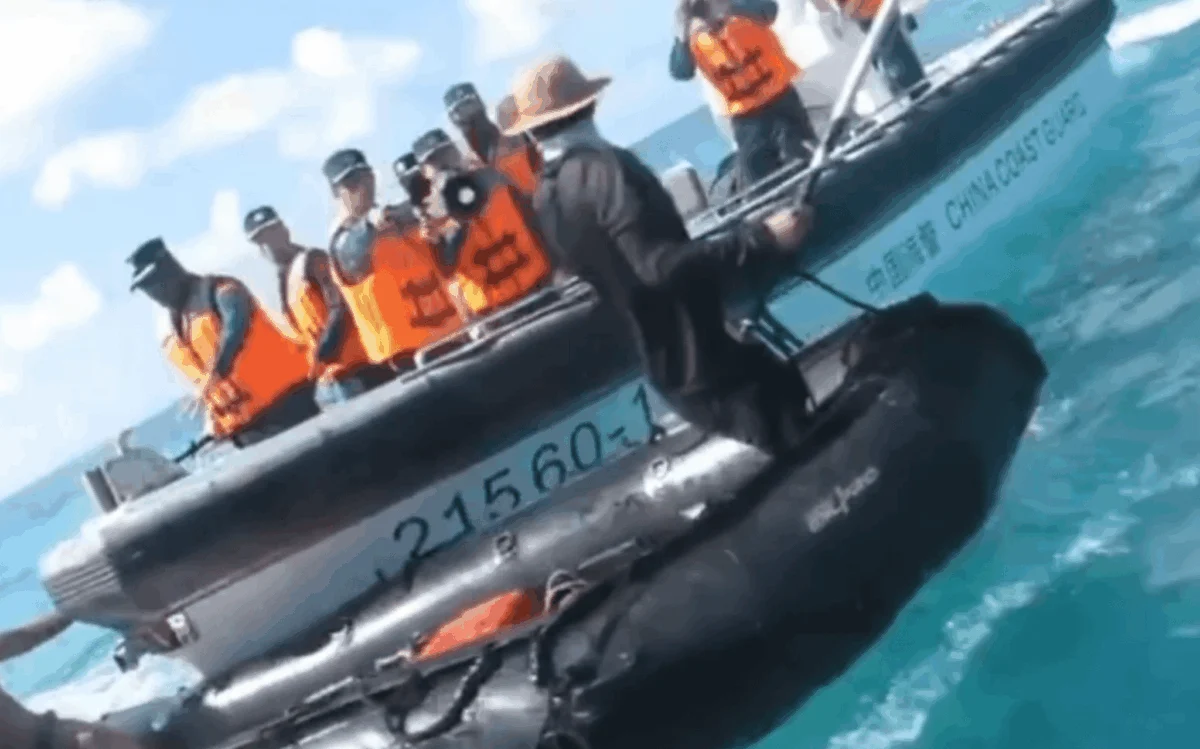
Beijing, China – China urgently summoned the Philippine ambassador on Tuesday, July 21, 2026, to lodge a vehement protest following a contentious clash at the disputed Second Thomas Shoal (known as Ren’ai Reef in China and Ayungin Shoal in the Philippines) in the South China Sea. The incident, which saw the Philippine military accuse the China Coast Guard (CCG) of assaulting a Filipino sailor with a baton, has ignited a fresh wave of international condemnation against Beijing and significantly ratcheted up tensions in the strategically vital waterway. Manila’s key allies, including the United States and Australia, swiftly denounced China’s actions, underscoring the escalating geopolitical stakes in the region.
The diplomatic fallout commenced shortly after reports emerged from Manila detailing a violent encounter during a routine Philippine resupply mission to the BRP Sierra Madre, a dilapidated naval vessel intentionally grounded at Second Thomas Shoal since 1999 to assert Philippine sovereignty. According to the Philippine military, on Monday, July 20, 2026, CCG vessels intercepted and aggressively interfered with Philippine boats attempting to deliver supplies to the small contingent of Filipino marines stationed aboard the derelict warship. This confrontation reportedly escalated to the point where a Filipino sailor was physically struck with a baton, marking a severe escalation in the long-running territorial dispute.

China’s Ministry of Foreign Affairs responded to the incident by "urgently summoning" the Philippine ambassador, accusing Manila of "deliberate provocation and attack" at the flashpoint reef. In a sharply worded statement, the ministry asserted, "The Philippine side provoked first, yet it has turned the blame upside down, distorted the facts, and maliciously hyped the issue." This counter-accusation highlights the deeply entrenched and conflicting narratives that characterize the South China Sea disputes, where both sides frequently claim victimhood while accusing the other of aggression.
The Volatile Waters of the South China Sea: A Geopolitical Crucible
The South China Sea is one of the world’s most contested maritime regions, a vital global trade route through which an estimated $3.4 trillion in annual trade passes. Its waters are also believed to hold rich fishing grounds and significant oil and gas reserves. Beijing claims sweeping sovereignty over almost the entire sea, represented by its controversial "nine-dash line," a demarcation that extends hundreds of miles from its southern coast and overlaps with the exclusive economic zones (EEZs) of several neighboring countries. These claims are vehemently disputed by multiple nations, including the Philippines, Vietnam, Malaysia, Brunei, and Taiwan, which also assert their own territorial rights based on international law.

A landmark ruling by the Permanent Court of Arbitration (PCA) in The Hague in 2016 invalidated China’s historical claims under the nine-dash line, finding them to have no legal basis under the United Nations Convention on the Law of the Sea (UNCLOS). The PCA ruling explicitly affirmed the Philippines’ sovereign rights in areas like Second Thomas Shoal, which lies within Manila’s 200-nautical-mile EEZ. However, China has consistently rejected this ruling, continuing its assertive presence and construction activities across the disputed features. This refusal to acknowledge international legal decisions fuels much of the regional instability and creates a persistent challenge to the rules-based international order.
Altercations in the heavily patrolled waterway are a regular occurrence, ranging from water cannon attacks and dangerous maneuvers by CCG vessels to alleged ramming incidents. The disputes are not merely about rocks and reefs; they represent a broader struggle for regional influence, resource control, and adherence to international law versus unilateral power projection.
Chronology of Escalation at Second Thomas Shoal

The BRP Sierra Madre, a World War II-era tank landing ship, has been deliberately run aground on Second Thomas Shoal since 1999. It serves as a permanent outpost for a small contingent of Philippine marines, symbolizing Manila’s claim to the feature. The existence of this rusty vessel is a constant thorn in Beijing’s side, which views it as an illegal occupation of Chinese territory. Regular resupply missions to the Sierra Madre are thus critical for the Philippines and routinely become flashpoints for confrontation.
- 1999: The BRP Sierra Madre is intentionally grounded on Second Thomas Shoal by the Philippines to assert its sovereignty against China’s expanding presence in the Spratly Islands.
- Early 2010s: China begins deploying more vessels to the vicinity of Second Thomas Shoal, frequently harassing Philippine resupply missions.
- 2013: The Philippines initiates arbitration proceedings against China’s claims in the South China Sea under UNCLOS.
- 2016: The Permanent Court of Arbitration issues its landmark ruling, largely favoring the Philippines and rejecting China’s nine-dash line claims. China dismisses the ruling.
- Late 2023 – Early 2026: Incidents involving water cannons, dangerous maneuvers, and alleged ramming by CCG vessels against Philippine boats become more frequent and aggressive, often resulting in damage to Philippine vessels and minor injuries to personnel. These incidents are widely documented and condemned by international observers.
- Monday, July 20, 2026: The specific incident triggering the current diplomatic storm occurs. The Philippine military reports that during a resupply mission to the BRP Sierra Madre, CCG vessels engaged in aggressive tactics, including allegedly clubbing a Filipino sailor with a baton, marking a direct physical assault. Videos released by the Armed Forces of the Philippines (AFP) show CCG rigid-hull inflatable boats (RHIBs) approaching Philippine vessels in what Manila described as a "lawful and non-confrontational operation" by their navy personnel to "drive away a China Coast Guard RHIB that had unlawfully approached the vicinity of the outpost."
- Tuesday, July 21, 2026: China summons the Philippine ambassador in Beijing, accusing the Philippines of provocation. Simultaneously, the US and Australia issue strong condemnations of China’s actions. US Secretary of State Marco Rubio arrives in Manila for the ASEAN summit.
International Outcry and Diplomatic Manoeuvres
The incident swiftly drew sharp rebukes from Manila’s key allies, highlighting the deepening alignment against China’s assertiveness in the region.

Australian Foreign Minister Penny Wong issued a statement condemning what she described as "destabilising and dangerous conduct" by China. Canberra’s strong reaction aligns with its consistent stance on upholding international law and freedom of navigation in the Indo-Pacific, reflecting concerns over regional stability and economic security. Australia, like many nations, relies heavily on the unimpeded passage of trade through the South China Sea.
Washington, a staunch treaty ally of the Philippines, was equally unequivocal in its condemnation. The US State Department denounced Beijing’s "dangerous and aggressive actions," reiterating its commitment to its mutual defense treaty obligations with the Philippines. US Secretary of State Marco Rubio’s arrival in Manila on Tuesday for a summit of the 11-member Association of Southeast Asian Nations (ASEAN) provided a timely platform for these discussions. His presence underscores the importance Washington places on its alliances in the Indo-Pacific and its concern over China’s escalating tactics.
Rubio has indicated his openness to a meeting with his Chinese counterpart, Wang Yi, who is also attending the ASEAN summit. While talks have not been publicly confirmed, such a meeting would be critical for de-escalation, though previous encounters, such as those on the sidelines of an ASEAN gathering in Kuala Lumpur last year and in Munich in February, have yielded limited breakthroughs on core South China Sea issues.

In an op-ed published in Philippine media outlets on Tuesday, Secretary Rubio explicitly heralded Washington’s commitment "to freedom of navigation in Southeast Asia" while reaffirming the US defensive umbrella in the region. He cautioned, "This freedom is by no means guaranteed. If these waters were to fall under the control of a power willing to use trade as a geopolitical weapon, both the United States and the ASEAN states would face serious new threats to their sovereignty, security, and economic future." While not directly naming China, the allusion to Beijing’s potential use of trade as a geopolitical tool was unmistakable, articulating a core concern among Indo-Pacific nations regarding China’s economic and military might.
Broader Implications for Regional Security and International Law
The latest clash at Second Thomas Shoal carries significant implications for regional security and the future of international law in maritime disputes.

- Escalation Risk: The alleged physical assault on a Filipino sailor represents a dangerous escalation from previous incidents involving water cannons or ramming. Such direct physical confrontation significantly raises the risk of miscalculation or unintended clashes, which could rapidly spiral into a broader conflict, potentially drawing in treaty allies like the United States.
- Challenge to International Law: China’s continued disregard for the 2016 PCA ruling and its assertive actions undermine the UNCLOS framework, a cornerstone of maritime law. This challenges the principles of a rules-based international order, potentially emboldening other states to pursue territorial claims through force or coercion rather than diplomatic and legal means.
- Strengthening Alliances: The repeated incidents in the South China Sea have paradoxically strengthened the resolve of the Philippines and its allies. Manila has actively sought to bolster its defense capabilities and deepen its security cooperation with the US, Australia, and other partners. The US-Philippines Mutual Defense Treaty, which obligates Washington to come to Manila’s aid if its public vessels, aircraft, or armed forces are attacked in the Pacific, becomes increasingly relevant with each incident.
- ASEAN’s Role: The ASEAN summit provides a crucial platform for regional dialogue, but the bloc has historically struggled to present a united front on the South China Sea due to the varying interests of its member states and China’s significant economic leverage. The latest incident will test ASEAN’s ability to forge a consensus on how to manage external pressures and uphold regional peace and stability.
- Geopolitical Competition: The South China Sea serves as a major theater for the broader geopolitical competition between China and the US and its allies. China’s actions are seen by many as part of a strategy to assert its dominance in its perceived backyard, while the US and its partners emphasize freedom of navigation and the protection of international norms. The recent clash underscores the fragility of peace in a region teeming with strategic interests and competing claims.
As diplomatic efforts unfold at the ASEAN summit in Manila, the international community will be closely watching for any signs of de-escalation or, conversely, further hardening of positions. The incident at Second Thomas Shoal is not merely a localized dispute; it is a microcosm of the larger struggle to define the future of maritime governance and power dynamics in the Indo-Pacific. The stakes, involving global trade, national sovereignty, and regional stability, could not be higher.

 Sagoh
Sagoh
 Asro
Asro