Rifan Muazin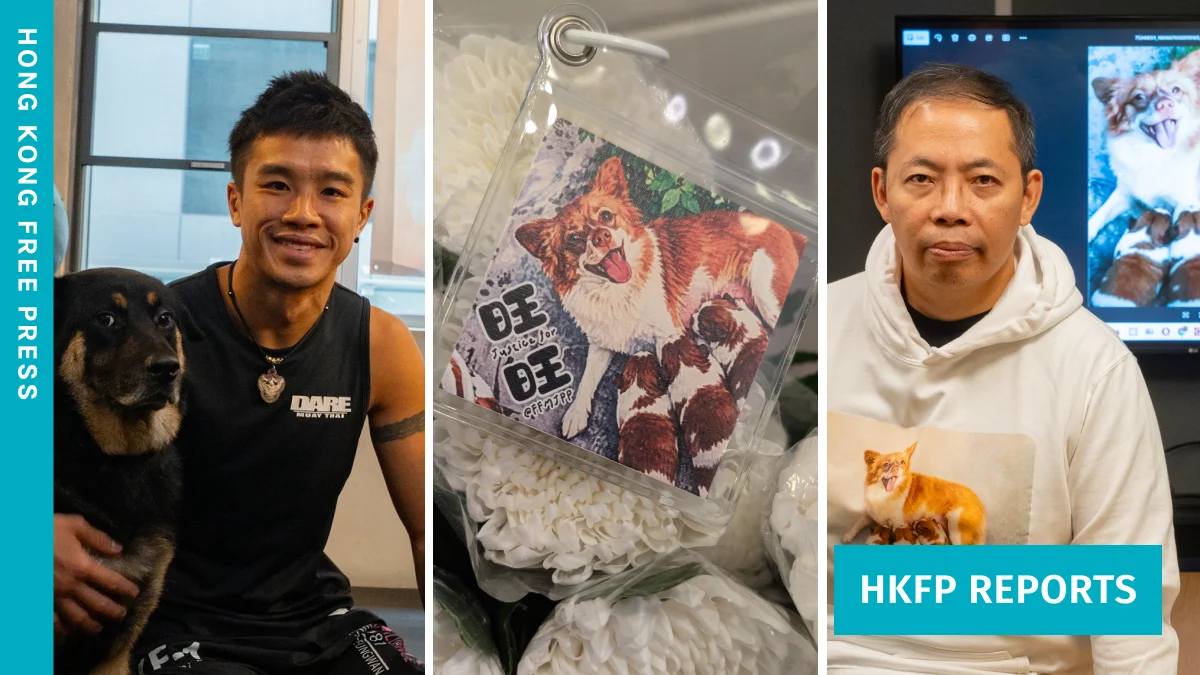
Outside a nondescript commercial building in the bustling heart of Causeway Bay, a poignant tableau unfolded. A procession of individuals, united by umbrellas against the persistent Hong Kong rain and clutching bouquets of flowers, snaked around the block. For hours, these mourners stood in vigil, a testament to the profound grief and outrage stirred by the brutal killing of Wang Wang, a stray dog, at the hands of five boys in mainland China. This act of empathy, transcending borders, highlights a growing concern for animal welfare and the complex, often "arbitrary" lines that govern public expression and advocacy in contemporary Hong Kong.

The outpouring of support for Wang Wang, a stray dog who met a horrific end, underscores a powerful emotional connection many feel towards animals. Brian, a 26-year-old from Guangzhou, exemplifies this dedication. He crossed the border into Hong Kong specifically to participate in the memorial, having learned about it through social media. Clutching a bouquet of white chrysanthemums, he patiently awaited his turn to ascend to a small Buddhist temple on the 23rd floor, a space designated for the procession. "When I first saw the video I was furious, and now I just feel helpless," Brian shared, his voice tinged with sorrow. He spoke under a pseudonym, a reflection of the cautious atmosphere surrounding such public displays of sentiment. "I just hope I can send off Wang Wang and her puppies one last time."
Wang Wang and her three puppies were subjected to unspeakable torture and death on June 28 in a village in Jieyang, Guangdong province. The perpetrators, all under the age of 14, captured videos of their heinous acts. These videos, which were subsequently removed from Chinese social media platforms, depicted the boys cruelly beating the dogs with sticks and ultimately dousing Wang Wang in fuel before setting her ablaze. The graphic nature of the killings, once unleashed onto the internet, spread rapidly, igniting widespread condemnation across Hong Kong and beyond.

The incident resonated deeply, prompting a wave of international solidarity. Billboards funded by ordinary Chinese citizens appeared in New York’s Times Square and around Taipei’s iconic 101 skyscraper, amplifying the call for accountability. In Hong Kong, the response was equally fervent, with activists and ordinary citizens alike channeling their outrage into advocating for stronger animal rights protections in mainland China.
However, the memorial for Wang Wang in Hong Kong was not without its challenges. Less than 24 hours before its scheduled commencement, the funeral arrangements were abruptly shifted online. Consequently, mourners were restricted to laying flowers outside the designated venue. The Hong Kong Animal Rights Association, initially slated to organize the event, withdrew from an interview with Hong Kong Free Press on the morning of the ceremony, citing unspecified reasons.

Adding to the somber atmosphere, plainclothes police officers were visible flanking the entrance of the building where the memorial was being held. A Thai boxing gym located nearby was also compelled to remove a banner depicting Wang Wang after the building’s management office was approached by law enforcement. This incident is indicative of a broader trend where public spaces and commercial entities appear increasingly wary of displaying content that could be perceived as sensitive or controversial, particularly in the current political climate. Similarly, charities and animal welfare groups have reportedly faced difficulties in getting advertisements featuring images of the dogs approved by public transport companies.
The shift in Hong Kong’s public sphere since the mass protests of 2019 and the subsequent imposition of national security legislation by Beijing has been palpable. Public advocacy and gatherings, once vibrant expressions of civic engagement, now operate under stringent restrictions and are often met with a heightened sense of suspicion. The desire to commemorate Wang Wang and her puppies, a seemingly apolitical act of compassion, has inadvertently navigated this new landscape, revealing the subtle yet significant boundaries that now define permissible expression, even in the realm of animal welfare.

"Be Careful": Navigating the Shifting Tides of Advocacy
Beneath the drizzling rain, confined by bright orange police tape, a young woman in her twenties, identifying herself only as "L," also stood in the queue. "Over on the mainland, people might not be able to express their views, and mentions of the incident are suppressed," she explained. "That’s why netizens and people who love animals have to take a stand." Her words reflect a common sentiment: a perceived need to fill a void of expression where official channels are either absent or actively censoring dissent.
The global community, including ordinary Hongkongers, has been actively seeking ways to keep the conversation around Wang Wang’s tragic death alive in the public sphere. This effort persists even as videos of the killings have been removed from Hong Kong’s social media platforms, reportedly at the request of authorities. Much of the public outcry has been directed at village authorities in Jieyang, who reportedly urged the public to refrain from sharing information about the killings, citing the perpetrators’ ages. As all five boys were minors, they were subsequently sent to a "specialised school" for corrective education, a measure that has drawn criticism for its perceived leniency.

In mid-July, weeks after Wang Wang’s death, Leung Pak-yu, the owner of a Muay Thai gym in Causeway Bay, took a bold stance. He displayed a five-meter-long banner on the facade of his building, bearing the powerful message: "Being a minor does not mean abuse can be lightly brushed aside." The banner featured a poignant image of Wang Wang nursing her pups, an image that had become a symbol in publicity campaigns worldwide before its widespread removal. However, Leung’s public display was short-lived. Three days after its installation, police officers approached the building’s management, and Leung was subsequently asked to remove the banner, with building management citing that the outer wall was not part of his rental agreement.
Undeterred, Leung had new posters made, printed on vinyl-coated canvas, which he then hung behind the windows of his gym. So far, these have not drawn official attention. "My friends keep telling me to be careful," Leung confided to HKFP, his gym also serving as the home for his two rescue dogs, a shy mongrel and a more boisterous bulldog. His words highlight the underlying tension – the desire to speak out versus the potential repercussions in an environment where public expression is closely monitored.

Leung believes that legislative reform is crucial to prevent similar tragedies. Unlike Hong Kong, which has its Prevention of Cruelty to Animals Ordinance, mainland China lacks a comprehensive nationwide animal cruelty law, though some cities have implemented specific regulations, such as Shenzhen’s ban on the consumption of companion animals. "Since Hong Kong, as a civilized society, is a part of China, we should have a responsibility to push for change," Leung stated, underscoring a sense of shared responsibility and a desire to influence broader societal norms.
"Severe Punishment" and the Call for Deterrence
Anthony Lai, a cybersecurity consultant and passionate animal welfare advocate, envisions a more prominent platform for his message. He aims to have his campaign plastered on a double-decker bus, traversing Nathan Road, one of Hong Kong’s busiest thoroughfares, a prime location to capture the attention of tourists, many of whom are from mainland China. "We had to go through multiple rounds of vetting before they would accept the design," Lai recounted, referring to the process of getting advertisements approved by public transport companies.

Lai, who grew up surrounded by animals in a rural part of the city, has long been involved in animal welfare campaigns. Both he and Leung emphasize the critical role of deterrence. They, along with many critics, point to China’s absence of a nationwide animal cruelty law as a significant legal vacuum that allows abusers to escape accountability. Feline Guardians, a US-based activist group focusing on cat abuse in mainland China, echoed this sentiment in a statement following the Wang Wang incident, emphasizing that implementing legislation would "protect cats and other companion animals."
Lai argues that a "severe punishment" is necessary not only to discourage repeat offenses but also to prevent the escalation of such violence into threats against human safety. He views Wang Wang’s death not as an isolated incident but as a chilling reflection of a society’s devaluation of life. "If they can do that to dogs, what’s stopping them from doing the same to humans?" he questioned, drawing a stark parallel between animal abuse and potential threats to societal well-being.

"Arbitrary" Lines and the Struggle for Public Space
Lai’s advocacy extends beyond public transport. About a week after Wang Wang’s death gained widespread attention, he organized a modest protest in Causeway Bay, armed with a hand-drawn cardboard placard. For his current bus advertisement campaign, he successfully crowdfunded approximately HK$70,000 from friends and supporters.
The initial design Lai submitted to Kowloon Motor Bus (KMB) featured the now-iconic image of Wang Wang and her puppies. However, he received no response until he altered the design. Similarly, the pet adoption platform Suppaw encountered obstacles with its tram advertisement campaign, having to revise its original design depicting Wang Wang and her pups.

Lai displayed samples of the updated design, where Wang Wang’s image was cropped and scaled down, and other animals were included against a serene blue background, with his own Pomeranian featured prominently. "Whether it’s this draft or that one, they carry the same meaning to me, which is to protect life," Lai stated. He speculated that the revised design, devoid of the explicit context of Wang Wang’s brutal death, was more readily approved.
Other individuals are also contributing to the awareness campaign through smaller, personal initiatives. Carmen Cheng, owner of a game store in Hin Keng, has personally funded the creation of keychains featuring Wang Wang, which she offers to customers free of charge. These keychains, some of which have been shipped overseas, have garnered significant attention. However, Cheng herself has faced repercussions, receiving threatening messages on Facebook shortly after announcing the project, warning her to cease her efforts. Despite this, she remains committed, with new shipments of keychains already in production.

From Hong Kong to China: The Broader Implications
Kenneth Chan, an associate professor in the Department of Government and International Studies at Hong Kong Baptist University, observes that even advocacy campaigns for seemingly innocuous causes like animal rights are viewed by the government with inherent suspicion. He notes the "perceived arbitrariness" of what individuals and businesses deem permissible in the eyes of the authorities. "Nothing can be ‘non-political’ in clear terms in a place where the authorities talk about being vigilant towards threats arising anywhere, anyhow, anytime," Chan remarked. He also suggested that aligning with authorities might offer some leeway in navigating these restrictions.
This complex regulatory environment was further illustrated by District Councillor Lau Chun-hoi’s trip to Shanghai to attend a pet fair. Lau, affiliated with Hong Kong’s largest pro-Beijing party, is also the convenor of the Animal Welfare Advocacy Alliance. He met with Zhao Wanping, a deputy to China’s National People’s Congress, who has for years advocated for national companion animal protection legislation. Despite these efforts, China still lacks a comprehensive nationwide animal cruelty law. Lau posted on Facebook last month, stating, "If acts of animal cruelty committed by minors are not met with proper punishment and correction, they are highly likely to escalate into risks that threaten society."

The case of Wang Wang and the subsequent reactions in Hong Kong highlight a growing tension between the public’s desire to express empathy and advocate for ethical treatment of animals, and the increasingly constrained environment for public discourse. The incidents underscore a critical need for legislative frameworks that address animal cruelty, not only as a matter of welfare but also as a reflection of a society’s commitment to compassion and its ability to deter future acts of violence, regardless of the age of the perpetrators. The "arbitrary" lines drawn by authorities, as described by observers, create an environment of uncertainty for advocates, pushing them to find creative and often cautious ways to raise awareness and effect change.


 Layla Zulfa
 Reynand Wu