 Azzam Bilal Chamdy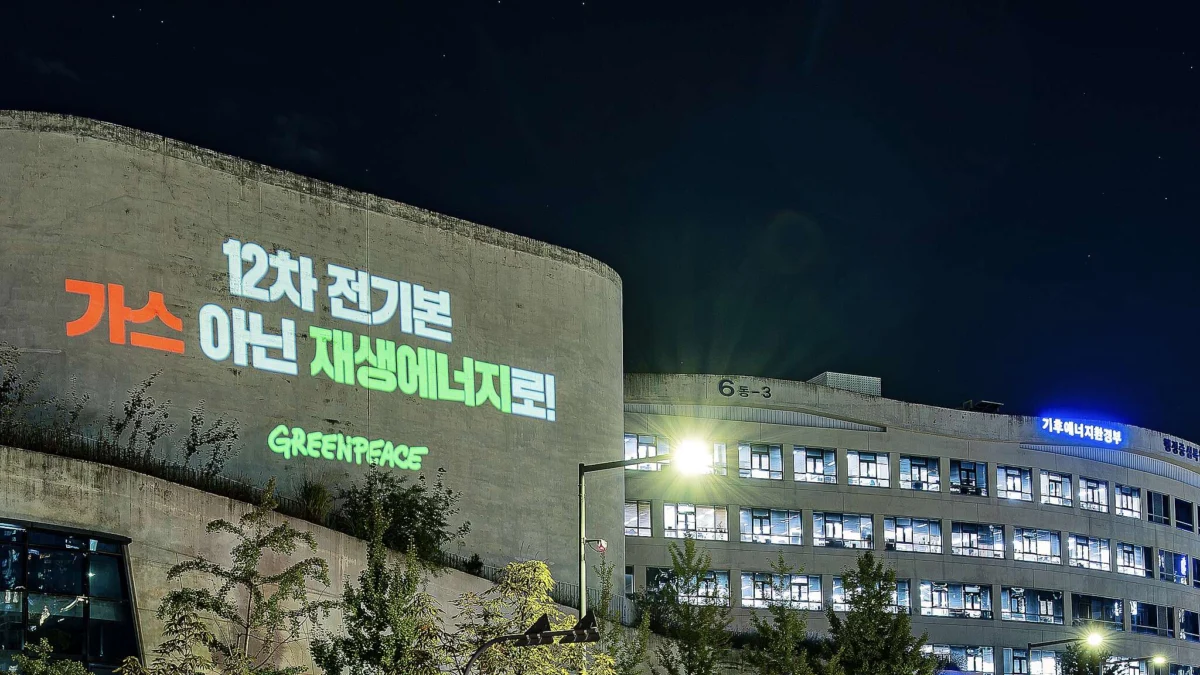
SEOUL – South Korea’s ambitious target to achieve 220 gigawatts (GW) of renewable energy capacity by 2040 faces significant hurdles, with the integration of power demands from upcoming industrial mega-projects poised to make achieving the nation’s Nationally Determined Contribution (NDC) carbon reduction goals “virtually impossible,” according to a stark new report. The analysis, released by international environmental organization Greenpeace East Asia and the civil society network Korea Beyond Fossil Fuels (KBF), highlights a critical juncture for the nation’s energy policy as it navigates the complex interplay between industrial expansion and climate commitments.
The study, titled Alternative Scenarios for Power Sector Decarbonization, was conducted by the energy research institute PLANIT. Leveraging the open-source Python for Power System Analysis (PyPSA) model, PLANIT meticulously analyzed various power sector pathways. Their assessment, based on the framework of the 11th Basic Plan for Electricity Supply and Demand, focused on optimizing grid operations and buildout costs to accurately gauge the potential emissions impacts of different energy strategies. The findings paint a concerning picture, suggesting that current projections and planned infrastructure developments are on a collision course with South Korea’s climate pledges.
Key Findings: The Scale of the Challenge
At the heart of the report’s alarming conclusions lies the projected energy demand from a series of large-scale industrial projects. These "mega-projects," which are expected to significantly boost the nation’s economic output, also carry a substantial energy appetite. The PLANIT study modeled two primary scenarios for increased power demand stemming from these developments: an additional 20GW and a more substantial 30GW. These figures are directly informed by the 12th Basic Plan Committee’s August announcement, which projected a demand increase ranging from 26.6 to 26.8GW over existing baselines.
The analysis reveals a critical flaw in the current planning: even with the complete phase-out of coal-fired power plants, integrating these mega-project power demands will cause power sector emissions to drastically exceed the NDC target cap of 56 million tonnes of CO2 equivalent (MtCO2e). The report’s data illustrates a dramatic surge in reliance on gas power generation, a fossil fuel, as the primary means to bridge the gap left by retiring coal plants and to meet the burgeoning demand from the new industrial complexes.
A Deeper Dive into the Data: Gas and Emissions Skyrocket
The accompanying table from the PLANIT study provides a clear, quantitative breakdown of these impacts. In a baseline scenario where coal is phased out and gas utilization is capped at 15% (representing a scenario with no additional mega-project demand), South Korea could achieve approximately 37 MtCO2e in emissions, a significant reduction but still a substantial portion of the NDC target. In this idealized scenario, renewable capacity would reach 249 GW, generating 359 TWh of electricity.
However, the introduction of industrial demand shatters this optimistic outlook. Under the + 20GW Mega Demand scenario, gas capacity remains at 33 GW, but gas generation skyrockets to 208 TWh – an increase of approximately 164 TWh compared to the baseline. While renewable capacity sees a modest increase to 280 GW, renewable generation only rises marginally to 363 TWh. The most critical consequence is the emissions level, which jumps to 84 MtCO2e, a staggering 1.5 times the NDC target.
The situation deteriorates further under the + 30GW Mega Demand scenario. Here, gas generation experiences an almost fivefold increase, reaching an enormous 224 TWh – a jump of about 180 TWh from the baseline coal phaseout scenario. This surge in gas power is necessitated by lifting the 15% capacity factor restriction on gas power plants to meet the heavy demand. Consequently, greenhouse gas emissions soar to approximately 90 MtCO2e, representing a daunting 1.6 times the NDC target. In this scenario, renewable capacity expands more significantly to 344 GW, generating 441 TWh, but this is insufficient to offset the massive increase in gas-fired power.
Expert Analysis: A Call for Policy Reorientation
Jahyeon Kim, Energy Transition Team Lead at PLANIT, offered a critical perspective on these findings. "The finding that additional mega-project demand is met primarily by gas power demonstrates that expanding renewables alone won’t deliver real carbon reductions without strict regulations on gas generation," Kim stated. He emphasized the urgent need for a decisive policy shift, arguing, "To prevent the phase-out of aging coal plants from simply leading to reliance on gas—another fossil fuel—a decisive policy shift is urgently required, such as halting the construction of new gas-fired power plants and capping gas utilization rates to redefine gas power strictly as a peaking resource." This suggests that without deliberate policy interventions, the transition away from coal could inadvertently lock South Korea into a prolonged dependence on another carbon-intensive energy source.
The implications of this reliance on gas are profound. Gas power, while often presented as a cleaner alternative to coal, still releases significant amounts of greenhouse gases, including methane, a potent warming agent. Furthermore, the construction of new gas infrastructure represents a long-term commitment to fossil fuels, potentially hindering the nation’s ability to achieve deeper decarbonization in the future.
Greenpeace and KBF Sound the Alarm

Minju Shin, Climate and Energy Campaigner at Greenpeace East Asia, echoed these concerns, criticizing the current trajectory. "Despite the government’s target of expanding 220GW of renewables by 2040, mega-project demand has flashed a red light for carbon reduction goals," Shin asserted. She specifically pointed to remarks made by Minister of Climate, Energy and Environment Kim Sung-hwan, who reportedly claimed that gas expansion is unavoidable. Shin argued that such statements directly contradict both the 11th Basic Plan’s stated intention to reduce Liquefied Natural Gas (LNG) reliance from 26.8% to 10.6% and the overarching NDC commitments.
Shin further elaborated on the imperative for thorough re-evaluation. "To prevent the upcoming 12th Basic Plan from deteriorating into a blueprint for megaproject-driven carbon emissions, it is imperative to rigorously examine whether the projected demand for these megaprojects has been overstated," she urged. "Expanding gas power must not be accepted as a foregone conclusion without verifying demand forecasts and assessing alternative scenarios utilizing renewables and energy storage systems (ESS)." This highlights the need for a more critical and data-driven approach to demand forecasting, considering the potential for overestimation and exploring all available low-carbon solutions.
The call for a robust assessment of renewables and energy storage systems (ESS) is particularly significant. Advanced battery technologies and other ESS solutions are becoming increasingly cost-effective and can play a crucial role in ensuring grid stability and reliability, even with a high penetration of variable renewable energy sources. By investing in and integrating these technologies, South Korea could potentially meet its growing energy demands without a commensurate increase in fossil fuel reliance.
A Timeline of Energy Policy and Industrial Ambition
South Korea has been actively engaged in energy policy planning for years, with the Basic Plan for Electricity Supply and Demand serving as a cornerstone of its long-term energy strategy. The 11th Basic Plan, released in December 2019, aimed to significantly increase the share of renewable energy in the power mix and reduce reliance on coal and nuclear power. This plan set the stage for ambitious renewable energy targets and a gradual decrease in the role of LNG.
The emergence of the 12th Basic Plan process, initiated in 2023, coincided with the planning and announcement of several large-scale industrial projects. These projects, often framed as vital for national economic growth and technological advancement, include significant investments in semiconductor manufacturing, battery production, and advanced materials. Their substantial energy requirements became a key consideration for the 12th Basic Plan Committee.
The August 2023 announcement by the 12th Basic Plan Committee, detailing the projected demand increase, served as a catalyst for the PLANIT study. Greenpeace East Asia and Korea Beyond Fossil Fuels, in collaboration with PLANIT, sought to provide an independent analysis of the implications of incorporating this projected demand into the national energy framework.
The release of the Alternative Scenarios for Power Sector Decarbonization report in late 2023 or early 2024 (specific date not provided in the original text) marks a critical intervention in the ongoing policy debate. It provides concrete data and analysis to challenge assumptions about the necessity of expanded gas power and to advocate for a more aggressive pursuit of renewable energy and energy efficiency measures.
Broader Impact and Implications for Global Climate Goals
The situation in South Korea is not an isolated incident. Many nations are grappling with the challenge of balancing economic development with climate action. The report’s findings serve as a cautionary tale, illustrating how the pursuit of industrial growth, if not meticulously planned with decarbonization in mind, can undermine hard-won climate progress.
For South Korea, the implications extend beyond its own NDC targets. As a major industrial economy and a significant player in global supply chains, its energy choices have ripple effects. A failure to meet its climate commitments could weaken the resolve of other nations and undermine the collective global effort to limit warming to 1.5 degrees Celsius, as outlined in the Paris Agreement.
The Greenpeace projection onto the Ministry of Climate, Energy and Environment building, calling for reduced gas-fired power generation and increased renewables, signifies the public and civil society pressure for a more sustainable energy future. This visual intervention underscores the urgency and public concern surrounding the nation’s energy policy decisions.
The report implicitly raises questions about the thoroughness of the demand-side assessment for the mega-projects. Are there opportunities for energy efficiency improvements within these industrial facilities? Could the deployment of on-site renewable energy generation and robust energy storage systems mitigate their impact on the national grid? These are critical questions that the 12th Basic Plan must address comprehensively.
Ultimately, the successful implementation of the 12th Basic Plan for Electricity Supply and Demand hinges on its ability to integrate industrial growth with ambitious climate action. The PLANIT report provides a clear roadmap of the risks associated with continued reliance on fossil fuels and offers a compelling argument for prioritizing renewable energy, energy storage, and stringent regulatory measures on gas power. The choices made in the coming months will not only determine South Korea’s energy future but also its contribution to the global fight against climate change. The nation stands at a crossroads, with the opportunity to either embrace a truly sustainable energy pathway or risk entrenching a carbon-intensive future under the guise of industrial progress.


 Nana
Nana
 Jia Lissa