Neng Nana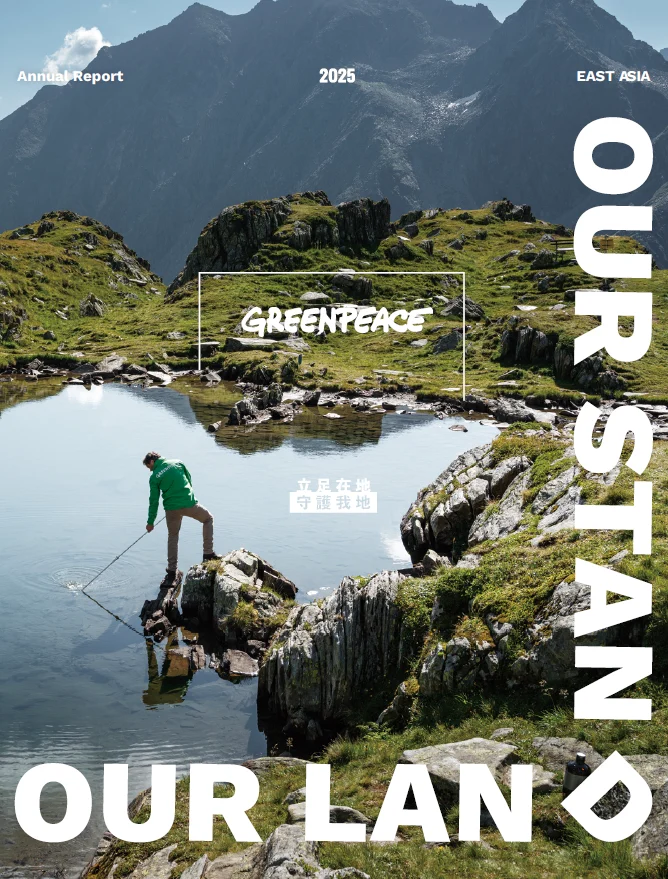
Nature’s stories are never just data. Our land, mountains, and oceans hold the shared memories of our coexistence with all living things. Environmental protection is ultimately about how we live in harmony with the Earth and remain connected to the generations that follow. Real change should not remain within academic debate alone – the challenges facing our land belong to all of us. With your generous support, we remain 100% financially independent, free from political and corporate influence. This strength begins in Hong Kong, scales across East Asia, and echoes around the world. Thank you for turning your love for our land and seas into actions to protect the home we share. Download Greenpeace East Asia’s Annual Report 2025 to read more.
Foreword: A Philosophy of Interconnectedness and Action
The publication of Greenpeace East Asia’s Annual Report 2025 marks a significant milestone, not merely as a record of activities, but as a profound articulation of a philosophy that underpins environmental advocacy. The report underscores a fundamental belief: that the narrative of our planet is woven from the interconnected lives of all beings, transcending mere statistical data. It emphasizes that the health of our land, the majesty of our mountains, and the vastness of our oceans are repositories of shared histories, chronicling our long-standing coexistence with the natural world. This perspective frames environmental protection not as a technical problem to be solved, but as a deeply human endeavor, intrinsically linked to how we cultivate harmony with the Earth and ensure a vibrant legacy for future generations. The report implicitly argues that the urgent environmental challenges confronting us are too significant to be confined to academic discourse; they are a collective responsibility, demanding the engagement and action of every segment of society.
Foundational Strength: The Power of Independence
A cornerstone of Greenpeace East Asia’s operational strength, as highlighted in the report, is its unwavering 100% financial independence. This autonomy is not simply a matter of organizational structure; it is the bedrock upon which its credibility and effectiveness are built. By remaining free from the influence of political agendas and corporate interests, Greenpeace East Asia ensures that its advocacy is driven solely by the imperative of environmental protection. This independence allows for a more robust and critical stance on issues, enabling the organization to challenge powerful entities and advocate for systemic change without compromise. The report’s acknowledgement of generous support from its constituents is a testament to the public’s trust in this model, recognizing that genuine environmental stewardship requires an unburdened voice.
Geographical Reach and Global Resonance
The report outlines a strategic approach to environmental action that originates in Hong Kong, extends its reach across East Asia, and ultimately reverberates on a global scale. This phased expansion signifies a deliberate effort to address regional environmental concerns with local understanding and tailored strategies, while simultaneously contributing to broader international efforts. The challenges of environmental degradation, from air and water pollution to biodiversity loss and climate change, are increasingly transnational. Therefore, an organization that can effectively operate at multiple geographical levels, fostering collaboration and sharing best practices, is crucial. The mention of "scaling across East Asia" suggests a growing network of influence and action, capable of tackling complex, cross-border environmental issues. The report’s concluding sentiment, "echoes around the world," points to the organization’s aspiration and demonstrated ability to contribute to a global environmental consciousness and movement.
The Call to Action: Translating Love into Impact
The report’s concluding message serves as a powerful call to action, urging individuals to translate their appreciation for the natural world into tangible protective measures. It acknowledges and thanks supporters for transforming their "love for our land and seas into actions to protect the home we share." This phrasing is significant, as it moves beyond passive admiration to active participation. It suggests that environmentalism is not solely the domain of scientists or policymakers, but a responsibility and an opportunity for everyone. The "home we share" emphasizes the universal nature of our planet and the shared stake we all have in its preservation. This sentiment fosters a sense of collective ownership and shared destiny, encouraging a more proactive and engaged citizenry in environmental stewardship.
Deep Dive into Greenpeace East Asia’s 2025 Activities (Inferred from Report’s Intent)
While the provided text offers a high-level overview, a comprehensive annual report typically details specific campaigns, achievements, and challenges. Based on Greenpeace’s known modus operandi, the 2025 report would likely elaborate on several key areas:
Climate Change Mitigation and Renewable Energy Advocacy
- Background Context: East Asia, particularly countries like China, South Korea, and Japan, is a major contributor to global greenhouse gas emissions, driven by significant industrial activity and energy consumption. The region also faces acute vulnerability to the impacts of climate change, including rising sea levels, extreme weather events, and water scarcity.
- Potential Report Content: The 2025 report would likely detail campaigns advocating for a rapid transition away from fossil fuels, particularly coal, and the aggressive expansion of renewable energy sources like solar and wind power. It might highlight successes in influencing government policies, corporate commitments to decarbonization, or community-led renewable energy projects. Data on the decline of coal investments in the region, or the rise in renewable energy capacity, would likely be presented as evidence of progress.
- Supporting Data (Hypothetical): The report might include statistics on the percentage of energy generated from renewables in key East Asian nations, alongside data on the reduction in coal-fired power plant construction or operational capacity. It could also reference scientific reports from bodies like the IPCC, underscoring the urgency of emission reductions in the region.
- Timeline/Chronology (Hypothetical): A section might trace the timeline of a specific climate campaign in 2025, from initial research and public awareness efforts to policy advocacy and stakeholder engagement, culminating in a policy shift or a corporate commitment.
- Analysis of Implications: A successful push for renewable energy in East Asia would have profound global implications, significantly impacting international climate negotiations, the global market for green technologies, and the overall trajectory of global emissions.
Ocean Conservation and Marine Pollution
- Background Context: East Asia’s extensive coastlines and significant maritime activities contribute to a range of ocean-related environmental issues. These include overfishing, plastic pollution, habitat destruction (e.g., coral reefs), and the impact of industrial discharge on marine ecosystems.
- Potential Report Content: The report would likely showcase initiatives focused on combating plastic pollution, advocating for sustainable fishing practices, and protecting critical marine habitats. This could involve campaigns against single-use plastics, efforts to establish marine protected areas, or work with fishing communities to adopt responsible methods.
- Supporting Data (Hypothetical): Data on the volume of plastic waste entering the oceans from East Asian countries, statistics on fish stock depletion, or the percentage of marine areas designated as protected could be featured. The report might also present findings from research on the impact of microplastics on marine life or human health.
- Statements/Reactions (Inferred): The report might include quotes from marine biologists, local fishermen, or community leaders who have partnered with Greenpeace, highlighting the tangible benefits of conservation efforts. It could also reference responses from government agencies or industry stakeholders to the organization’s proposals.
- Broader Impact: Effective ocean conservation in East Asia is vital not only for regional biodiversity and food security but also for the health of the global ocean, which plays a critical role in climate regulation and supporting global marine ecosystems.
Forest Protection and Sustainable Agriculture
- Background Context: Deforestation, driven by agricultural expansion, logging, and infrastructure development, remains a significant concern in parts of East Asia. The demand for commodities like palm oil, soy, and timber can lead to habitat loss, biodiversity decline, and carbon emissions.
- Potential Report Content: The report could detail campaigns aimed at promoting deforestation-free supply chains, advocating for sustainable agricultural practices that reduce chemical use and soil degradation, and protecting vital forest ecosystems. This might involve engaging with corporations to ensure their sourcing policies are environmentally sound, or supporting indigenous communities in their efforts to protect their ancestral lands.
- Supporting Data (Hypothetical): Statistics on deforestation rates in key regions, data on the impact of industrial agriculture on soil health and water quality, or figures illustrating the biodiversity loss associated with habitat destruction would be relevant.
- Analysis of Implications: Protecting forests and promoting sustainable agriculture in East Asia contributes to global efforts to combat climate change (as forests are significant carbon sinks), preserve biodiversity, and ensure food security for growing populations.
Environmental Justice and Community Empowerment
- Background Context: Environmental degradation often disproportionately affects marginalized communities. Issues such as industrial pollution, inadequate waste management, and the impacts of climate change can exacerbate existing social and economic inequalities.
- Potential Report Content: The report might highlight efforts to empower local communities to advocate for their environmental rights, promote environmental justice, and participate in decision-making processes that affect their health and well-being. This could involve providing legal support, facilitating community organizing, or raising public awareness about environmental injustices.
- Statements/Reactions (Inferred): The report would likely feature personal testimonies from individuals or community leaders who have benefited from Greenpeace’s support, detailing how their lives and environments have improved as a result of collective action.
- Broader Impact: Fostering environmental justice ensures that the benefits of environmental protection are shared equitably and that vulnerable populations are not left behind. It strengthens the democratic fabric of environmental governance and builds more resilient communities.
The Power of Sustained Engagement
The Annual Report 2025, by emphasizing the organization’s financial independence and broad impact, serves as a powerful testament to the efficacy of sustained, mission-driven environmental advocacy. The report’s structure, moving from philosophical underpinnings to concrete actions and global reach, provides a compelling narrative of an organization deeply committed to its cause. The call to action, rooted in transforming love for the planet into meaningful engagement, resonates with a growing global awareness of the interconnectedness of human well-being and environmental health. As environmental challenges continue to evolve in complexity and urgency, the model of independent, impactful advocacy championed by Greenpeace East Asia, as detailed in its 2025 report, remains a vital force in shaping a more sustainable and harmonious future.


 Raul Delapena Setiawan
 Nila Kartika Wati