 Laily UPN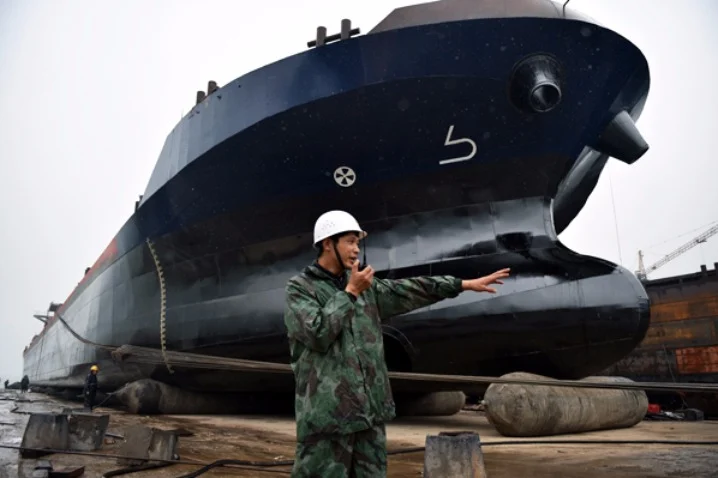
For the first time in seven years, China’s shipbuilding industry has claimed the leading position globally in terms of new orders, surpassing its long-standing rival, South Korea. Data released by the reputable British shipbuilding and marine analysis agency, Clarkson Research Services, on a recent Friday, revealed a significant shift in the global maritime manufacturing landscape. From January to November of the reporting year, Chinese shipyards secured a total of 7.13 million compensated gross tons (CGT) across 324 vessels, outperforming South Korea, which received 5.74 million CGT in new orders during the same period. This achievement underscores a pivotal moment in the intense international competition within the shipbuilding sector, reflecting China’s strategic advancements and growing capabilities in an industry critical for global trade and national economic strength.
A Decisive Shift in Global Maritime Dominance
The latest figures from Clarkson Research Services delineate a clear ascendancy for China, capturing 36.3 percent of the global market share for new shipbuilding orders. This represents a substantial 7 percentage point lead over South Korea, which accounted for 29.4 percent of global orders. This shift is not merely a quantitative victory but also signifies a qualitative leap for Chinese shipbuilders, who have increasingly moved beyond conventional vessel types to secure contracts for more complex, high-value-added ships. The "compensated gross tonnage" (CGT) metric is particularly indicative of this qualitative change, as it accounts for the amount of work required to build a ship, meaning higher-value and more technically demanding vessels contribute more to CGT figures than simpler, larger bulk carriers. This metric highlights that China’s recent success is not solely based on volume but also on the increasing sophistication of its output.
The rivalry between China, South Korea, and Japan has defined the global shipbuilding industry for decades. Historically, Japan held sway in the post-war era, before South Korea’s rapid rise in the late 20th century, particularly in highly technical segments like Liquefied Natural Gas (LNG) carriers, very large crude carriers (VLCCs), and large container ships. China, entering the fray with robust government backing and immense industrial capacity, initially focused on more standardized vessels such as bulk carriers and tankers, leveraging competitive labor costs and a vast domestic market. The global financial crisis of 2008-2009 significantly impacted shipbuilding demand worldwide, leading to overcapacity and fierce price competition. In the aftermath, China aggressively expanded its shipbuilding infrastructure and capabilities, steadily closing the technology gap with its competitors.
Key Orders Signifying China’s Growing Prowess
The year’s performance has been bolstered by several landmark contracts that highlight the burgeoning capabilities of Chinese shipyards. In August, the French shipping giant CMA CGM SA placed an order for nine colossal 22,000 twenty-foot equivalent units (TEU) container vessels. These massive ships, among the largest in the world, were commissioned from Shanghai Waigaoqiao Shipbuilding Co and Hudong Zhonghua Shipbuilding Co, both prominent players in China’s shipbuilding landscape. Such orders for ultra-large container ships, which demand significant engineering and manufacturing precision, underscore the international shipping industry’s confidence in Chinese yards’ ability to deliver cutting-edge vessels.
Further cementing this trend, October saw an unprecedented agreement between China State Shipbuilding Corp (CSSC), China Investment Corp, and Carnival Corp, the world’s largest cruise operator. This consortium committed a substantial 25.5 billion yuan ($3.85 billion) investment towards the construction of a super luxury cruise ship. This particular order represents a monumental breakthrough for Chinese shipbuilding companies, as it marks their first foray into the highly specialized and exceptionally lucrative cruise ship construction market. This segment has traditionally been dominated by a handful of European shipyards, requiring advanced design, complex interior outfitting, and stringent safety standards. Securing such a contract signals China’s ambition and demonstrated capacity to compete at the absolute pinnacle of maritime manufacturing.
The Strategic Shift: From Quantity to Quality and Innovation
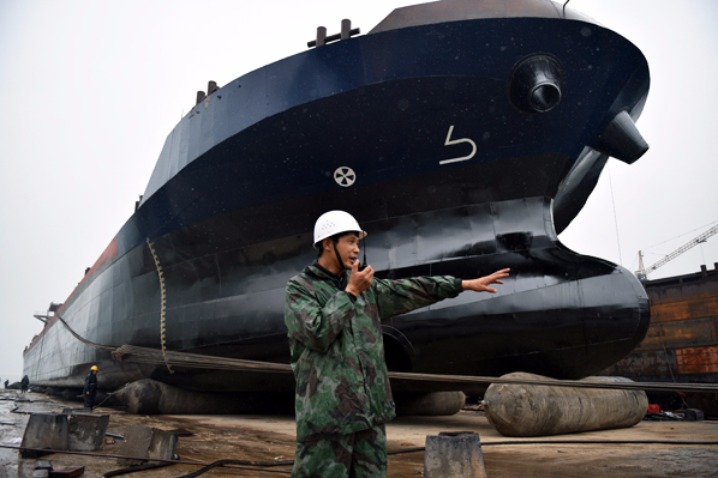
The transformation of China’s shipbuilding industry is characterized by a deliberate strategic pivot from merely focusing on volume to prioritizing quality, technological sophistication, and environmental sustainability. Dong Liwan, a shipbuilding industry researcher at Shanghai Maritime University, aptly observed that "with the orders for high-value-added ships continuing to go to Chinese shipyards, their South Korean competitors will definitely feel the pinch." This statement encapsulates the competitive pressure now being exerted on established leaders by China’s comprehensive industrial upgrading.
This strategic shift is deeply embedded in national industrial policies, such as the "Made in China 2025" initiative, which aims to elevate China’s manufacturing capabilities across various high-tech sectors, including advanced maritime equipment. Sun Licheng, President of the China Classification Society, emphasized this commitment: "China’s shipbuilding industry is realizing the transformation with its hardworking spirit to achieve technical breakthrough and innovation." He further stated that "while maintaining growth, it is realizing production mode transformation, structural adjustment and transformation, and upgrading, and reinforcing China’s shipbuilding status in the world." The overarching goal, as articulated by Sun, is for China to evolve into a "strong shipbuilding country by 2020," with a concentrated effort on accelerating the development of advanced intelligent manufacturing and industrial equipment capabilities.
Pioneering Smart and Green Shipping Technologies
The emphasis on intelligence and environmental friendliness is not merely rhetoric but is being actively demonstrated through tangible projects. At the recent All China Maritime Conference and Exhibition, China State Shipbuilding Corporation (CSSC) proudly unveiled the world’s first smart ship, named Great Intelligence. This vessel, a bulk carrier with a loading capacity of 38,800 metric tons, integrates advanced information technology, big data, and artificial intelligence to enhance operational efficiency, safety, and environmental performance. Features include intelligent navigation, real-time monitoring of ship performance, and optimized routing, setting a new benchmark for autonomous and data-driven maritime transport. The deployment of such a vessel illustrates China’s commitment to leading the digitalization of the shipping industry.
Parallel to this technological push is a strong commitment to environmental stewardship. The global maritime industry faces increasing pressure from international regulations, such as those imposed by the International Maritime Organization (IMO), to reduce emissions and pollution. Chinese shipyards are responding proactively. COSCO Dalian shipyard, for instance, has signed significant orders with Thordon Bearings, a leading marine industry solution provider, for its water-lubricated propeller shaft bearings. This innovative technology allows ships to use seawater as the lubrication medium instead of traditional oil, thereby eliminating the risk of oil pollution into marine ecosystems. Alex Li, managing director of CY Engineering Co Ltd, Thordon Bearings’ partner in China, highlighted the significance of this collaboration: "The latest order is a significant sign showing Chinese shipbuilders’ commitment to reducing industry-borne emissions and pollutants." This move is indicative of a broader trend where environmental sustainability is becoming a key differentiator and a driver of innovation within China’s shipbuilding sector.
Broader Implications and Future Outlook
The implications of China’s rise to the top of the global shipbuilding order books are far-reaching. For China, it reinforces its position as a global manufacturing powerhouse and a key player in international trade. The shipbuilding industry is a significant employer and a catalyst for technological development, with spillover benefits for other heavy industries, materials science, and digital technologies. It also plays a crucial strategic role in supporting China’s expanding maritime interests, including its vast merchant fleet and its ambitious Belt and Road Initiative, which relies heavily on efficient global shipping networks.
For South Korea, this shift necessitates a reevaluation of strategy. While Korean yards still maintain a technological edge in certain ultra-high-value segments like sophisticated LNG carriers and specialized offshore drilling units, the competitive landscape demands further innovation and consolidation. South Korean shipbuilders have been under pressure to streamline operations, reduce costs, and focus on proprietary technologies to maintain profitability and market share. The "pinch" described by Dong Liwan is likely to intensify, pushing Korean firms to accelerate their own transitions towards higher-margin, technologically advanced products and services.
Globally, the increased competition from China could lead to greater innovation across the industry as shipyards worldwide strive to differentiate themselves. It also suggests a potential reshaping of global supply chains for maritime components and services. As China’s expertise grows in areas like smart shipping and green technologies, it is poised to become an even more influential voice in setting international standards and driving future maritime developments. The transition from merely constructing vessels to pioneering intelligent, environmentally friendly, and highly complex ships marks a new era for China’s shipbuilding industry, cementing its status as a formidable leader on the global stage. The journey towards becoming a "strong shipbuilding country" by 2020 and beyond appears to be well underway, with profound implications for the future of global commerce and maritime innovation.

 Evan Lee Salim
 Suro Senen