Jia Lissa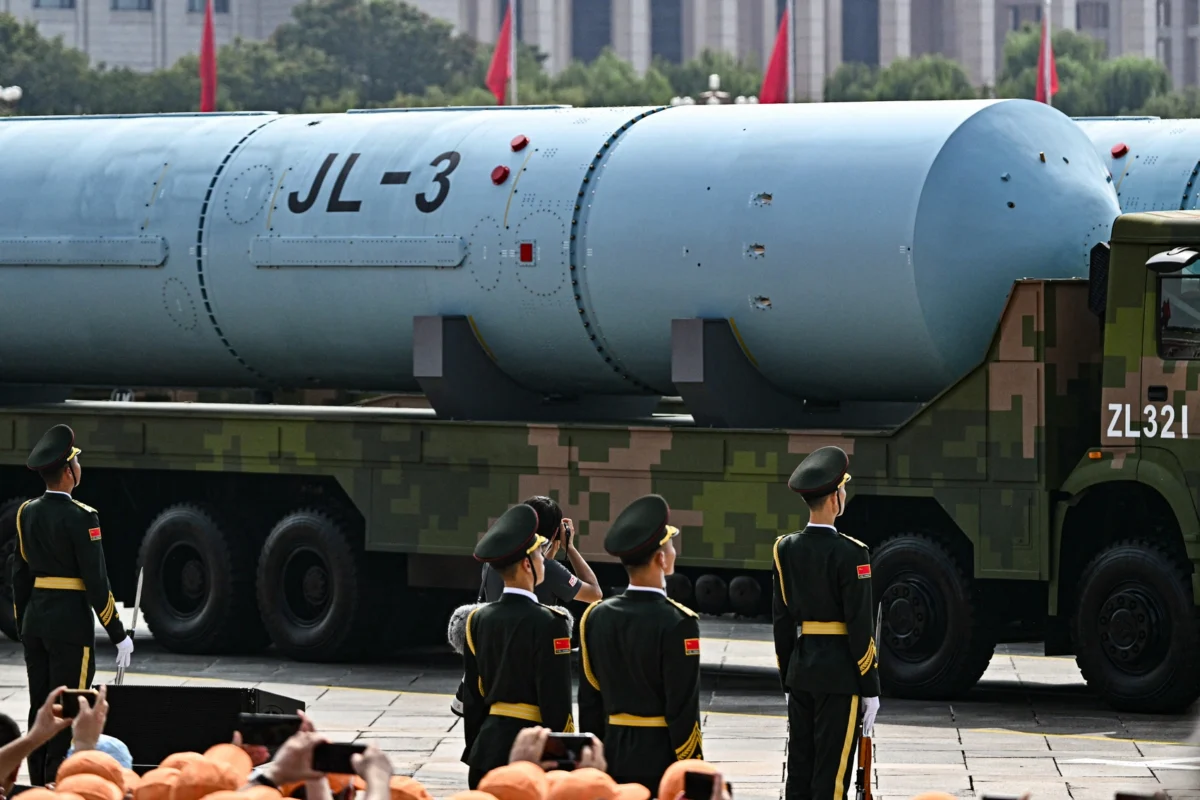
A Chinese submarine test-fired a "strategic" missile carrying a dummy warhead into the Pacific Ocean on Monday, Beijing announced, a move that immediately drew sharp condemnation from nations across the Indo-Pacific region. The incident, confirmed by China’s Ministry of National Defense, unfolded at approximately 12:01 pm (0401 GMT), when a nuclear-powered submarine launched what was described as a "strategic missile carrying a training simulation warhead." According to an official statement released via WeChat by spokesperson Wang Xuemeng, the missile "accurately land(ed) in the designated sea area," asserting that the test was a "routine arrangement of China’s annual military training" and that "relevant countries were informed in advance." However, the timing and nature of the launch have ignited fresh concerns about regional stability and Beijing’s rapidly expanding military capabilities, particularly its nuclear arsenal.
This latest demonstration of military might by the People’s Liberation Army (PLA) Navy occurred on a day already charged with geopolitical significance. Coinciding with the missile test, Australia and Fiji signed a pivotal defense treaty, a strategic move by Canberra to strengthen alliances and counter Beijing’s growing influence in the South Pacific. Simultaneously, China and Russia commenced their annual joint naval exercises, known as "Joint Sea," off the coast of Qingdao, a major Chinese military port. These concurrent events underscore a complex and increasingly tense security environment in the Indo-Pacific, where China’s assertive military posture is being met with enhanced regional security cooperation and vocal diplomatic protests.

A Pattern of Escalation: China’s Strategic Missile Program
The recent submarine-launched ballistic missile (SLBM) test is not an isolated event but rather fits into a broader pattern of China’s accelerated military modernization and strategic weapons development. This includes a significant expansion of its nuclear capabilities and an increase in defense spending, which has consistently ranked among the highest globally. According to the U.S. Pentagon’s annual report on China’s military power, Beijing held more than 500 operational nuclear warheads as of May 2023, a substantial increase from previous years. The report further projects that China is likely to possess over 1,000 nuclear warheads by 2030, a trajectory that puts it on pace to become one of the world’s leading nuclear powers, challenging the long-standing nuclear parity between the United States and Russia.
This rapid build-up is driven by China’s ambition to achieve a credible nuclear triad—the ability to launch nuclear weapons from land-based intercontinental ballistic missiles (ICBMs), strategic bombers, and submarines. The development of advanced SLBMs, such as the JL-3 (Júlang-3) which is believed to be the missile tested, is crucial for establishing a robust second-strike capability. This means that even if its land-based nuclear forces were neutralized in a first strike, China’s submarines, hidden deep in the ocean, could retaliate, thereby enhancing its overall nuclear deterrence. The JL-3, a third-generation intercontinental-range SLBM, represents a significant leap in China’s undersea warfare capabilities, allowing its Type 094 Jin-class nuclear-powered ballistic missile submarines (SSBNs) to target distant adversaries from protected waters.

The current test echoes a similar event two years prior, in 2024, when China’s elite Rocket Force fired an intercontinental ballistic missile into the sea near French Polynesia. That launch, believed to be one of China’s advanced Dong Feng-31 missiles capable of delivering a thermonuclear warhead, marked China’s first ICBM launch over international waters in more than 40 years. Crucially, the 2024 missile splashed down into a patch of ocean that is part of a designated nuclear-free zone under an international treaty, drawing criticism for disregarding established norms. New Zealand’s Foreign Minister Winston Peters highlighted this "recurring pattern," indicating that such tests are becoming a regular feature of China’s military activities in the Pacific, a sentiment echoed by internal documents from the New Zealand Defence Force, which privately warned last month that Beijing’s naval forays and ballistic missile tests would become a "persistent" feature of the Pacific region.
Regional Reactions and Diplomatic Fallout
The response from regional powers was swift and unequivocal. New Zealand’s Foreign Minister Winston Peters expressed "deep concern" over the test, emphasizing that "the Pacific is an Ocean of Peace." He stated that the launch "is not consistent with regional stability" and revealed that his country was only informed "within hours" of the test, raising questions about the adequacy of China’s prior notification claim. This immediate pre-notification, however brief, was confirmed by Papua New Guinea’s Foreign Minister Justin Tkatchenko, who stated, "Yes, China has briefed me. I was personally called by the Chinese ambassador." A New Zealand government source similarly confirmed that China had alerted them about an upcoming ICBM test.

Australia, a key regional ally and increasingly vocal critic of China’s military expansion, labeled the launch "destabilising." Australian officials reiterated concerns about actions that could escalate tensions and undermine the rules-based international order. Japan, another critical player in Indo-Pacific security, also voiced strong objections, stating it had "strongly called for a rethink" of the test and "expressed serious concerns over China’s increasing military activity." These reactions collectively highlight a growing apprehension among democratic nations in the region regarding China’s military ambitions and its willingness to conduct high-stakes strategic weapons tests in international waters.
The condemnation from these nations is rooted in a broader context of historical sensitivities and contemporary geopolitical competition. Pacific island nations, in particular, remain deeply scarred by the legacy of nuclear tests conducted by Western powers in the decades following World War II. The memories of environmental damage, health crises, and forced displacement caused by these tests make any similar activity, even with dummy warheads, a highly sensitive issue that resonates deeply within their communities.
The Geopolitical Chessboard: Australia-Fiji Treaty and China-Russia Drills

The timing of China’s missile test amplified its geopolitical implications, particularly in relation to the newly signed defense treaty between Australia and Fiji. This treaty represents a significant diplomatic victory for Australia, bolstering its ties with a crucial Pacific island nation and strengthening its efforts to counter China’s expanding influence in the region. Australia, alongside allies like the United States and the United Kingdom through the AUKUS security pact, has been actively working to enhance security cooperation with Pacific island states, offering defense and security assistance to prevent any single power from dominating the region. This strategy directly responds to China’s "charm offensive" in the Pacific, which has seen Beijing invest heavily in infrastructure projects such as new hospitals, freshly paved roads, and gleaming sports stadiums across various island nations. While these projects are framed as development aid, critics argue they often come with geopolitical strings attached, potentially leading to debt traps and increased Chinese strategic leverage, as evidenced by the controversial security pact China signed with the Solomon Islands in 2022.
Adding another layer of complexity, the missile test coincided with the commencement of the "Joint Sea" annual joint naval exercises between China and Russia off Qingdao. These exercises, which involve both sides conducting "harbour-based planning" such as "exercises in command and tactical coordination," are slated to progress to sea drills encompassing "joint reconnaissance, air and missile defence, as well as training in the actual use of weapons," according to China’s state news agency Xinhua. The deepening military cooperation between China and Russia is a significant geopolitical development, signaling a strategic alignment against what both perceive as Western hegemony. These joint drills demonstrate a growing interoperability between their forces and project a united front, further contributing to the shifting global power dynamics and increasing the strategic challenges for the United States and its allies.
Implications for Regional Security and International Norms

The latest SLBM test by China carries significant implications for regional security and international norms. While China asserts the test was routine and pre-notified, the fact that it was conducted with a "strategic missile carrying a training simulation warhead"—meaning a missile designed to carry a nuclear payload—raises alarms about its nuclear modernization program. Such tests, even with dummy warheads, serve to validate advanced missile technology and demonstrate operational readiness, which can be interpreted as both a deterrent signal and a provocative act depending on the perspective.
From China’s standpoint, these tests are essential for ensuring the reliability and effectiveness of its strategic deterrence capabilities, particularly its nascent sea-based leg of the nuclear triad. A robust SLBM force provides greater survivability for its nuclear arsenal, making it less vulnerable to a pre-emptive strike and thus enhancing its overall deterrence posture. This aligns with China’s long-term goal of building a "world-class military" by 2049, capable of defending its national interests and projecting power globally.
However, from the perspective of its neighbors and the wider international community, these tests contribute to an atmosphere of distrust and could fuel an arms race in the region. The Pacific Ocean, traditionally envisioned as a zone of peace and cooperation, is increasingly becoming a theater for strategic competition. The continued presence of advanced military assets and the conduct of missile tests by major powers risk undermining fragile regional stability and complicating efforts towards non-proliferation. The concerns raised by New Zealand, Australia, and Japan are not merely diplomatic protests but reflect genuine anxieties about the potential for miscalculation or escalation in an increasingly militarized region. The assessment by the New Zealand Defence Force that China’s ballistic missile tests are becoming a "persistent feature" suggests a future where such demonstrations of force are normalized, further entrenching a climate of strategic uncertainty in the Indo-Pacific.

 Sagoh
Sagoh
 Asro
Asro