Asep Darmawan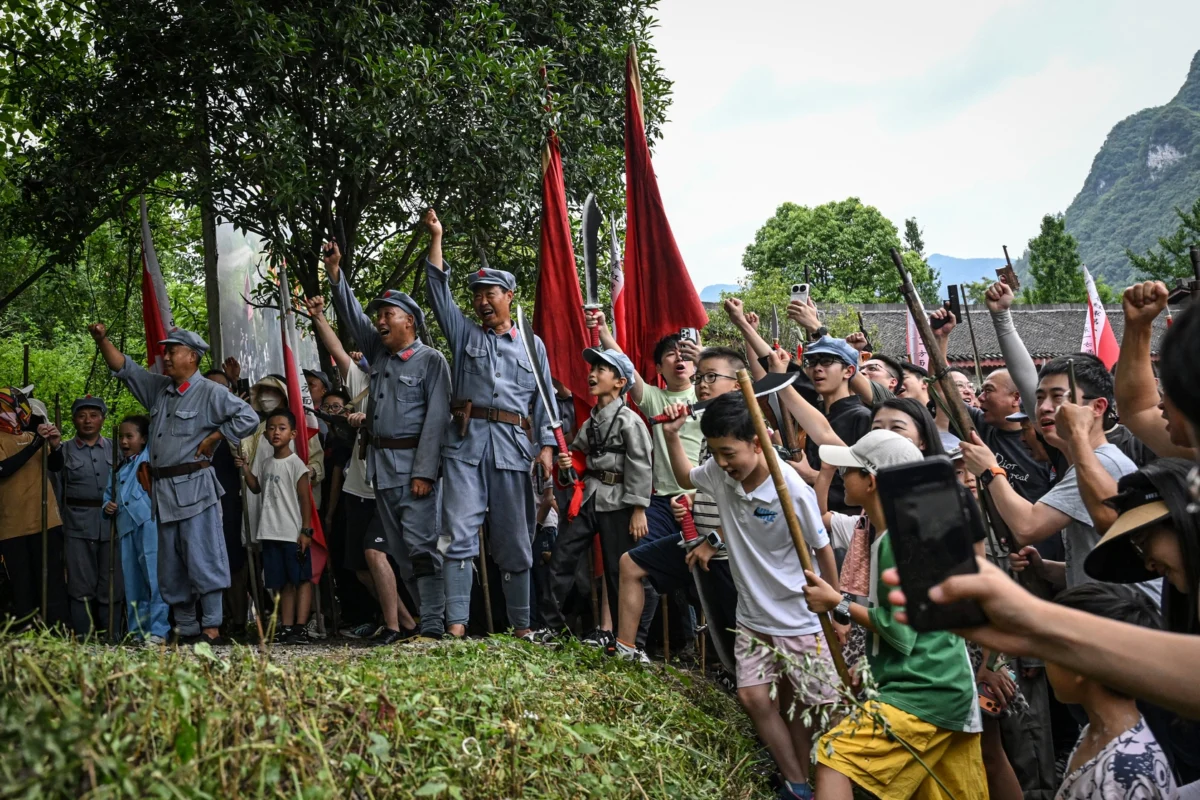
Nestled amidst the rugged peaks of China’s southwestern Guizhou Province, the Loushan Pass recently became the vibrant stage for a spectacular reenactment of a pivotal 1935 battle, drawing throngs of participants and spectators alike. Dressed in meticulously crafted Red Army uniforms and brandishing prop weapons, scores of tourists, accompanied by professional performers, surged up a steep mound, their advance illuminated by dazzling pyrotechnics that painted the hillside with flashes of light and plumes of smoke. The immersive spectacle, held on July 25, 2026, transformed the historic site into a living canvas, allowing over a thousand visitors over a single weekend to "relive" a critical moment in China’s revolutionary history. This event is a prominent example of China’s "red tourism" initiative, a government-backed program aimed at promoting patriotic education and historical memory through experiential travel to sites significant in the country’s communist past.
The atmosphere at Loushan Pass was electric, a blend of historical reverence and theatrical excitement. Participants, ranging from earnest adults to enthusiastic children as young as five, embraced their roles with fervor. A platoon of squealing youngsters, also donned in miniature Red Army costumes, brandished toy swords and charged uphill, aiming to "capture" positions notionally held by the Nationalist Kuomintang forces. As they reached their objectives, bright red flags, symbolizing victory, were triumphantly raised against a backdrop of billows of smoke and the concussive sounds of simulated "bombs," adding to the visceral realism of the experience.

For many, this was more than just a performance; it was a profound journey back in time. Jiang Jun, a 40-year-old tourist, articulated this sentiment to AFP, describing the event as "truly awe-inspiring." He elaborated, "It felt as though I was actually right there in the thick of the battle. I felt as though I could experience what those martyrs must have felt back then." This emotional connection to the past, fostering a sense of shared national identity and sacrifice, is precisely the goal of such meticulously orchestrated events. Another participant, identified only as Xu, who had traveled from the neighboring Guangxi province, underscored the perceived national importance of memorializing such locations. "If Mao’s forces had not broken through nationalist lines at Loushan Pass," Xu asserted, "we wouldn’t have the new China that we have today and our standard of living wouldn’t be so good." Such statements reflect a widely held belief in China regarding the indispensable role of these historical struggles in forging the modern nation.
The Strategic Significance of Loushan Pass
The Battle of Loushan Pass holds an iconic status within the annals of Chinese Communist Party (CPC) history, primarily for its role during the legendary Long March. The Long March, a monumental military retreat undertaken by the Red Army of the Communist Party of China to evade the pursuit of the Kuomintang army, spanned from October 1934 to October 1936. It was a harrowing odyssey covering thousands of miles across treacherous terrain, with immense casualties. By early 1935, the Red Army, having suffered devastating losses, was in a desperate situation.
Loushan Pass, a strategically vital mountain pass located north of Zunyi, presented a formidable natural barrier. Its control was crucial for either advancing or retreating forces. The Red Army engaged the Nationalist forces in two significant clashes at Loushan Pass in 1935. The first, on January 25, 1935, saw the Red Army briefly seize the pass but then withdraw to prepare for the crucial Zunyi Conference. The second, and more decisive, battle occurred on February 28, 1935. Following the Zunyi Conference – where Mao Zedong’s leadership was consolidated – the Red Army launched a renewed offensive. Under Mao’s strategic direction, the Communist forces executed a brilliant maneuver, breaking through Chiang Kai-shek’s Nationalist encirclement. This victory was not merely tactical; it was a profound psychological boost for the embattled Red Army and cemented Mao’s authority. It marked the first major Red Army victory against the Nationalists since the start of the Long March, reversing a string of defeats and rekindling hope among the exhausted troops.

Mao Zedong himself immortalized this triumph in a poignant poem titled "Loushan Pass" (忆秦娥·娄山关), written shortly after the battle. The poem captures the harsh beauty of the landscape and the fierce determination of the Red Army, becoming a powerful piece of revolutionary literature that continues to be widely recited and celebrated in China. Its lines evoke the "iron pass," the "waning moon," and the "west wind," painting a vivid picture of the struggle and eventual victory. This poetic legacy further elevates the pass’s importance beyond mere military strategy, embedding it deeply into the national cultural consciousness.
The Long March: A Foundation Myth
To understand the full weight of the Loushan Pass reenactment, one must grasp the profound significance of the Long March in Chinese history and its role as a foundational myth for the People’s Republic of China. Spanning over 12,500 kilometers (approximately 7,767 miles) and involving multiple Communist armies, the Long March was a testament to endurance, sacrifice, and ideological conviction. It was during this arduous journey that Mao Zedong emerged as the undisputed leader of the Communist Party, shaping its future direction and ultimately leading it to victory in the Chinese Civil War.
The Long March is presented as a crucible that forged the spirit of the Communist Party, demonstrating its resilience, revolutionary zeal, and deep connection with the common people. Its narrative is replete with stories of heroism, strategic genius, and unwavering commitment to the revolutionary cause. Key events along the march, such as the Zunyi Conference, the crossing of the Dadu River, and the snowy mountains, are celebrated as milestones in the Party’s journey to power. These narratives are not merely historical accounts; they are foundational pillars of patriotic education, instilling in successive generations a sense of national pride, unity, and loyalty to the CPC. The Loushan Pass, as the site of a crucial victory during this epic retreat, naturally commands a significant place within this narrative, offering a tangible link to a heroic past.

The Rise of "Red Tourism"
The reenactment at Loushan Pass is a direct manifestation of Beijing’s decades-long strategic initiative to develop "red tourism" (红色旅游). This program encourages domestic travel to sites that hold historical and cultural significance related to the Chinese Communist Revolution, the War of Resistance Against Japanese Aggression, and the founding of the People’s Republic of China. The primary objectives of red tourism are multifaceted:
- Patriotic Education: To instill patriotism, revolutionary ideals, and a sense of national identity, particularly among younger generations.
- Historical Memory: To preserve and promote the official narrative of the Communist Party’s history and its struggles.
- Regional Development: To boost economic growth in historically revolutionary but often economically underdeveloped regions, such as Guizhou, Jiangxi, and Shaanxi provinces.
- Cultural Exchange: To offer domestic and international tourists a unique insight into a crucial period of Chinese history and culture.
The government has heavily invested in infrastructure development, site preservation, and the creation of immersive experiences at red tourism destinations. These sites range from Mao Zedong’s birthplace in Shaoshan, Hunan Province, to the revolutionary base of Jinggangshan, the Zunyi Conference site (also in Guizhou), and the caves of Yan’an where the Red Army established its headquarters after the Long March.
Data from the China Tourism Academy indicates the significant growth of red tourism. Before the COVID-19 pandemic, red tourism typically accounted for a substantial portion of China’s domestic tourism market, with hundreds of millions of visits annually. For instance, in 2019, red tourism sites attracted an estimated 1.4 billion visits, generating substantial revenue and supporting local economies. While the pandemic caused a temporary dip, the sector has seen a strong rebound, particularly with increased domestic travel. The central government continues to champion red tourism as a key component of its national development strategy, with plans to further upgrade facilities, enhance visitor experiences, and integrate modern technology like virtual reality (VR) and augmented reality (AR) to make historical narratives even more engaging.

Economic and Social Implications for Guizhou
Guizhou Province, where Loushan Pass is located, is one of China’s most mountainous and historically impoverished regions. The promotion of red tourism here serves a dual purpose: historical education and economic revitalization. Tourism, in general, has become a critical driver of economic growth in Guizhou, lifting many communities out of poverty. The development of sites like Loushan Pass brings direct economic benefits through ticket sales, local employment (for performers, guides, service staff), and increased demand for accommodation, food, and local handicrafts. Indirectly, it stimulates investment in transportation infrastructure, hospitality services, and other related industries.
The Loushan Pass reenactment, which attracted over a thousand people in a single weekend, generates significant revenue for the local economy. This influx of visitors translates into tangible benefits for the residents of Zunyi and surrounding areas. For a province striving to bridge development gaps, red tourism offers a sustainable pathway to prosperity, leveraging its unique historical assets. Moreover, these events often foster a sense of community pride and collective identity among local populations, who see their history celebrated on a national stage.
An Immersive Educational Experience
The Loushan Pass event exemplifies the immersive nature that modern red tourism aims for. It’s no longer just about visiting a museum or a monument; it’s about actively participating in history. The involvement of children, in particular, highlights the intergenerational appeal and the pedagogical intent. By allowing young participants to wear uniforms, wave flags, and "charge" into battle, the organizers aim to create lasting impressions and a tangible connection to the past sacrifices made for the nation. This approach moves beyond rote memorization of historical facts, offering an emotional and experiential learning curve.

The use of actors portraying historical figures, coupled with realistic pyrotechnics and sound effects, transforms a historical site into a vibrant narrative. This dramatic flair, while engaging, also raises interesting questions about the balance between historical accuracy and theatrical presentation. While the broad strokes of the battle are preserved, certain details might be simplified or dramatized for maximum impact. However, for the majority of participants, the goal is not a forensic historical analysis but an emotional resonance and a deeper appreciation for the revolutionary spirit. The social media buzz around such events further amplifies their reach, making them popular cultural phenomena that blend entertainment with education.
Broader Implications and the Future
The reenactment at Loushan Pass is more than just a local tourist attraction; it is a microcosm of China’s broader efforts to harness history for contemporary national goals. By meticulously curating and promoting these revolutionary sites, the Communist Party reinforces its legitimacy and narrative of national liberation and progress. It serves as a powerful tool for "patriotic education," a continuous campaign to strengthen national unity and loyalty to the Party.
The success of such immersive historical experiences suggests a future where red tourism continues to evolve, incorporating more interactive technologies and diverse narratives. As China continues its journey of national rejuvenation, the stories of its revolutionary past, brought to life through events like the Loushan Pass reenactment, will remain central to shaping the collective memory and aspirations of its people. The experience of storming a historic mound, feeling the simulated tremors of "bombs," and raising a red flag, offers a unique blend of adventure, education, and patriotic reflection, ensuring that the legacy of the Long March and its pivotal battles like Loushan Pass endure for generations to come. The enthusiastic participation of tourists like Jiang Jun and Xu underscores the deep cultural resonance and continued relevance of these historical narratives in modern Chinese society.


 Jia Lissa
 Azzam Bilal Chamdy