Raul Delapena Setiawan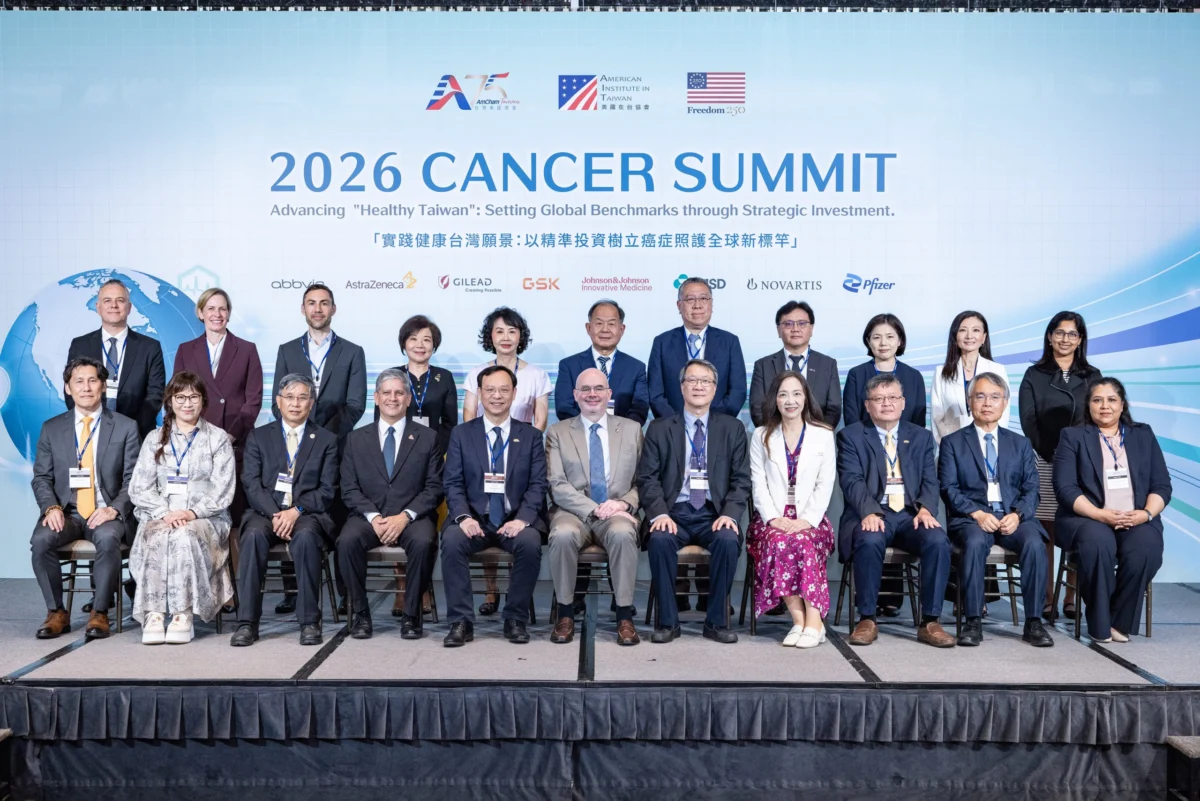
The American Chamber of Commerce in Taiwan (AmCham Taiwan) and the American Institute in Taiwan (AIT) hosted the 2026 AmCham Taiwan Cancer Summit on July 28 at the Regent Taipei, marking a significant milestone in the ongoing efforts to modernize the nation’s oncological care. Under the central theme of “Advancing ‘Healthy Taiwan’: Setting Global Benchmarks through Strategic Investment,” the summit served as a high-level platform for government officials, industry leaders, academic experts, and patient advocacy groups to address the critical challenges of resource allocation, funding sustainability, and the integration of innovative therapies into the national healthcare framework.
This year’s summit arrived at a pivotal moment for Taiwan’s healthcare policy, as the administration continues to push toward the ambitious goal of reducing the standardized cancer mortality rate by one-third by the year 2030. The event emphasized that achieving such a target requires more than just clinical excellence; it demands a robust, connected ecosystem supported by sustainable financial mechanisms and international collaboration.
Evolution of the Cancer Summit and the U.S.-Taiwan Partnership
The 2026 summit represents the fourth iteration of an initiative that began in 2021. Originally launched as broader healthcare innovation forums by AmCham and AIT, these gatherings were designed to foster dialogue on policy and industry collaboration between the United States and Taiwan. The shift toward a dedicated Cancer Summit occurred in 2023, spearheaded by AmCham Taiwan’s Pharmaceutical Committee.
The conceptual foundation of the summit is deeply rooted in the spirit of the U.S. Cancer Moonshot initiative, which seeks to accelerate the rate of progress against cancer. As cancer remains the leading cause of death in Taiwan and a top public health priority in the United States, the summit has evolved into a premier venue for bilateral exchange. Over the past four years, the forum has transitioned from discussing general healthcare digital transformation to focusing on specific, actionable strategies for cancer drug reimbursement, clinical trial expansion, and the implementation of precision medicine.
The partnership between AmCham and AIT underscores the strategic nature of healthcare in the U.S.-Taiwan relationship. Beyond diplomatic ties, the collaboration facilitates the entry of cutting-edge American biomedical innovations into the Taiwan market, while allowing Taiwan to showcase its high-quality clinical data and research capabilities to global stakeholders.
Strategic Investment and the Healthy Taiwan Vision
AmCham Taiwan President Carl Wegner opened the summit by highlighting that cancer is not merely a medical issue but a multifaceted global health challenge that intersects with economic stability and social welfare. Wegner noted that scientific breakthroughs in the laboratory can only benefit society if they are supported by strong partnerships and sustainable investment. He advocated for a “future-ready” healthcare system that prioritizes the translation of innovation into tangible patient outcomes.
Central to the discussions was President Lai Ching-te’s “Healthy Taiwan” vision. This policy framework aims to reshape the national healthcare landscape by prioritizing preventative care and the rapid adoption of new medical technologies. The summit served as a sounding board for how this vision can be operationalized through strategic investment, particularly in the realm of oncology.
Minister of Health and Welfare Shih Chung-liang delivered the Grand Keynote Dialogue, providing a comprehensive overview of the government’s progress. He detailed the establishment of the Healthy Taiwan Promotion Committee, a body designed to oversee the digital and structural transformation of the nation’s health services. Minister Shih emphasized that the government is no longer looking at healthcare spending as a cost, but as a strategic investment in the nation’s human capital.
The Cancer Drugs Fund: Financial Sustainability and Digital Transformation
One of the most critical topics discussed was the optimization of the Cancer Drugs Fund (CDF). Established in 2025, the CDF was designed to bridge the gap between the regulatory approval of innovative therapies and their eventual reimbursement under the National Health Insurance (NHI) system.
Minister Shih revealed significant updates regarding the fund’s progress and the broader oncology budget. He noted that the government has more than doubled the cancer screening budget, increasing it from NT$2.8 billion to NT$6.8 billion. This surge in funding is intended to catch malignancies at earlier, more treatable stages, which is both more effective for patient survival and more cost-efficient for the state in the long run.
However, the sustainability of the CDF remains a primary concern for industry stakeholders. The first panel of the summit, titled "Strategic Investment and Long-term Sustainability of the CDF," explored how to ensure the fund remains viable as more high-cost, high-efficacy drugs enter the market. Panelists discussed the necessity of outcome-based reimbursement models, where the government pays for drugs based on their actual clinical performance in the Taiwanese population.

To support these efforts, Minister Shih highlighted the digital transformation of cancer care. By streamlining the prior authorization process through digital platforms, the Ministry of Health and Welfare aims to reduce administrative burdens on clinicians and accelerate patient access to life-saving drugs. Furthermore, the systematic collection of real-world data (RWD) from these digital processes will be used for follow-up evaluations. This data-driven approach allows the government to assess the value of specific treatments accurately, ensuring that the CDF resources are directed toward the most effective therapies.
Aligning with International Standards of Care
The second major pillar of the summit focused on the alignment of Taiwan’s clinical practices with international standards. For Taiwan to be a global leader in oncology, it must ensure that its treatment protocols are consistent with globally recognized guidelines, such as those provided by the National Comprehensive Cancer Network (NCCN).
Medical experts at the summit shared the latest clinical developments in several key areas, including breast cancer, gynecologic cancers, and hematologic malignancies. A recurring theme was the need for "comprehensive care pathways." These pathways extend beyond the administration of drugs to include early diagnosis, genomic testing, and long-term survivorship support.
The discussion highlighted that while Taiwan boasts world-class medical facilities and practitioners, delays in the reimbursement of new drugs can sometimes cause a divergence from international guidelines. Panelists argued that by synchronizing the NHI formulary more closely with NCCN standards, Taiwan could improve its clinical trial environment. When standard-of-care treatments in Taiwan match those in the U.S. and Europe, it becomes significantly easier for Taiwan to participate in multi-national clinical trials, bringing even more innovation to local patients.
Addressing the Mortality Burden and Treatment Gaps
To achieve the goal of a 33% reduction in cancer mortality by 2030, the government is adopting a more granular approach to oncology. Minister Shih stated that the Ministry of Health and Welfare is currently reviewing the specific mortality burdens and treatment gaps across different cancer types.
Not all cancers are equal in their impact on the Taiwanese population. For instance, while progress has been made in treating certain solid tumors, other areas like lung cancer and liver cancer continue to pose significant challenges due to late-stage detection. By prioritizing resources toward high-mortality cancers and implementing tailored prevention and treatment plans, the government hopes to accelerate the decline in the national mortality rate.
This "tailored" approach also involves precision medicine. The summit touched upon the importance of NGS (Next-Generation Sequencing) testing, which the NHI began covering in 2024. The integration of genomic data into the treatment decision-making process is seen as a cornerstone of the "Healthy Taiwan" initiative, allowing for more effective, personalized care that avoids the "trial and error" approach of traditional chemotherapy.
Implications for the Future of U.S.-Taiwan Healthcare Collaboration
The 2026 Cancer Summit reaffirmed the commitment of both AmCham Taiwan and AIT to fostering a resilient healthcare ecosystem. The implications of these discussions extend beyond the immediate oncology sector.
- Economic Resilience: By investing in healthcare innovation, Taiwan strengthens its position as a hub for biotechnology in the Asia-Pacific region. This attracts foreign investment and creates high-value jobs in research and development.
- Regulatory Harmonization: The push for alignment with international standards suggests a future where Taiwan’s regulatory environment for pharmaceuticals becomes more predictable and transparent, benefiting both patients and multinational companies.
- Patient-Centric Policy: The inclusion of patient advocacy groups in the summit highlights a shift toward more inclusive policymaking. Ensuring that the patient’s voice is heard in discussions about drug access and funding is essential for the social legitimacy of healthcare reforms.
- Bilateral Security: Healthcare is increasingly viewed through the lens of national security. A healthy population is a resilient population. The collaboration between the U.S. and Taiwan on cancer research and supply chain stability for essential medicines reinforces the broader strategic partnership.
Conclusion: A Roadmap to 2030
As the 2026 AmCham Taiwan Cancer Summit concluded, the roadmap for the next four years became clearer. The focus will remain on the twin pillars of financial innovation and clinical excellence. With the Cancer Drugs Fund now operational, the challenge shifts to its refinement and long-term integration into the National Health Insurance framework.
The commitment from the Ministry of Health and Welfare to utilize digital transformation and real-world data provides a promising path toward more efficient resource allocation. Meanwhile, the continued advocacy from AmCham and AIT ensures that Taiwan remains connected to the global vanguard of medical innovation.
The goal of reducing cancer mortality by one-third by 2030 is ambitious, but the consensus at the summit was one of cautious optimism. Through continued policy dialogue, strategic investment, and a steadfast commitment to international standards, Taiwan is well-positioned to set a global benchmark for cancer care, fulfilling the promise of a "Healthy Taiwan" for all its citizens.


 Ammar Sabilarrohman
 Asep Darmawan