Neng Nana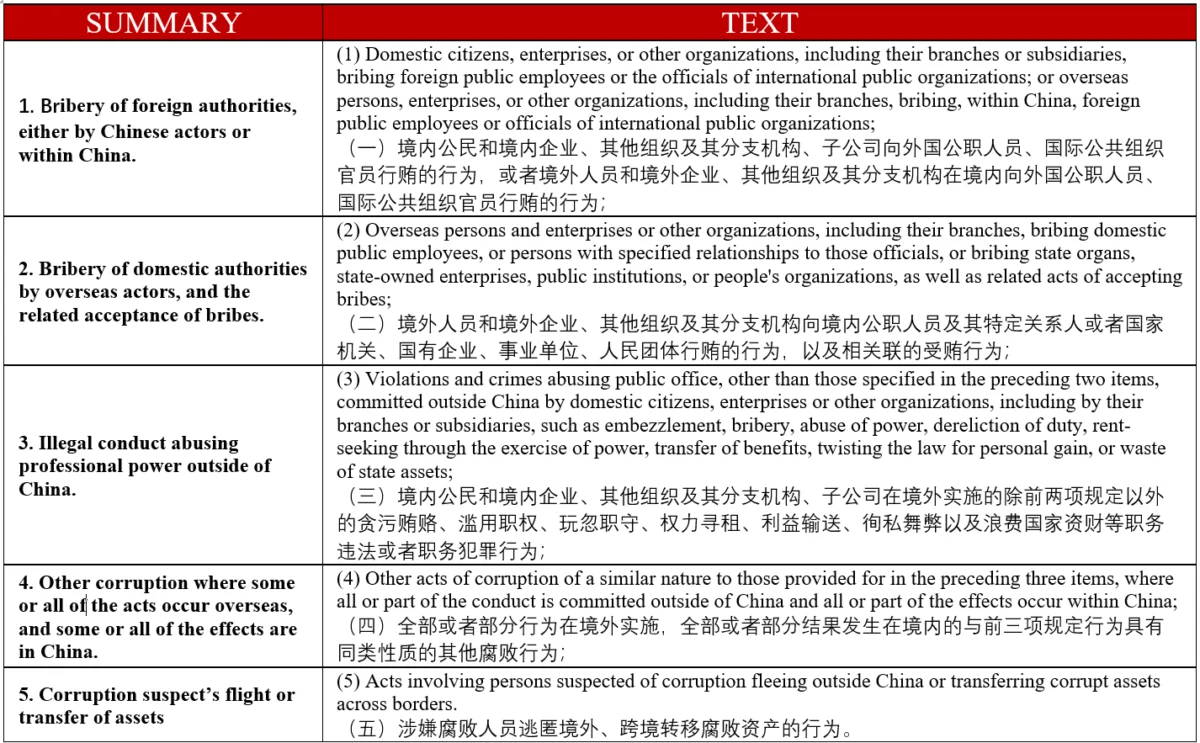
The emergence of the draft Cross-Border Corruption Law (CBCL) marks a pivotal moment in the evolution of the People’s Republic of China’s legal framework, signifying a robust expansion of its extraterritorial jurisdiction. While recent international attention has focused heavily on the Ethnic Unity Law and the draft Procuratorial Public Interest Litigation Law for their potential to target overseas individuals and entities, the CBCL represents a more comprehensive and systemic attempt to regulate conduct far beyond China’s borders. By focusing on coordinated investigations, international cooperation, and mandatory corporate compliance, the CBCL aims to create a holistic environment for addressing corruption in an increasingly globalized economy.
Despite its potential for broad impact, the CBCL has remained relatively under-scrutinized in comparison to other recent legislative drafts. However, legal experts suggest that its implications for multinational corporations, state-owned enterprises (SOEs), and foreign-incorporated subsidiaries could be far-reaching. The law appears to be inspired by established international standards, such as the United States’ Foreign Corrupt Practices Act (FCPA) and the UK Bribery Act, yet it retains a "uniquely Chinese character" that may cover a wider spectrum of conduct and entities than its Western counterparts.
The Evolution of China’s Anti-Corruption Framework: A Chronology
To understand the significance of the CBCL, it is essential to view it within the context of China’s decade-long anti-corruption campaign. Since 2012, the Chinese leadership has prioritized the eradication of corruption as a matter of political survival. This effort has gradually shifted from a domestic focus to a global one as Chinese capital and personnel have expanded through initiatives such as the Belt and Road Initiative (BRI).
The following timeline highlights the key legislative and policy milestones leading to the draft CBCL:
- 2012–2017: The "Tigers and Flies" campaign focuses on domestic officials, leading to the investigation of millions of party members.
- 2014: Launch of "Operation Fox Hunt" and "Operation Sky Net," specifically targeting fugitives and asset recovery from overseas.
- 2018: The National Supervision Law is enacted, establishing the National Supervision Commission (NSC) as a powerful agency with the authority to investigate public officials, including those in state-owned enterprises.
- 2021: Multi-agency guidelines are issued to strengthen the prevention of corruption in overseas projects, signaling a shift toward corporate accountability in international business.
- 2023: Amendments to the Criminal Law increase penalties for bribery, including private-sector bribery, reflecting a broadening definition of corrupt acts.
- 2025: The Ministry of Commerce (MOFCOM) releases the "Guidelines on Overseas Integrity Compliance for Enterprises," providing a voluntary blueprint for what has now become mandatory under the draft CBCL.
- 2026: The draft Cross-Border Corruption Law is released for public comment, consolidating various enforcement powers and compliance requirements into a single statute.
Defining the Scope: The Ambiguities of Article 3
At the heart of the CBCL is Article 3, which defines "cross-border corruption." Crucially, this article does not establish new criminal offenses. Instead, it serves as a jurisdictional trigger, determining when the law’s provisions regarding prevention, reporting, and international cooperation are activated.
One of the most significant aspects of Article 3 is its treatment of subsidiaries. Items 3(1) and 3(3) explicitly include the conduct of "branches and subsidiaries" of domestic enterprises. Legal analysts point out that while a subsidiary incorporated within China is already subject to domestic law, the inclusion of "subsidiaries" in this context is clearly intended to capture entities incorporated under foreign laws.
This creates a scenario where a subsidiary of a Chinese company, incorporated in the United States and staffed entirely by non-Chinese citizens, could fall under the scope of Chinese law if it engages in bribery within the U.S. While a criminal prosecution would still require a specific offense under the Chinese Criminal Law, the CBCL imposes reporting and compliance obligations on the Chinese parent company that are triggered by the subsidiary’s actions. This "parental responsibility" model mirrors the reach of the FCPA but applies it through the lens of China’s supervision system.
Furthermore, Article 3(3) introduces the concept of "malfeasance in office" (zhiwu weifa fanzui). This term typically refers to abuses of public power, such as embezzlement or rent-seeking by state actors. However, Chinese courts have occasionally interpreted this broadly to include "abuse of office by non-state actors," such as private-sector employees misappropriating company funds. If the CBCL adopts this broader reading, it would significantly expand the regulatory burden on private businesses operating internationally, requiring them to monitor and report a much wider range of internal misconduct.
Mandatory Compliance: A New Standard for Global Business
Articles 29 through 34 of the draft law establish a mandatory compliance framework for enterprises engaged in cross-border operations. This is a departure from previous guidance, which was largely advisory. The law mandates that enterprises establish systems for:
- Risk Identification and Assessment: Regularly evaluating the legal and reputational risks of their overseas jurisdictions.
- Internal Reporting Mechanisms: Creating "whistleblower" channels for employees to report suspected corruption.
- Financial Controls: Ensuring accurate record-keeping and the oversight of third-party agents or consultants.
- Education and Training: Providing mandatory anti-corruption training for employees and management.
The most potent tool in this section is Article 45, which creates a new form of liability based solely on the failure to maintain these systems. If an enterprise fails to meet its compliance obligations, authorities can order a period of rectification. Continued non-compliance can lead to severe administrative penalties, including the suspension of business operations or the revocation of business licenses. Importantly, these penalties can be applied even if no specific act of bribery or corruption has been proven; the "failure to comply with compliance" is itself the violation.

International Cooperation and the UNCAC Framework
The CBCL formalizes China’s approach to international legal assistance, largely aligning it with the United Nations Convention against Corruption (UNCAC). The draft provides a structured framework for pursuing fugitives, obtaining evidence from foreign jurisdictions, and recovering assets moved abroad.
However, the law also introduces strict controls on how domestic entities interact with foreign investigators. Much like China’s Data Security Law and the International Criminal Judicial Assistance Law, the CBCL requires that any cooperation with foreign law enforcement be channeled through designated Chinese authorities. This is intended to protect "national security and public interests," but it creates a complex legal environment for multinational corporations caught in overlapping investigations by multiple countries.
For example, if a company is under investigation by both the U.S. Department of Justice and the Chinese National Supervision Commission, the CBCL effectively prohibits the company from providing data or testimony to the U.S. authorities without prior Chinese government approval. This "blocking" mechanism could lead to significant legal friction between China and Western regulatory bodies.
Analysis of Implications and Stakeholder Reactions
The introduction of the CBCL has prompted a variety of reactions from legal practitioners and the business community. While the law provides more clarity on the government’s expectations, it also introduces significant uncertainty due to its ambiguous language.
Implications for State-Owned Enterprises (SOEs):
SOEs are likely to be the primary focus of initial enforcement. Given their role in large-scale infrastructure projects under the BRI, they represent the highest risk for cross-border corruption. The CBCL will force these entities to professionalize their overseas management and move away from "informal" business practices that have historically characterized some international ventures.
Implications for Private Enterprises:
For private Chinese firms expanding globally, the CBCL represents a major increase in compliance costs. Small and medium-sized enterprises (SMEs) may find the requirement for "commensurate compliance systems" difficult to navigate without clear, industry-specific guidelines.
Geopolitical Friction:
Observers note that the CBCL is part of a broader trend of "legal warfare" (fali zhan), where China uses its domestic law as a tool of foreign policy. By asserting jurisdiction over foreign-incorporated subsidiaries, China is directly challenging the traditional Western monopoly on global anti-corruption enforcement. This could lead to a "compliance arms race," where companies must navigate two sets of rigorous, and sometimes conflicting, legal standards.
Exit Restrictions and Human Rights Concerns:
Article 19’s mention of exit restrictions for those suspected of "corruption" has raised concerns among international human rights advocates. The use of "exit bans" against foreign nationals and business executives has been a point of contention in diplomatic relations between China and the West. The CBCL appears to codify and potentially expand the use of these measures in the context of anti-corruption investigations.
Conclusion: Navigating a New Legal Landscape
The draft Cross-Border Corruption Law is a clear signal that China intends to play a more assertive role in regulating global commerce. By bridging the gap between domestic supervision and international business, the law creates a powerful mechanism for the Chinese state to monitor its citizens and entities abroad.
For businesses, the message is clear: "overseas" is no longer "out of reach." The shift from voluntary guidance to mandatory compliance, backed by the threat of operational suspension, necessitates a top-to-bottom review of corporate governance for any entity with a Chinese nexus. As the draft moves toward finalization, the international community will be watching closely to see how China balances its stated goal of fighting corruption with the complexities of international sovereignty and the practicalities of global trade.

 Reynand Wu
 Asep Darmawan