Jia Lissa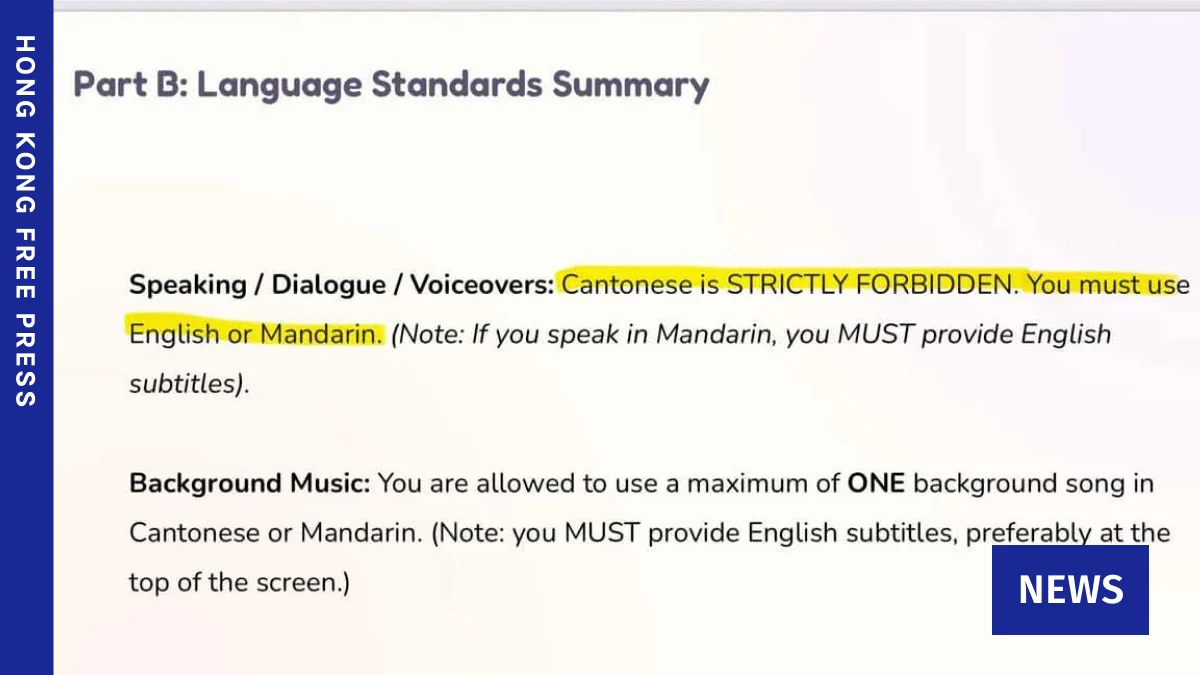
A prestigious girls’ school in Hong Kong, Good Hope School, has been embroiled in controversy following the circulation of a leaked production guideline for its graduation video that explicitly stated Cantonese was "strictly forbidden." The guideline, which mandated the use of English or Mandarin for all dialogue and voiceovers, sparked immediate public outcry and concern about linguistic freedom in the city. In response to the mounting criticism, the school’s principal issued a clarification, emphasizing that Cantonese is not banned at the institution and attributing the controversial directive to an oversight that had not yet been revised.
The incident came to light on Friday evening when screenshots of the production guideline were widely shared on the social media platform Threads. The directive was unequivocal: "Cantonese is STRICTLY FORBIDDEN" for speaking, dialogue, and voiceovers, with students instructed to "use English or Mandarin." Furthermore, the guideline stipulated that any detected Cantonese audio in voice tracks would necessitate the muting of that audio and a complete redo of sound effects, indicating a potentially stringent enforcement mechanism.

The leaked document immediately ignited a firestorm of criticism from the public and alumni, many of whom expressed dismay and confusion. A Threads user, believed to be a student from the graduating class, voiced the sentiment of many in a now-deleted post: "This is Hong Kong, a place where Cantonese is spoken. We request an explanation from the school as to why ‘Cantonese is strictly forbidden’." The user’s post further articulated a broader concern, stating, "If Hong Kong students don’t even have the freedom to speak Cantonese, Hong Kong won’t have a future." This sentiment underscored the deep cultural and identity significance of Cantonese for many in Hong Kong, particularly in the context of its unique linguistic heritage.
The immediate reaction from the school authorities was swift. Principal Gary Harfitt addressed the concerns in an email to students and parents, acknowledging the problematic guideline and offering an apology. He stated that the presentation slide "contained inappropriate language and I deeply regret this." Harfitt clarified that the guideline was circulated "before it could be revised" and assured the school community that the message did not reflect the school’s actual policy or the reality of the S6 Graduation Ceremony. He emphasized that this had "never been the case" and that "Hopers, past and present, know this."
Chronology of Events and Official Responses
The timeline of the controversy began with the circulation of the leaked guideline on Friday evening. This quickly led to widespread social media discussion and condemnation. The following day, Saturday, the Education Bureau of Hong Kong issued a statement. While the bureau did not directly comment on the school’s specific language policies or the reasons behind the initial guideline, it confirmed that it had "urged the school to review event arrangements and maintain effective communication with stakeholders." The bureau also stated that it would be "in contact with the school to provide guidance and support," indicating its engagement with the situation to ensure appropriate resolutions.

The leaked guideline stipulated that classes would be required to mute Cantonese audio and "completely redo sound effects" if detected. This level of detail suggested a premeditated, albeit apparently erroneous, policy that went beyond a mere suggestion. The directive’s stark contrast with Hong Kong’s identity as a Cantonese-speaking metropolis fueled the public’s unease.
The controversy also drew attention to the broader context of language and identity in Hong Kong. While English and Mandarin are also widely spoken and used in official capacities, Cantonese remains the mother tongue for the vast majority of the population and is deeply intertwined with local culture and heritage. Historically, Cantonese has faced pressures from the dominance of Mandarin, especially following the handover of Hong Kong to China in 1997. Educational institutions, as custodians of culture and future generations, are often at the forefront of these linguistic dynamics.
Background and Broader Implications
Good Hope School, established in 1950, is a well-regarded secondary school for girls, known for its strong academic record and its commitment to nurturing well-rounded individuals. The school’s alumni network, "Hopers," is extensive, and any perceived slight against the school’s values or its students’ cultural identity is likely to elicit a strong response.

The leaked guideline’s demand for English or Mandarin over Cantonese touches upon sensitive issues of cultural preservation and linguistic rights in Hong Kong. In recent years, there has been heightened public discourse about the importance of maintaining Cantonese as a vibrant and distinct language, especially amidst evolving political and social landscapes. The incident at Good Hope School has amplified these discussions, bringing to the fore concerns that the unique linguistic identity of Hong Kong might be under threat.
The fact that the guideline was issued for a graduation video, an event often meant to celebrate student achievements and memories, makes the prohibition of Cantonese particularly poignant. Graduation videos are typically a repository of student experiences, often incorporating elements that reflect their local context and identity. Restricting the use of Cantonese in such a personal and commemorative medium was seen by many as an erasure of a fundamental aspect of Hong Kong student life.
The potential implications of such policies, even if unintended or swiftly corrected, can be significant. They can erode trust between educational institutions and the communities they serve, and foster a sense of alienation among students who feel their cultural identity is not valued. For a city like Hong Kong, where language is a powerful marker of identity and a symbol of its unique history, such controversies carry considerable weight.

Supporting Data and Context
Hong Kong’s linguistic landscape is characterized by a trilingual environment, with Cantonese, English, and Mandarin playing significant roles. According to the 2016 Population By-census, Cantonese was the most common language spoken at home, with 88.5% of the population reporting it as their usual spoken language. English was spoken by 43.4%, and Mandarin by 13.5%. Despite the prevalence of Cantonese, there has been a noted increase in the use of Mandarin in recent years, a trend that has sparked debates about its impact on the dominance of Cantonese.
Educational institutions in Hong Kong are often tasked with navigating this complex linguistic environment. While the official languages of instruction are typically English and Chinese, the specific emphasis and approach to teaching and promoting different languages can vary. The Education Bureau’s mandate includes ensuring that students develop proficiency in both Chinese (which generally refers to Mandarin in a formal academic context) and English, while also acknowledging the importance of Cantonese in daily life and cultural contexts.
The directive to "strictly forbid" Cantonese in a student-produced video at a Hong Kong school raises questions about the balance between promoting global languages and preserving local linguistic heritage. Critics argue that such directives can inadvertently promote a hierarchy of languages, potentially marginalizing Cantonese and undermining its status as a primary language of communication and cultural expression in Hong Kong.

Analysis of Implications and Future Outlook
The swift apology from Principal Harfitt and the clarification from the Education Bureau suggest an effort to contain the damage and reassure the public. However, the incident has undoubtedly left a mark, prompting introspection within the school and potentially other educational institutions about their language policies and communication strategies.
The broader implication for Hong Kong is a renewed awareness of the sensitivities surrounding language and identity. In a city that prides itself on its unique cultural blend and its historical resilience, any perceived threat to its linguistic heritage is a matter of significant public concern. The controversy serves as a reminder of the ongoing dialogue about how Hong Kong maintains its distinct identity while engaging with the wider world.
Moving forward, it will be crucial for educational institutions to ensure that their internal policies and external communications are sensitive to the cultural context of Hong Kong and reflect a genuine respect for its linguistic diversity. The incident highlights the importance of clear communication, robust review processes for all school-related materials, and a deep understanding of the cultural significance of language for the student body and the wider community. The Education Bureau’s involvement, offering guidance and support, signals an intent to address such issues proactively and ensure that schools remain inclusive spaces that celebrate, rather than suppress, the diverse linguistic and cultural heritage of Hong Kong. The future of Cantonese in Hong Kong, and indeed the city’s identity, is intrinsically linked to how such linguistic discussions are navigated by its institutions and its people.

 Muslim