Evan Lee Salim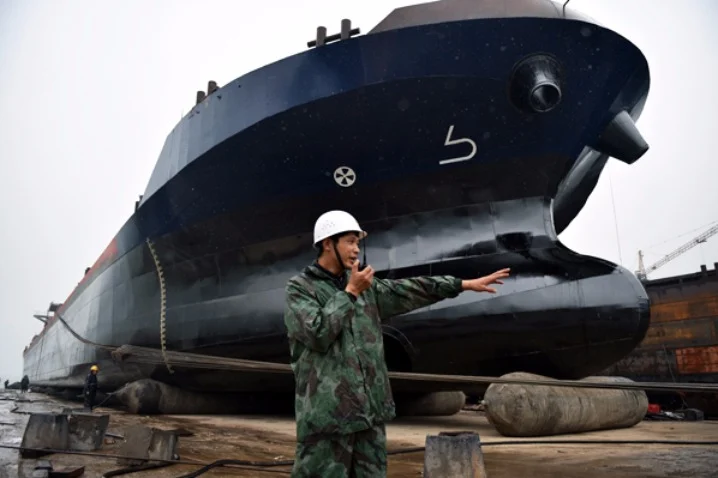
China’s shipbuilding industry has achieved a significant milestone, claiming the top position globally in new orders over the past eleven months, a remarkable feat that sees it surpass its long-standing competitor, South Korea. This ascendance, confirmed by leading international maritime analysis firm Clarkson Research Services, marks the first time in seven years that China has outperformed South Korea in this critical sector, signaling a strategic shift in the global maritime landscape.
According to data released by the British shipbuilding and marine analysis agency Clarkson Research Services on a Friday in December, China’s shipyards accumulated an impressive total of 7.13 million compensated gross tons (CGT) from 324 vessels between January and November of the reporting year. This figure places China firmly ahead of South Korea, which secured 5.74 million CGT during the same period. The detailed statistics further reveal China’s dominant market share, accounting for 36.3 percent of global shipbuilding orders, a substantial 7 percentage points higher than South Korea’s 29.4 percent. This resurgence underscores China’s persistent drive for innovation and its strategic transition from a high-volume producer to a leader in high-value and technologically advanced maritime solutions.
A Historic Shift: Seven-Year Turnaround
The return to the top for China’s shipbuilding sector represents a pivotal moment, marking the culmination of years of strategic investment and industrial transformation. For the better part of the past decade, South Korea, alongside Japan, had largely dominated the global shipbuilding arena, particularly in the construction of complex and high-value vessels such such as liquefied natural gas (LNG) carriers, ultra-large container ships, and offshore drilling platforms. China, while consistently a major player, had often been associated with bulk carriers and standard tankers, striving to catch up in technological sophistication.
The global shipbuilding industry is inherently cyclical, heavily influenced by global trade volumes, commodity prices, and economic stability. Following the 2008 financial crisis, the industry experienced a downturn, leading to consolidation and intense competition. During this challenging period, many Chinese shipyards, often backed by state support, embarked on ambitious programs to upgrade their capabilities, invest in research and development, and diversify their product offerings. This long-term vision is now yielding tangible results, demonstrating China’s resilience and its ambition to become a comprehensive maritime power. The surpassing of South Korea is not merely about raw tonnage but signifies a deeper qualitative shift in China’s industrial prowess.
Chronology of Key Orders and Innovations
The remarkable performance of Chinese shipyards in the reporting period was bolstered by several landmark contracts and technological breakthroughs that highlight the industry’s evolving capabilities:
-
August 2017: Mega-Container Vessels for CMA CGM: A significant order placed by French shipping giant CMA CGM SA in August saw Chinese shipyards secure contracts for nine state-of-the-art 22,000 twenty-foot equivalent units (TEU) container vessels. These massive ships, among the largest of their kind globally, were commissioned from two prominent Chinese builders: Shanghai Waigaoqiao Shipbuilding Co. and Hudong Zhonghua Shipbuilding Co. This order was particularly noteworthy as it demonstrated China’s growing capacity to construct ultra-large container ships, a segment traditionally dominated by South Korean yards. The ability to handle such complex and high-capacity vessels signifies a maturation in Chinese shipbuilding design, engineering, and project management.
-
October 2017: First Luxury Cruise Ship Order: In a groundbreaking development, China State Shipbuilding Corp (CSSC), in collaboration with China Investment Corp (CIC) and Carnival Corp, the world’s largest cruise operator, signed a monumental agreement in October. This partnership committed a total investment of 25.5 billion yuan (approximately $3.85 billion at the time) towards the construction of a super luxury cruise ship. This was an unprecedented order for Chinese shipbuilding companies, as the design and construction of large, sophisticated cruise vessels have historically been the exclusive domain of a few specialized European shipyards. Securing this contract marked a pivotal entry for China into one of the most technologically demanding and high-value segments of the maritime industry, signaling a dramatic leap in capabilities.
-
"Great Intelligence": World’s First Smart Ship: Further showcasing its commitment to innovation, China State Shipbuilding Corporation delivered the "Great Intelligence," hailed as the world’s first smart ship, at the recent All China Maritime Conference and Exhibition. With a loading capacity of 38,800 metric tons, this vessel integrates advanced sensor technology, big data analytics, and artificial intelligence to optimize operations, enhance navigation safety, and improve energy efficiency. Features include intelligent navigation, intelligent engine room, and intelligent cargo management systems, representing a paradigm shift towards autonomous and data-driven shipping. This achievement positions China at the forefront of the smart shipping revolution, which promises to redefine maritime logistics and operations.
-
Green Technology Adoption by COSCO Dalian: Demonstrating a strong commitment to environmental sustainability, COSCO Dalian shipyard finalized orders with Thordon Bearings, a leading marine industry solution provider, for its water-lubricated propeller shaft bearings. These innovative systems utilize seawater as a lubrication medium, effectively eliminating the need for oil-based lubricants that pose a risk of marine pollution. As Alex Li, managing director of CY Engineering Co Ltd, Thordon Bearings’ partner in China, emphasized, this order is a clear indicator of Chinese shipbuilders’ dedication to reducing industry-borne emissions and pollutants, aligning with stringent global environmental regulations.
Strategic Transformation: From Quantity to Quality
The current success of China’s shipbuilding industry is not merely a reflection of increased order volumes but a testament to a deliberate and comprehensive strategy aimed at elevating quality and technological sophistication. This strategic shift has been a cornerstone of national industrial policies, including the ambitious "Made in China 2025" initiative, which identifies high-end marine equipment and high-tech vessel manufacturing as key areas for development.
Dong Liwan, a respected shipbuilding industry researcher at Shanghai Maritime University, articulated the implications of this trend, stating that "with the orders for high-value-added ships continuing to go to Chinese shipyards, their South Korean competitors will definitely feel the pinch." This sentiment underscores the direct competitive pressure being exerted by China’s advancements, particularly in segments that traditionally offered higher profit margins for its rivals.
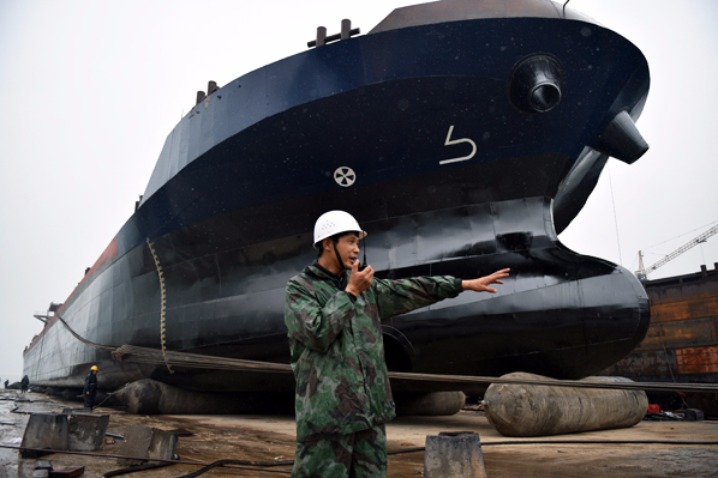
Sun Licheng, president of the China Classification Society, echoed this perspective, emphasizing the fundamental transformation underway: "China’s shipbuilding industry is realizing the transformation with its hardworking spirit to achieve technical breakthrough and innovation." He further elaborated, "While maintaining growth, it is realizing production mode transformation, structural adjustment and transformation, and upgrading, and reinforcing China’s shipbuilding status in the world." This statement highlights a multi-faceted approach involving significant investments in R&D, automation, and advanced manufacturing techniques, moving beyond simply replicating existing designs to pioneering new ones. The goal, as Sun Licheng articulated, is to become a "strong shipbuilding country by 2020," with a particular focus on accelerating the development of advanced intelligent manufacturing and industrial equipment capabilities. This vision involves not only building more ships but building smarter, greener, and more complex vessels that meet the evolving demands of global trade and environmental regulations.
Competitive Landscape and Regional Implications
The shift in global shipbuilding dominance carries significant implications for the traditional leaders, particularly South Korea and Japan. While South Korea has historically excelled in specialized vessels like LNG carriers and large offshore platforms, China’s rapid advancements in these very segments, coupled with its aggressive pricing strategies and strong government backing, are eroding this advantage. The competitive pressure extends beyond new orders to technological leadership and market share in key high-value niches.
South Korean shipbuilders, such as Hyundai Heavy Industries, Samsung Heavy Industries, and Daewoo Shipbuilding & Marine Engineering, have long relied on their expertise in complex engineering and efficient production processes. However, they now face a formidable challenge from Chinese counterparts who are rapidly closing the technological gap and leveraging economies of scale. This situation may compel South Korean firms to further specialize in ultra-high-tech, niche markets or focus on innovative design and after-sales services to maintain their competitive edge.
The broader Asian shipbuilding market remains intensely competitive, with Japan also being a significant player, albeit one that has faced its own challenges in recent years. The global balance of power in shipbuilding is clearly shifting towards China, backed by its robust domestic demand, strategic state-owned enterprises, and a concerted national effort to ascend the industrial value chain.
Government Policy and Industrial Vision
The sustained growth and technological upgrading of China’s shipbuilding industry are inextricably linked to robust government support and strategic industrial planning. The central government has identified shipbuilding as a strategically important sector, crucial for national economic development, international trade, and maritime security. Policies have included direct subsidies, preferential loans, tax incentives, and substantial investments in shipbuilding infrastructure and R&D.
State-owned enterprises (SOEs) like China State Shipbuilding Corporation (CSSC) and China Shipbuilding Industry Corporation (CSIC) play a pivotal role, acting as both major builders and key drivers of technological innovation. These SOEs are often at the forefront of securing large-scale international contracts and spearheading projects like the "Great Intelligence" smart ship. The government’s long-term vision extends beyond merely boosting production capacity; it aims to foster an ecosystem that supports innovation in design, materials science, automation, and environmental technologies. This comprehensive approach is designed to ensure China’s shipbuilding industry remains competitive and resilient in the face of global economic fluctuations and technological shifts.
Technological Advancements and Future Outlook
The trajectory of China’s shipbuilding industry is firmly set towards embracing advanced technologies and sustainable practices. The focus on "smart ships" like the "Great Intelligence" is indicative of a broader industry trend towards digitalization and automation. Future vessels are expected to integrate more sophisticated Internet of Things (IoT) sensors, advanced analytics for predictive maintenance, optimized route planning powered by AI, and potentially even autonomous navigation capabilities. These innovations promise to enhance operational efficiency, reduce human error, and lower operating costs for ship owners.
Furthermore, environmental sustainability is becoming an increasingly critical driver for shipbuilding. Global regulations, such as those imposed by the International Maritime Organization (IMO) regarding sulfur emissions (IMO 2020) and greenhouse gas reductions (IMO 2030), are pushing the industry towards greener solutions. Chinese shipyards are actively investing in research and development for alternative fuels (e.g., LNG, methanol, ammonia, hydrogen), battery-hybrid propulsion systems, carbon capture technologies, and energy-efficient hull designs. The adoption of water-lubricated bearings by COSCO Dalian is just one example of this commitment to reducing the environmental footprint of shipping.
Looking ahead, China is poised to capitalize on emerging market segments, including specialized vessels for offshore wind farm installation, Arctic-class ships, and advanced naval vessels. The confluence of strong government backing, sustained investment in R&D, a skilled workforce, and a clear strategic vision positions China to not only maintain its lead in global shipbuilding orders but also to solidify its reputation as a pioneer in maritime technology and sustainability.
Global Economic Context
The shipbuilding industry’s performance is a bellwether for global trade. The resurgence of orders in China reflects a broader, albeit sometimes uneven, recovery in global economic activity and trade volumes. As international commerce relies heavily on maritime transport, increased shipbuilding orders generally indicate confidence in future trade growth. However, the industry remains subject to geopolitical tensions, supply chain disruptions, and fluctuations in commodity prices, which can impact demand for new vessels. China’s current dominance provides it with significant economic leverage and reinforces its position as a central player in global manufacturing and trade networks. The shift from South Korea to China in this critical industrial sector underscores a broader rebalancing of industrial power on the world stage.
In conclusion, China’s ascent to the top of global shipbuilding orders for the first time in seven years is a momentous achievement. It signifies not just a quantitative increase in production but a qualitative transformation driven by a relentless pursuit of innovation, intelligence, and environmental stewardship. With strategic investments and a clear national vision, China is firmly establishing itself as the undisputed leader in the global maritime industry, shaping its future trajectory for decades to come.


 Suro Senen
 Pevita Pearce