Dwi Wanna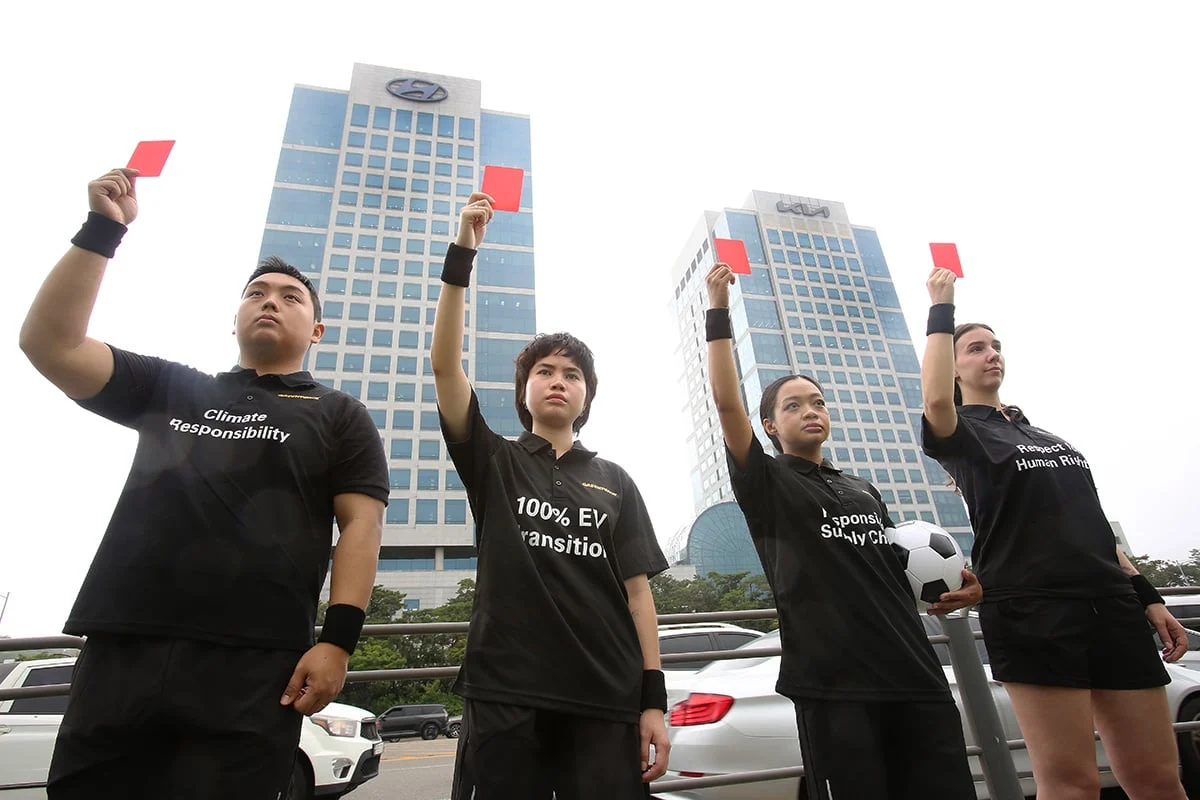
SEOUL – In a striking display of activism, Greenpeace East Asia, alongside a global coalition of environmental and human rights organizations, staged a high-profile protest at the Hyundai Motor Group headquarters today. Activists unfurled symbolic referee "red cards," directly targeting the automotive giant’s prominent sponsorship of the FIFA World Cup. The demonstration demands that Hyundai Motor Group, the world’s third-largest automotive manufacturer, immediately address egregious human rights violations, widespread labor exploitation, and significant carbon-intensive risks embedded within its extensive global supply chain. Furthermore, the coalition calls for the company to reverse its recent, perceived backtrack on its electric vehicle (EV) transition commitments.
This Seoul demonstration represents the culmination of a month-long, internationally coordinated wave of actions aimed at scrutinizing Hyundai-Kia’s high-profile association with the FIFA World Cup. While the finale in South Korea was orchestrated by Greenpeace East Asia on the ground, the broader international campaign boasts the backing of 11 environmental and human rights organizations. Their collective objective is to expose what they describe as a stark dichotomy between Hyundai’s public-facing sustainability narratives and the documented harms linked to segments of its supply chain, which operate behind the automaker’s multi-million dollar "eco-friendly" sports marketing facade.
The escalating global pressure campaign has been strategically timed to coincide with key FIFA World Cup matches, amplifying the visibility of the coalition’s demands. Prior to today’s protest, the international coalition formally delivered an Open Letter to Hyundai Executive Chair Euisun Chung. This letter explicitly urged the company to leverage its prestigious position as a premier FIFA sponsor to implement robust structural climate commitments and establish enforceable corporate accountability measures across its operations.
Market Risk: Hyundai Lags in Clean Transition and Supply Chain Governance
While Hyundai actively utilizes its FIFA World Cup sponsorship to cultivate an image of corporate sustainability, a closer examination of its sales figures reveals a significant reliance on internal combustion engine (ICE) vehicles. Currently, ICE vehicles constitute a staggering 93% of Hyundai-Kia’s 6.8 million annual sales. This continued dependence on fossil fuel-powered transportation translates into a substantial environmental footprint. The group’s combined annual carbon dioxide equivalent emissions amount to an estimated 250 million tonnes, a figure comparable to the total national emissions of Spain.
Recent independent assessments of automotive sustainability benchmarks further highlight Hyundai’s relative underperformance. These analyses consistently rank Hyundai significantly behind global competitors such as Tesla, Volkswagen, and Mercedes-Benz in critical areas like supply chain decarbonization and the rigor of its human rights due diligence processes. This lagging performance presents a growing market risk for Hyundai, as regulatory bodies and environmentally conscious consumers increasingly demand greater accountability and transparency in the automotive sector.
The South Korean automaker is facing mounting regulatory and reputational pressures to enhance oversight of its manufacturing pipeline and its intricate network of sourcing relationships. Independent investigations conducted by prominent organizations, including Steel Watch, Mighty Earth, and Jobs to Move America, have unearthed a disturbing pattern of serious environmental and labor concerns at various tiers of Hyundai’s supply chain, particularly among its tier-one suppliers.
A specific area of intense scrutiny has been Hyundai Steel’s continued reliance on coal-based production methods. This practice has drawn widespread criticism for its significant contribution to air pollution and the associated billions of dollars in public health costs across manufacturing hubs in South Korea and Brazil. Reports from organizations like For Our Climate and Energy and Clean Air have detailed the detrimental impacts on local communities and the environment.
Statements from the Global Coalition
The unified voice of the global coalition underscores the urgency and breadth of the concerns surrounding Hyundai Motor Group.
Erin Eunseo Choi, climate and energy campaigner at Greenpeace East Asia, articulated the coalition’s frustration with Hyundai’s strategic direction: "Hyundai Motor’s latest sustainability report talks about ‘Electrification and Our Climate Response,’ but quietly dropping its concrete 2030 battery EV sales targets sends a very different signal. By shifting its roadmap to focus heavily on hybrids and Extended-Range EVs (EREVs) – vehicles that still rely on internal combustion engines – Hyundai is pursuing a false transition. While EREVs may masquerade as electric, they are not a true zero-emission solution; instead, they risk locking in reliance on fossil fuels and diverting vital resources from full battery electrification. When the vehicles Hyundai sells account for 79% of its Scope 3 emissions, slowing electrification is like pulling your striker off the pitch in the middle of a match. As war-driven oil price spikes fast-track the shift toward EVs, any indecision in making a true transition risks a further loss of market share."
Nish Humphreys, Campaign Manager at Ekō, emphasized the disconnect between Hyundai’s public image and its operational realities: "Hyundai wants the world watching its Football World Cup ads, not the dark side of its supply chain. On the field, it’s sponsoring kids’ dreams. But behind the scenes, it’s a different game. Public reporting has raised serious concerns about child labor, worker deaths, and injuries, along with the unexplained disappearance of Indigenous activists in Mexico who protected Hyundai’s steel supplier. Together with the activists on the ground, over 7,400 people have ‘red-carded’ Hyundai in our virtual protest, joining a global crowd of 52,000 citizens, football fans, and Hyundai drivers who have signed the Ekō petition demanding the company clean up its supply chain before the final whistle blows." The virtual "red-carding" campaign, facilitated by Ekō, has seen widespread public participation, reflecting a growing citizen demand for corporate accountability.
Abhilasha Bhola, Climate Campaigns Director at Public Citizen, delivered a stark assessment of the situation: "The record is clear: Hyundai-Kia’s supply chain is marred by documented human rights abuses, environmental destruction, and labor exploitation. The World Cup’s corporate sponsors cannot continue to profit while workers, communities, and our planet bear the deep impacts of corporate misconduct."
Strategic Demands to Hyundai Motor Group
The global coalition has outlined three fundamental and non-negotiable directives for Hyundai Motor Group’s executive leadership, aimed at fostering genuine change and accountability:
- Commit to a 100% Zero-Emission Vehicle Sales Target by 2035: This demand calls for a clear and unwavering commitment to phasing out internal combustion engine vehicles entirely, aligning with global climate goals and accelerating the transition to fully electric mobility. This includes a commitment to phasing out hybrid and extended-range electric vehicles as well, focusing solely on battery electric vehicles.
- Implement Robust Human Rights and Environmental Due Diligence Across the Entire Supply Chain: This requires Hyundai to proactively identify, prevent, mitigate, and account for how it addresses actual and potential adverse impacts on human rights and the environment throughout its entire value chain. This includes a commitment to transparently report on these efforts and to engage with affected stakeholders.
- Divest from Coal and Transition to Renewable Energy Sources for all Operations: This directive targets the significant carbon footprint associated with Hyundai’s manufacturing processes, particularly its reliance on coal. The coalition demands a clear roadmap for transitioning to 100% renewable energy sources for all of Hyundai’s global operations, including its extensive supply chain.
Broader Impact and Implications
The protest at Hyundai Motor Group headquarters is more than just a singular event; it is a potent signal within a larger global movement advocating for greater corporate responsibility, particularly among major international corporations leveraging high-profile sponsorships. The coalition’s actions highlight a growing trend where environmental and human rights concerns are increasingly intertwined with business operations and brand reputation.
Hyundai’s deep ties to the FIFA World Cup, a global spectacle watched by billions, provide a platform for these critical issues to gain wider attention. The coalition’s strategy of targeting the sponsor amplifies the pressure on Hyundai to address the systemic problems within its supply chain. The timing of these actions, occurring during a period of intense global focus on sports and corporate branding, maximizes the potential for public and investor scrutiny.
The financial implications for Hyundai could be significant. As consumers and investors become more attuned to sustainability and ethical practices, companies with documented human rights abuses or environmental damage in their supply chains risk reputational damage, boycotts, and divestment. Furthermore, the increasing regulatory landscape surrounding environmental, social, and governance (ESG) factors means that companies like Hyundai must demonstrate proactive measures to mitigate risks and ensure compliance.
The coalition’s specific demands, such as a commitment to 100% zero-emission vehicle sales by 2035 and comprehensive due diligence, reflect a growing consensus within the automotive industry and among environmental advocates regarding the necessary steps for a sustainable future. Hyundai’s response to these demands will be closely watched, not only by the coalition and the public but also by its competitors, investors, and regulatory bodies worldwide. The "red card" metaphor serves as a stark warning: failure to address these critical issues could lead to a significant penalty for the company’s future growth and standing in the global market.
ENDS
Media Documentation & Assets:
[Links to protest photos and videos would typically be included here.]
Media Contact:
Yujie Xue, International Communications Officer, Greenpeace East Asia, [email protected]

 Evan Lee Salim
 Lina Hope