Nana
Nana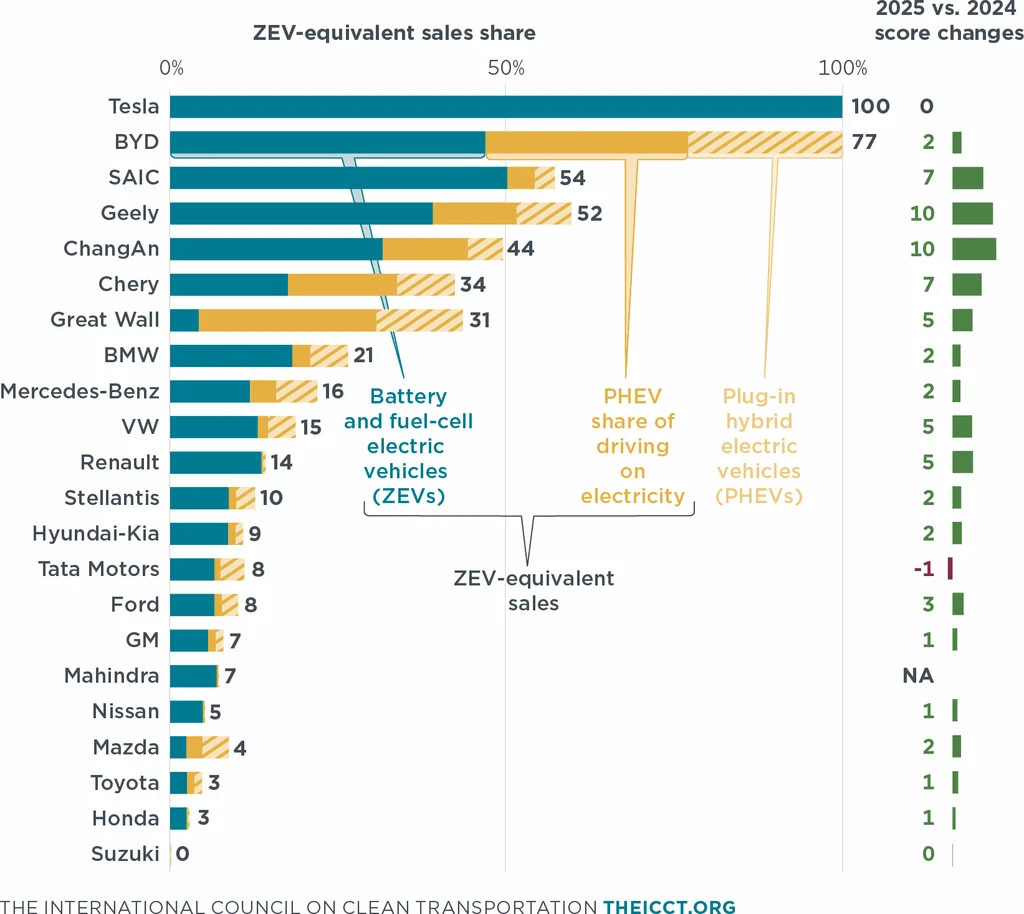
The worldwide transition toward zero-emission transportation is gaining momentum, but the pace at which automotive manufacturers are embracing this seismic shift varies dramatically, creating distinct winners and losers in the rapidly evolving global market. A recent webinar, hosted by Greenpeace Japan on July 13, shed critical light on these disparities, featuring insights from Dale Hall of the International Council on Clean Transportation (ICCT) and Erin Eunseo Choi of Greenpeace East Asia. Their analysis focused on the performance of leading automakers in their transition to battery-electric vehicles (BEVs), highlighting significant strategic divergences and their profound implications for regional markets, particularly in Southeast Asia.
The webinar, part of an ongoing series on green mobility and climate action, underscored the urgency of accelerating the adoption of BEVs. Experts emphasized that while government policies play a role, the adaptability of corporate business models is paramount in navigating this transformative era. The discussions revealed a clear dichotomy: companies that have proactively restructured their operations and investments for an electric future are gaining market share and setting the pace, while those relying on legacy technologies or slow-moving electrification plans are increasingly falling behind.
Southeast Asia: A Crucial Battlefield for Future Mobility
Southeast Asia has emerged as a critical arena for the future of automotive mobility, with Indonesia standing out as a particularly influential market. As one of the region’s largest auto markets and a nation actively positioning itself as a hub for electric vehicle (EV) production and adoption, Indonesia’s trajectory offers a compelling case study of the global EV race. By the end of 2025, Indonesia’s BEV market experienced a notable surge, becoming the third-largest in Southeast Asia with over 103,000 units sold. This rapid growth presents both immense opportunities and significant risks for established automakers, especially those from Japan, whose long-standing dominance in the region is now under severe threat.
According to Erin Eunseo Choi of Greenpeace East Asia, the contrasting strategies employed by automakers from China, Japan, and South Korea are yielding markedly different outcomes in this vital market. The implications of losing ground in Southeast Asia are substantial, carrying heavy long-term consequences for companies that fail to adapt.
China’s Electrifying Ascent
Chinese automakers, spearheaded by industry giants BYD and Geely, have adopted an aggressive, front-footed approach to expanding their electric vehicle sales. Even amidst a contraction in Indonesia’s overall automotive market, Chinese brands achieved a remarkable year-on-year sales increase of 153%, effectively tripling their market share to 10%. This surge signifies a powerful shift in consumer preference and market dynamics.
BYD, in particular, has cemented its position as the undisputed leader in Indonesia’s BEV segment, capturing over half of the market share. The broader success of Chinese EV brands is evident in their dominance of the Indonesian market, accounting for more than 90% of all EV sales in the first half of 2025. This rapid market penetration is attributed to a combination of competitive pricing, advanced technology, and a strategic focus on meeting local demand with tailored EV offerings.
Japan’s Eroding Dominance
While Japanese automotive brands have historically enjoyed a strong legacy and market presence in Southeast Asia, their once-unassailable grip is now weakening. Data from the first quarter of 2025 revealed a concerning trend: most Japanese brands, with the notable exception of Toyota, experienced sales declines. This stands in stark contrast to the rapid expansion of their Chinese competitors.
Choi identified a core strategic issue: many Japanese manufacturers remain heavily invested in internal combustion engine (ICE) vehicles and hybrid technologies, rather than prioritizing a clear, accelerated roadmap for battery-electric vehicles in key markets like Southeast Asia. This delay in electrification not only impacts market share but also exacerbates regional climate inequities. Combustion vehicles sold in Southeast Asia, she noted, emit significantly higher amounts of carbon dioxide equivalent per vehicle compared to those sold in markets with high EV adoption rates, such as Europe. This disparity places a disproportionate burden on climate-vulnerable communities in the region.
South Korea’s Troubled Trajectory
The performance of South Korean automakers, particularly Hyundai, serves as a stark warning sign for the broader industry. Within the BEV segment in Indonesia, Hyundai’s sales have plummeted dramatically, falling from 7,590 units in 2023 to just 1,828 units in 2025 – a staggering 75.9% decline.
While Hyundai has articulated clear commitments to phase out internal combustion engines in markets like Europe and the United States, it has notably lacked similar ambitious timelines for Southeast Asia. This apparent gap between its pledges in developed markets and its actions in the Global South risks eroding its regional competitiveness, according to Choi. The company’s strategy appears to be bifurcated, failing to apply a uniform pace of electrification across all its operating regions.
Erin Eunseo Choi articulated this critical observation during the webinar: "This is not simply a story of government policy succeeding or failing in isolation. It’s a story about which companies adapted their business models fast enough to meet that policy environment – and which didn’t.” Her statement encapsulates the core challenge facing legacy automakers in the face of disruptive innovation and evolving global priorities.
The ICCT Global Automaker Rating 2025: A Clear Scorecard
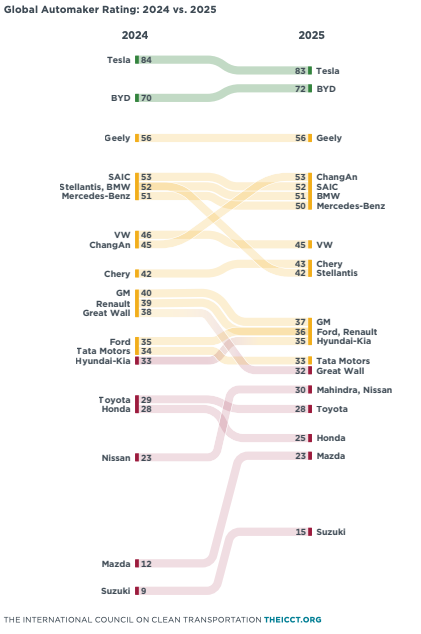
Providing a comprehensive global perspective, Dale Hall of the ICCT presented findings from the organization’s "Global Automaker Rating 2025." This report meticulously evaluates the 22 largest global auto manufacturers across six key markets, collectively representing approximately 80% of global new car sales. The rating assesses various crucial metrics, including Zero-Emission Vehicle (ZEV) sales share, ZEV investment, and ZEV targets.
Leading the Pack: Tesla and BYD Set the Standard
The ICCT report’s overall ranking places Tesla and BYD at the forefront, establishing them as the leading tier of global automakers in the transition to electric mobility. In stark contrast, Japanese manufacturers occupied the bottom five positions in the overall ranking, indicating a significant lag compared to their international peers. This finding corroborates the regional observations made by Greenpeace regarding the challenges faced by Japanese brands in key emerging markets.
ZEV-Equivalent Sales Share: A Growing Divide
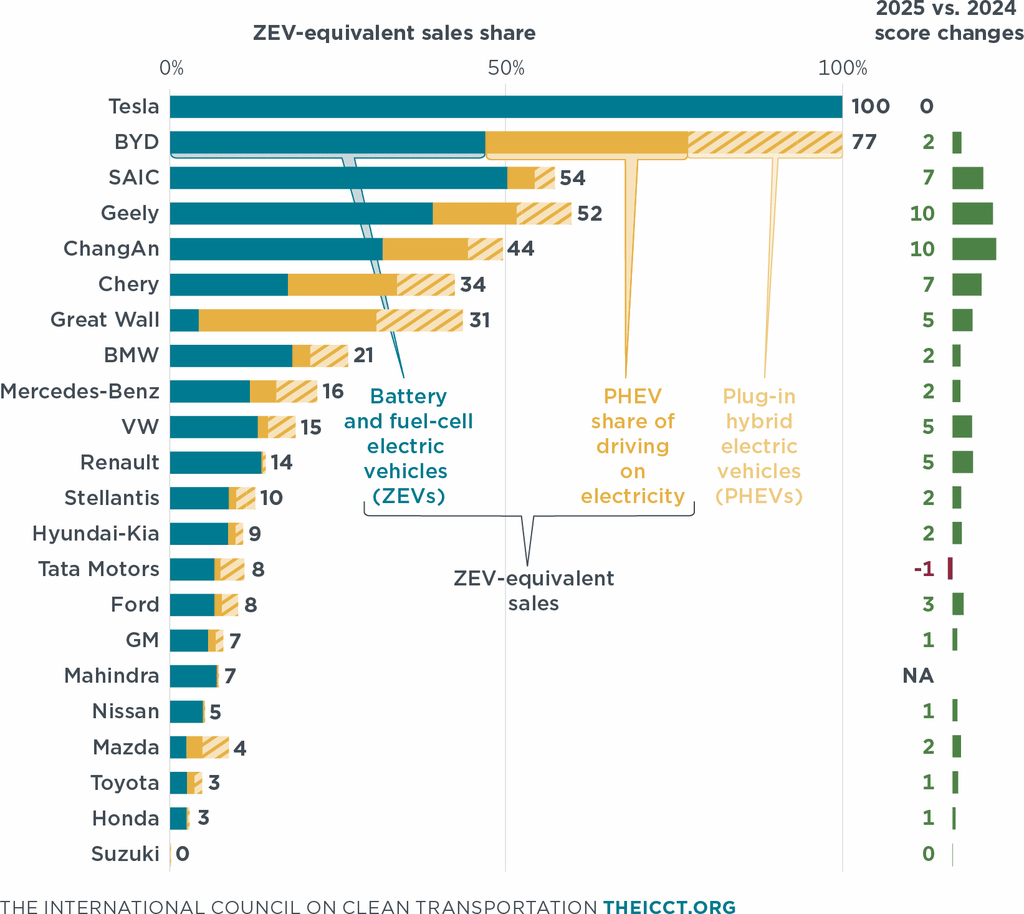
The analysis of ZEV-equivalent sales share revealed that nearly all evaluated automakers have increased their proportion of electric vehicle sales. This growth is predominantly driven by Chinese brands such as Geely, Changan, and SAIC, which are demonstrating remarkable agility and market responsiveness. However, the report highlights that legacy foreign automakers continue to trail significantly behind these leaders. To meet upcoming stringent climate standards and remain competitive, these established players will need to dramatically accelerate their EV sales volumes.
ZEV Investment: Chinese Manufacturers Lead the Charge
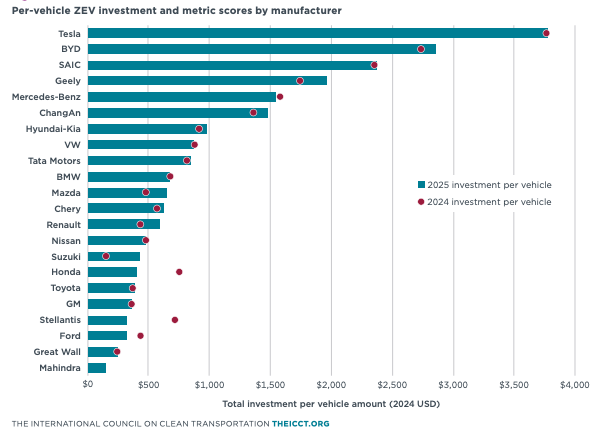
In terms of ZEV investment, Chinese manufacturers are notably ramping up their capital expenditures per vehicle. This strategic investment is aimed at expanding their production capacity and global reach, with a particular focus on emerging markets like Southeast Asia and Latin America. Concurrently, legacy automakers in the United States, Europe, and Japan have either reduced their ZEV investments or kept them relatively flat. This divergence in investment strategy directly impacts their future market positioning, potentially ceding ground to more aggressive competitors.
ZEV Targets: Retreat and Ambition Clash
The ICCT report also examined the stated ZEV targets for 2030. While leaders like Changan and BYD have strengthened their ambitious goals, several major legacy brands have reportedly rolled back or lowered their targets. Some are reportedly pivoting their strategies to emphasize hybrids, a move that could undermine global climate targets. This retreat from aggressive EV targets by established players raises concerns about the overall pace of decarbonization in the automotive sector.
Dale Hall elaborated on these findings, emphasizing the strategic divergence observed across different regions: "In terms of long-term strategic vision, we see a clear divergence across regional lines. Several of the legacy brands – like Stellantis in Europe, Ford in the US, and Honda in Japan – reduced their mid-term targets amid short-term policy changes and are trying to hedge their investments by adopting more flexible platforms and hybrids, reducing their EV investments."
He continued, "Whereas the market leaders – like BYD, Geely, and SAIC, all from China – are aggressively increasing their EV investments and expanding their production capacity into new markets, again like Southeast Asia and Latin America. That will continue to give them more economies of scale and further footholds in the fastest-growing car markets in the world.”
Broader Implications and Future Outlook
The findings presented by Greenpeace East Asia and the ICCT paint a clear picture of an automotive industry at a critical juncture. The accelerated shift towards zero-emission transportation is not merely a technological transition but a fundamental reshaping of market dynamics, corporate strategies, and geopolitical influence.
For consumers in markets like Indonesia, the rise of Chinese automakers offers more immediate access to affordable and advanced EV technology. This increased competition can drive innovation and lower prices, accelerating EV adoption. However, it also poses an existential challenge to the market share and profitability of traditional automotive giants.
The implications for climate action are profound. A slower transition by major legacy automakers, particularly in developing regions, means continued reliance on polluting internal combustion engines for longer periods. This not only contributes to ongoing greenhouse gas emissions but also perpetuates the disproportionate impact of climate change on vulnerable populations.
The divergence in investment and strategic targets suggests a potential bifurcation of the global automotive market. Companies that are aggressively investing in and developing BEV technology, particularly those in China, are poised to capture significant market share in the coming decade. Conversely, manufacturers that are hesitant or strategically hedging their bets with hybrid technologies risk becoming marginalized in the long term.
The ICCT’s Global Automaker Rating 2025 serves as a crucial benchmark, providing transparency and accountability for the industry. As governments worldwide continue to set more ambitious climate goals and implement supportive policies for EVs, the pressure on all automakers to accelerate their electrification efforts will only intensify. The success of companies like BYD and Geely in rapidly expanding markets and their aggressive investment strategies offer a blueprint for effective adaptation in the face of climate imperatives and evolving consumer demand. The coming years will likely see a continued shake-up of the global automotive landscape, with companies demonstrating foresight, agility, and a genuine commitment to zero-emission mobility emerging as the true leaders.

 Asep Darmawan
 Asro
Asro