Jia Lissa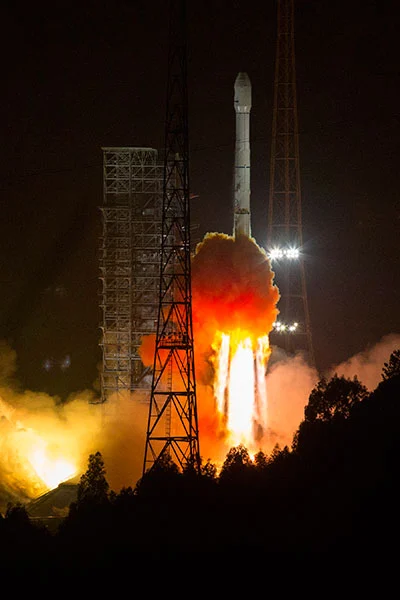
The successful launch of Algeria’s first communications satellite, Alcomsat-1, aboard a Chinese Long March 3B carrier rocket on Monday, signifies a pivotal moment in Sino-Algerian relations and a significant advancement in China’s burgeoning space export capabilities. This landmark mission, originating from the Xichang Satellite Launch Center in Sichuan province, not only underscores the deepening strategic partnership between China and Algeria but also positions China as a key player in providing advanced satellite technology to Arab nations. The satellite, designed and manufactured by China Academy of Space Technology (CAST), a subsidiary of China Aerospace Science and Technology Corporation (CASC), is poised to enhance Algeria’s public service infrastructure and foster economic and social development.
A New Era of Space Collaboration Takes Flight
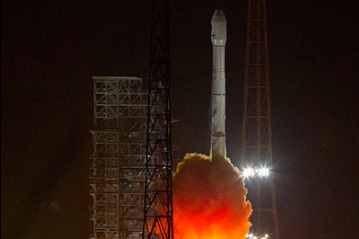
The launch, which occurred at 12:40 am local time, saw the powerful Long March 3B rocket ascend into the night sky, carrying the Alcomsat-1 payload. Approximately 26 minutes into its flight, the satellite was successfully deployed into a geostationary transfer orbit, a crucial step before it assumes its operational position. This achievement, detailed in a press release from China Great Wall Industry Corp (CGWIC), the project’s international marketing and launch service provider, marks the culmination of years of dedicated collaboration and technological exchange between the two nations.
The significance of this mission was underscored by congratulatory messages exchanged between Chinese President Xi Jinping and Algerian President Abdelaziz Bouteflika on Monday morning. President Xi hailed the project as a "important manifestation of the China-Algeria comprehensive strategic partnership" and a "good example of space cooperation between China and Arab countries." He emphasized the satellite’s potential to play a "significant role in promoting Algeria’s economic and social development," expressing Beijing’s willingness to strengthen exchanges and cooperation across various sectors to deepen the bilateral partnership for the mutual benefit of both countries and their peoples.
President Bouteflika echoed these sentiments, describing Alcomsat-1 as a "remarkable achievement in space cooperation" that "reflects the deep traditional friendship between the two sides." He affirmed Algeria’s commitment to working with China to enhance their collaborative endeavors.
A Contract Forged in Friendship, Built on Technology
The foundation for this successful launch was laid in December 2013, when the Algerian Space Agency (ASAL) and CGWIC, China’s foremost space contractor in the international market, signed the crucial satellite contract. This agreement paved the way for the design and manufacturing of Alcomsat-1 by CAST, leveraging the robust DFH-4 satellite platform. The DFH-4, a widely utilized and proven platform developed by CASC, has become a cornerstone of China’s satellite export strategy, offering a balance of performance, reliability, and cost-effectiveness.
Alcomsat-1 boasts a liftoff weight of 5.2 metric tons and is engineered for a service life of 15 years. Its comprehensive suite of capabilities will be deployed to support a diverse range of public services within Algeria. These include enhancing television broadcasting, facilitating robust emergency communications, expanding access to remote education, and providing satellite-based signal augmentation. These applications are expected to significantly improve connectivity, disseminate vital information, and bridge geographical divides within Algeria.
China’s Growing Prowess in the Global Space Market
The successful launch of Alcomsat-1 positions China as a formidable competitor in the global satellite market, particularly within the Arab world. Fu Zhiheng, vice-president of CGWIC, expressed confidence in the satellite’s capabilities, stating that Alcomsat-1 is "as good as Western communications satellites in terms of technology and capacity." This assertion highlights China’s commitment to delivering high-quality, competitive space solutions on the international stage.
While Mr. Fu did not elaborate on specific future projects, his mention of "other contracts between his firm and Arab countries" suggests a broader strategy to expand China’s footprint in the region’s burgeoning space sector. This aligns with China’s broader Belt and Road Initiative, which aims to foster economic and infrastructure development through international cooperation.
Background and Chronology of the Alcomsat-1 Project
The journey from contract signing to successful launch spanned approximately four years, a testament to the meticulous planning and execution involved in space programs.
- December 2013: The contract for the Alcomsat-1 satellite is officially signed between the Algerian Space Agency (ASAL) and China Great Wall Industry Corp (CGWIC). This marks the formal commencement of the project.
- 2014-2016: Design and manufacturing of the Alcomsat-1 satellite take place at the China Academy of Space Technology (CAST) facilities. This phase involves extensive engineering, component integration, and rigorous testing to ensure the satellite meets all specified requirements.
- 2017: Pre-launch preparations, including transportation of the satellite to the Xichang Satellite Launch Center and integration with the Long March 3B rocket, are conducted. Extensive testing and simulations are carried out to guarantee mission readiness.
- Early December 2017: The satellite and rocket are assembled on the launch pad, undergoing final checks and system integrations.
- December 11, 2017 (Local Time): At 12:40 am, the Long March 3B carrier rocket successfully lifts off from the Xichang Satellite Launch Center.
- Approximately 26 minutes post-launch: Alcomsat-1 is successfully deployed into a geostationary transfer orbit.
- December 11, 2017: Presidents Xi Jinping and Abdelaziz Bouteflika exchange congratulatory messages on the successful mission.
Supporting Data and Technical Specifications
- Satellite Name: Alcomsat-1
- Type: Communications Satellite
- Launch Vehicle: Long March 3B carrier rocket
- Launch Site: Xichang Satellite Launch Center, Sichuan Province, China
- Launch Date and Time: December 11, 2017, 12:40 am (local time)
- Payload Deployment: Geostationary Transfer Orbit
- Manufacturer: China Academy of Space Technology (CAST), part of China Aerospace Science and Technology Corporation (CASC)
- Satellite Platform: DFH-4
- Liftoff Weight: 5.2 metric tons
- Designed Service Life: 15 years
- Primary Applications: Television broadcasting, emergency communications, remote education, satellite-based signal augmentation.
Broader Implications and Future Outlook
The successful launch of Alcomsat-1 carries significant implications beyond the bilateral relationship between China and Algeria.
For Algeria:
The satellite will serve as a critical tool for national development, enhancing connectivity and access to essential services. Its deployment is expected to:
- Boost Broadcasting Reach: Enable wider and clearer television broadcasting across the entire Algerian territory, including remote and underserved areas.
- Improve Emergency Response: Provide reliable communication channels for disaster management and emergency services, crucial for a country prone to natural events.
- Expand Educational Opportunities: Facilitate distance learning programs, making education more accessible to a larger segment of the population, particularly in rural regions.
- Enhance Infrastructure: Support the development of a more robust telecommunications infrastructure, crucial for economic growth and modernization.
For China:
This mission solidifies China’s position as a reliable and competitive provider of space technology.
- Demonstration of Capability: The successful launch of a sophisticated communications satellite for an international client validates China’s technological prowess and its ability to meet global standards.
- Market Expansion: It opens doors for further collaborations with other Arab nations and countries within the broader Belt and Road Initiative, aiming to establish China as a leading space exporter.
- Technological Advancement: The project contributes to the ongoing refinement and development of China’s satellite platforms, such as the DFH-4, enhancing their competitiveness in the global market.
- Soft Power Projection: Space cooperation serves as a powerful tool for building diplomatic ties and enhancing China’s international influence.
For the Global Space Industry:
The increasing involvement of Chinese companies in the international satellite market introduces a new dynamic. It offers alternative sourcing options for countries seeking advanced space capabilities, potentially driving innovation and competition. The success of Alcomsat-1 suggests that Chinese-made satellites are becoming increasingly viable and attractive alternatives to those from traditional Western suppliers.
The Alcomsat-1 mission is more than just a satellite launch; it represents a tangible outcome of strategic partnership, technological exchange, and a shared vision for progress. As Algeria embarks on this new chapter of enhanced connectivity and service delivery, China continues to solidify its standing as a significant force in the global space arena, paving the way for future collaborations and advancements.


 Nana Wu
 Suro Senen