Nana Muazin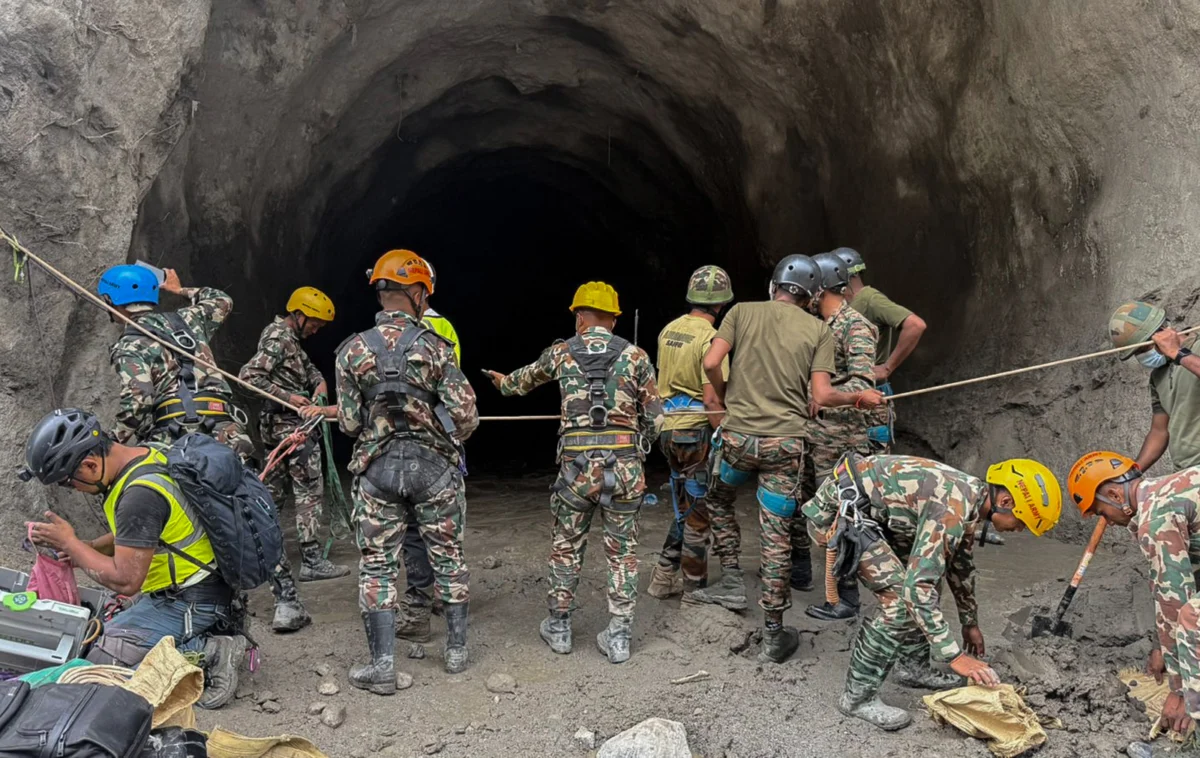
The death toll from the devastating Himalayan glacial floods surged past the grim 1,000 mark on Tuesday, as desperate search and rescue operations intensified across vast swathes of Nepal and southern China. Teams from both nations are racing against time, digging through treacherous debris and battling the elements, with particular focus on dozens of hydropower workers feared trapped deep within submerged tunnels. The catastrophe, triggered by a high-altitude glacial collapse last Wednesday, unleashed a colossal wave of freezing water, rocks, and mud that obliterated entire settlements, leaving a trail of unimaginable destruction and a staggering 4,462 people still unaccounted for.
The Devastating Onslaught
The cataclysmic event, believed to have originated from a Glacial Lake Outburst Flood (GLOF) in the upper reaches of the Himalayas, sent a torrent roaring downstream with terrifying speed and force. The sheer volume and velocity of the debris-laden water carved new channels, reshaped landscapes, and indiscriminately swept away homes, bridges, and critical infrastructure. The initial reports on August 28th had already indicated a rising death toll, with authorities ordering rescuers to safety amidst new flood risks. However, the true scale of the disaster only began to emerge in the days that followed, culminating in the somber announcement on Tuesday that over 1,000 lives had been lost. The affected areas, primarily in Nepal’s mountainous regions and extending into Tibet, China, are now scenes of widespread desolation, with communities shattered and the natural environment drastically altered.
Race Against Time: Search and Rescue Operations

In Nepal, the primary focus of rescue efforts remains the desperate search for approximately 100 hydropower workers believed to be trapped within multiple tunnels, notably at the Rasuwagadhi Hydropower project. Nepali rescue teams, comprising army personnel, police, and local volunteers, are engaged in a perilous operation involving digging, drilling, and even blasting through immense quantities of sludge, rock, and debris. The conditions are extremely hazardous, with the risk of further landslides and the unstable nature of the flood-affected terrain. So far, the grim reality is that only corpses have been retrieved from these blocked tunnels, fueling fears that many of those trapped may not have survived the initial deluge or the subsequent entrapment.
Raja Ram Basnet, spokesman for the Nepal Army, affirmed on Tuesday, "We are focused on search and rescue efforts at the tunnels; our work is continuing." He further elaborated on the broader humanitarian concerns, stating, "Our soldiers are also deployed to collect bodies and prevent the spread of disease." The sheer number of fatalities has overwhelmed local mortuaries in Nepal, forcing authorities to resort to burying hundreds of unidentified bodies after meticulous DNA sampling, a testament to the unprecedented scale of the tragedy. The cross-border impact is also evident, with at least 17 bodies recovered from rivers far downstream in India, highlighting the interconnectedness of the Himalayan river systems.
A Nation Grieves: Personal Stories of Loss
Amidst the official figures and rescue efforts, the human cost of the disaster is profoundly felt. In the capital, Kathmandu, the raw grief of a nation is palpable. Crowds have converged outside hospitals, creating poignant memorial walls adorned with photographs of missing relatives, clinging to fading hopes of finding their loved ones alive. These walls represent countless untold stories of sudden loss and desperate yearning.
One such heart-wrenching account comes from Debu Sapkota, a 58-year-old driver. He came to post photographs of his 83-year-old mother-in-law and his granddaughter, both of whom vanished in the town of Trishuli Bazaar after being swept away by last week’s surge. Sapkota recounts the terrifying moments: a warning alert sounded, but his elderly mother-in-law was "too old to run." Her granddaughter, in a heroic attempt to help her escape, was also consumed by the raging torrent. With witnesses confirming they were carried away, Sapkota now harbors no hope for their survival. "I am here hoping to find their bodies," he stated, his voice heavy with sorrow, as he clutched photos of the two women dressed in traditional attire.

The rituals of mourning have begun in earnest in some less affected areas. In Chitwan district, grieving relatives have been observed conducting cremations for their lost loved ones, a somber scene reflecting the widespread sorrow. Helicopters have been instrumental in transporting victims’ bodies from remote, inaccessible areas to collection points in districts like Nuwakot and Rasuwa, underscoring the logistical challenges of managing such a widespread catastrophe.
Understanding Glacial Lake Outburst Floods (GLOFs)
The recent disaster serves as a stark and tragic reminder of the destructive potential of Glacial Lake Outburst Floods (GLOFs). GLOFs are sudden releases of large volumes of water from glacial lakes, which form as glaciers retreat and melt. These lakes are often dammed by unstable moraines—accumulations of glacial debris—which can fail due to various triggers. These triggers include seismic activity, heavy rainfall, rapid ice melt, or even a large ice avalanche falling into the lake, causing a displacement wave that breaches the natural dam.
The Himalayas, home to the largest concentration of glaciers outside the polar regions, are particularly susceptible to GLOFs. As global temperatures rise, glaciers are retreating at an accelerated pace, leading to the formation and expansion of numerous glacial lakes. Many of these lakes are precariously situated above densely populated valleys and critical infrastructure, making the regions highly vulnerable to such events. Historical records show numerous GLOFs across the Himalayas, but the frequency and intensity are projected to increase, posing an existential threat to mountain communities.
The Looming Shadow of Climate Change

Nepal, a nation that contributes negligibly to global greenhouse gas emissions, finds itself on the frontlines of climate change impacts. The catastrophic glacial floods are a stark manifestation of this global phenomenon. Scientists universally agree that the Himalayas, often referred to as the "Third Pole," are melting at an unprecedented rate due to rising global temperatures. This accelerated melt not only contributes to the formation and expansion of unstable glacial lakes but also weakens the permafrost and geological stability of mountain slopes, increasing the risk of landslides and subsequent GLOFs.
Nepali Prime Minister Balendra Shah articulated this profound injustice, labeling the catastrophe "unimaginable and heartbreaking." In a powerful statement issued late Monday, he emphasized, "It is now time for us to strongly raise with the international community the issue of the disasters we are experiencing as a result of climate change." His call underscores the urgent need for developed, industrialized nations—the primary contributors to global warming—to acknowledge their responsibility and support vulnerable countries in climate adaptation and disaster risk reduction. The disaster has ignited renewed calls for global climate action, highlighting the disproportionate suffering faced by nations least responsible for the crisis.
Widespread Destruction and Infrastructure Collapse
The physical damage inflicted by the glacial floods is extensive and profoundly impacts the daily lives of hundreds of thousands. Entire communities have been wiped off the map, leaving countless families homeless and displaced. Many are now living in makeshift shelters, exposed to the elements, with heavy rains continuing to lash the region, complicating relief efforts and exacerbating humanitarian concerns.
Critical infrastructure, vital for economic activity and connectivity, has been decimated. Roads, which are often the lifelines of remote mountain villages, have been smashed, isolating communities and hindering the delivery of aid. Dozens of bridges have collapsed, severing crucial links and making vast areas inaccessible. Power plants, essential for electricity generation, have been destroyed, plunging regions into darkness and disrupting communication networks. Police officer E. Hawadi in the badly affected Nuwakot district lamented the overwhelming challenges, stating, "There are too many challenges." AFP photographers in Nuwakot on Tuesday captured scenes of resilience amidst despair, with people sifting through the mud and rubble of their former homes, desperately searching for salvageable items, some already stringing up plastic sheeting to create rudimentary shelters in the ruins.

Government Response and Calls for Global Action
The Nepali government, under immense pressure, is coordinating a multi-faceted response. Beyond immediate search and rescue, efforts are underway to provide humanitarian aid, establish temporary shelters, and address the critical issue of public health, including preventing the spread of disease from decomposing bodies. With limited resources, the government faces an arduous task. The Prime Minister’s public statements reflect both the immediate crisis and the broader, long-term implications.
The economic ramifications are staggering for Nepal, an economy already under strain. Initial assessments suggest that reconstruction costs could run into the "billions of dollars," a monumental sum for a developing nation. This financial burden necessitates significant international assistance, not just for immediate relief but for long-term recovery and building more resilient infrastructure. The call to the international community is not merely for aid but for recognition of climate justice and support for adaptation strategies.
Cross-Border Impact and Cooperation Challenges
The disaster’s reach extends beyond Nepal’s borders, impacting southern Tibet, China. The list of missing individuals includes a significant number of foreigners – 583 in Nepal and 261 in China – representing more than 30 nations. These include tourists drawn to the serene beauty of the Himalayas for trekking adventures, as well as Hindu pilgrims seeking spiritual solace at Tibet’s sacred Mount Kailash. The loss of life among international visitors adds another layer of complexity to the recovery efforts and highlights the global nature of this tragedy.

In China, state media has reported 16 dead and 546 people missing. Emergency workers, officials, and residents in Tibet held memorial services on Tuesday, a solemn gesture for the victims. China’s official news agency Xinhua stated that over 2,000 people, including soldiers, are involved in rescue operations, "working around the clock to search for survivors, repair roads, set up communication base stations and restore power lines."
However, the transparency of information from Tibet, a region largely inaccessible to foreign journalists, has been questioned by advocacy groups. Tencho Gyatso, president of the International Campaign for Tibet, called for China to disclose "complete and verifiable information about the damage and casualties." Beijing’s foreign ministry, in response on Monday, asserted that the "release of information has been open, transparent and timely," rejecting international reports of underreporting deaths. This highlights the challenges of information flow and international scrutiny in disaster zones with geopolitical sensitivities.
The Arduous Path to Recovery and Resilience
As the immediate crisis continues, the long-term implications for Nepal and the broader Himalayan region are profound. The sheer scale of destruction means that recovery will be a multi-year, multi-billion-dollar undertaking. Beyond rebuilding physical infrastructure, there is the immense psychological toll on survivors and affected communities. The displacement of thousands, the loss of livelihoods, and the trauma of witnessing such devastation will require sustained humanitarian and psychological support.
The disaster also serves as a critical wake-up call for enhanced disaster preparedness and early warning systems across the Himalayas. Investing in advanced monitoring of glacial lakes, developing robust evacuation plans, and educating vulnerable communities about GLOF risks are paramount. Furthermore, the incident underscores the urgent need for global cooperation on climate change mitigation and adaptation, particularly for nations like Nepal, which bear the brunt of environmental crises they did not create. The path to recovery will be arduous, but it also presents an opportunity to rebuild more resilient communities, integrate climate-smart infrastructure, and champion the cause of climate justice on the global stage.


 Sagoh
Sagoh
 Asro
Asro