Suro Senen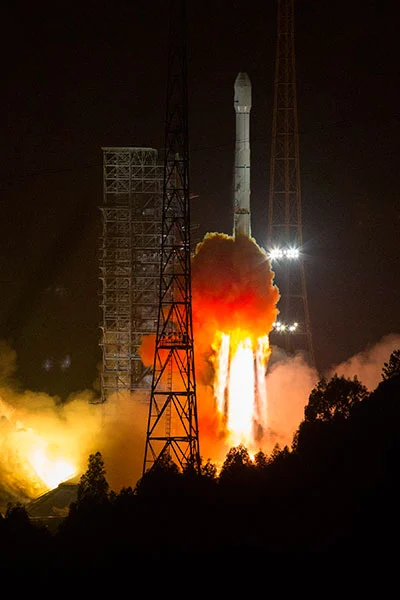
The successful launch of Algeria’s first communications satellite, Alcomsat-1, by China on Monday represents a significant achievement in international space collaboration and a notable advancement for Algeria’s technological capabilities. The satellite, a product of Chinese design and manufacturing, was propelled into orbit by a Long March 3B carrier rocket from the Xichang Satellite Launch Center in Sichuan province. This mission underscores the growing partnership between China and Arab nations in the high-technology sector, positioning China as a key player in the global satellite export market.
A Historic Launch and Bilateral Triumph
The launch, which occurred at 12:40 am Beijing time, saw the Alcomsat-1 satellite successfully placed into a geostationary transfer orbit approximately 26 minutes after liftoff. The operation was overseen by China Great Wall Industry Corp, the designated contractor for the project, a subsidiary of China Aerospace Science and Technology Corp (CASC). This event marks the first instance of China exporting a communications satellite to an Arab country, a development that carries substantial geopolitical and economic implications.
The significance of the mission was underscored by congratulatory messages exchanged between Chinese President Xi Jinping and Algerian President Abdelaziz Bouteflika. President Xi lauded the project as a crucial demonstration of the comprehensive strategic partnership between China and Algeria, highlighting it as a model for space cooperation between China and the wider Arab world. He emphasized the satellite’s expected role in fostering Algeria’s economic and social development and expressed Beijing’s commitment to deepening bilateral ties across various sectors for the mutual benefit of both nations and their peoples.
President Bouteflika echoed these sentiments, describing the Alcomsat-1 as a remarkable achievement in bilateral space cooperation and a testament to the deep-rooted traditional friendship between Algeria and China. He reiterated Algeria’s willingness to strengthen collaborative efforts with China.
The Alcomsat-1 Project: A Timeline of Collaboration
The journey to Alcomsat-1’s successful launch began with the signing of the contract in December 2013. This agreement was established between the Algerian Space Agency and China Great Wall Industry Corp, a company that has emerged as China’s foremost space contractor in the international arena. The subsequent design and manufacturing phases were undertaken by the China Academy of Space Technology (CAST), a core entity within CASC, utilizing the robust DFH-4 satellite platform.
The DFH-4 platform, developed by CAST, is a testament to China’s advancements in satellite technology. It is designed to accommodate payloads for various applications, including telecommunications, broadcasting, and Earth observation. The platform’s modular design and proven reliability have made it an attractive option for international clients seeking cost-effective and technologically advanced satellite solutions.
The Alcomsat-1 itself boasts a liftoff weight of 5.2 metric tons and is engineered for a lifespan of 15 years. Its operational capabilities are diverse, intended to support a wide array of public services. These include enhancing television broadcasting, facilitating emergency communications, expanding access to remote education, and providing satellite-based signal augmentation. These services are crucial for Algeria, a vast North African nation with significant geographical challenges that can be mitigated through advanced communication technologies.
Technological Prowess and Market Competitiveness
Fu Zhiheng, vice-president of China Great Wall Industry Corp, expressed confidence in Alcomsat-1’s technological capabilities, stating that it is comparable to Western-made communications satellites in terms of both technology and capacity. This assertion positions Chinese satellite technology as a competitive alternative in the global market, challenging the long-standing dominance of Western manufacturers. While specific details were not elaborated, Fu Zhiheng also hinted at ongoing discussions and potential contracts with other Arab countries, suggesting that Alcomsat-1 may be the vanguard of a broader trend in Sino-Arab space collaboration.
The DFH-4 platform, on which Alcomsat-1 is based, has been a key component of China’s efforts to expand its reach in the global satellite market. Launched commercially in 2007, the DFH-4 series has been utilized in several domestic and international satellite programs. Its design specifications allow for a payload capacity of up to 450 kg and a power generation capability of up to 7.5 kilowatts, making it suitable for demanding communication and broadcasting missions. The platform’s longevity and reliability are critical factors for clients seeking long-term return on investment.
Implications for Algeria and Beyond
For Algeria, the Alcomsat-1 represents a significant leap in its national development strategy. Access to a dedicated communications satellite will enable the country to:
- Enhance Broadcast Services: Improve the reach and quality of television and radio broadcasting, ensuring wider access to information and cultural content across the nation, including remote and underserved regions.
- Strengthen Emergency Communications: Provide reliable communication channels during natural disasters or other emergencies, enabling faster response times and more effective coordination of relief efforts.
- Expand Educational Opportunities: Facilitate distance learning programs, making education more accessible to students in remote areas and supporting lifelong learning initiatives.
- Boost Economic Activities: Support various economic sectors through improved connectivity, potentially enabling e-commerce, telemedicine, and enhanced data transmission for businesses.
- Assert Technological Sovereignty: Reduce reliance on foreign satellite infrastructure and foster indigenous expertise in space technology, contributing to national security and technological independence.
The successful deployment of Alcomsat-1 also has broader implications for China’s role in the global space industry. It signals China’s growing capacity not only to develop sophisticated space technology but also to successfully export it and manage complex international projects. This achievement aligns with China’s broader Belt and Road Initiative, which aims to foster economic and infrastructure development through international cooperation. By providing advanced space capabilities to developing nations, China is building strategic partnerships and enhancing its global influence.
Furthermore, the collaboration with Algeria sets a precedent for future space partnerships between China and other Arab nations. The Arab world, with its growing demand for telecommunications, broadcasting, and earth observation services, represents a significant market for satellite technology. China’s willingness to offer competitive and technologically advanced solutions, coupled with its increasing experience in managing international space projects, positions it as a formidable competitor to established players in the Western hemisphere.
A Comparative Look at Satellite Technology and Exports
The global satellite market is characterized by intense competition, with established players like the United States, Europe, Russia, and increasingly, China, vying for market share. Historically, Western companies have dominated the export of advanced communication satellites. However, China’s Long March rocket family and its domestically developed satellite platforms, such as the DFH series, have become increasingly competitive.
The DFH-4 platform, in particular, has been a key enabler of China’s export strategy. Its adaptability to various mission requirements and its cost-effectiveness have made it an attractive option for countries looking to develop their own satellite capabilities without incurring the prohibitive costs associated with procuring satellites from Western providers. The successful launch and deployment of Alcomsat-1 serve as a powerful demonstration of this platform’s capabilities and reliability.
According to industry reports, the global satellite market is projected to experience substantial growth in the coming years, driven by increasing demand for broadband internet, satellite TV, and Earth observation data. China’s proactive approach to developing and exporting its space technology places it in a strong position to capitalize on this growth. The Alcomsat-1 project is a concrete example of this strategy in action, fostering goodwill and demonstrating technical competence.
Future Prospects and Strategic Alliances
The successful conclusion of the Alcomsat-1 mission is likely to pave the way for further collaboration between China and Algeria, as well as other nations in the Middle East and North Africa. The shared success in space technology can serve as a catalyst for deeper engagement in other fields, including infrastructure development, trade, and scientific research.
China’s approach to space diplomacy, which emphasizes mutual benefit and shared development, resonates well with many developing nations. By providing access to advanced technology and fostering capacity-building, China is not only expanding its economic footprint but also strengthening its diplomatic ties and contributing to a more multipolar international order.
The Alcomsat-1 project is more than just a satellite launch; it is a symbol of a burgeoning partnership and a testament to the evolving landscape of global space exploration and commerce. As China continues to invest heavily in its space program and expand its international collaborations, its influence in the global space arena is set to grow, with projects like Alcomsat-1 serving as critical milestones on this trajectory. The successful deployment of this Algerian satellite is a clear indicator that the era of Chinese-made satellites making significant inroads into the international market has firmly arrived.


 Nana Wu