Ammar Sabilarrohman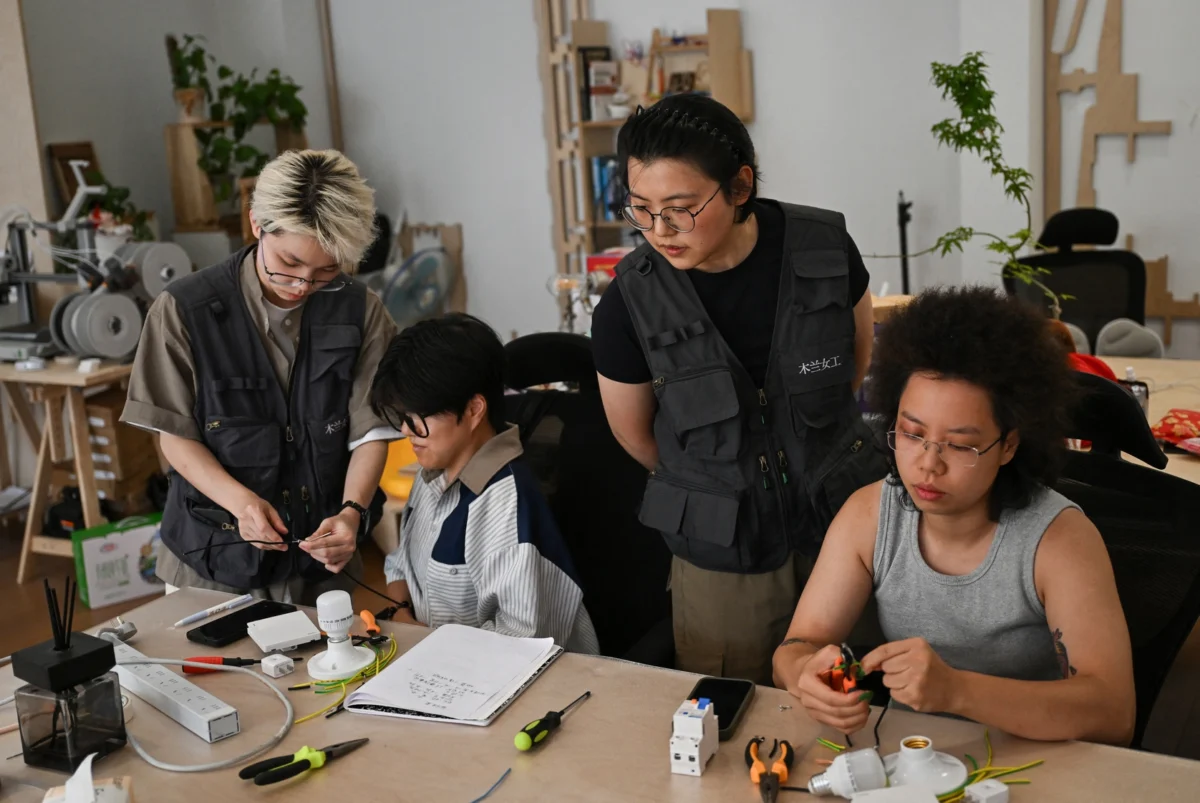
The sound of pliers clicking filled a bustling workshop in eastern China’s vibrant city of Hangzhou, a symphony of nascent empowerment as a dedicated group of women meticulously practiced stripping wires. Their female instructor, a beacon of expertise and encouragement, moved gracefully through the classroom, offering precise advice and guidance, her presence underscoring a profound shift in societal expectations. This scene, captured on June 28, 2026, at the Mulan Build workshop in Zhejiang province, is more than just a training session; it is a vivid illustration of a burgeoning movement where Chinese women are reclaiming skills long considered the exclusive domain of men.
DIY and home maintenance work has historically been a male-dominated field across China, deeply entrenched in cultural norms that often assign practical, manual labor to men while relegating women to domestic roles. However, a significant demographic shift, marked by an increasing number of women living alone and a rising desire for self-sufficiency, has ignited a fervent appetite for courses designed to impart these once-gendered skills. This quiet revolution is not confined to a single city; nationwide, multiple all-women repair groups are emerging, with Mulan Build in Hangzhou standing as a prominent pioneer.
"People are moving away from the traditional mindset that certain jobs must be tethered to a specific gender," affirmed Chen Ning, the 27-year-old founder of Mulan Build, in an interview with AFP. Her statement encapsulates the ethos driving these initiatives, challenging centuries-old perceptions and opening new avenues for female independence and professional development. Within the workshop, students, deeply absorbed in their tasks, carefully threaded wires into junction boxes, transforming disparate components into functional circuits. One by one, light bulbs flickered on, each illuminated filament a tangible signal of a job well done, and a small victory against antiquated stereotypes.

The Rise of Self-Sufficiency: A Societal Shift
The burgeoning interest in these traditionally masculine trades reflects a complex interplay of demographic shifts, evolving social values, and practical necessities. China has witnessed a notable decline in marriage rates over the past decade, coupled with a significant rise in single-person households, particularly among women. Official data from China’s Ministry of Civil Affairs indicates a continuous decline in marriage registrations since 2013, reaching a 36-year low in 2022. Concurrently, the number of single-person households has surged, with a substantial proportion being women who are increasingly prioritizing personal autonomy and career development. This trend is further supported by women’s rising financial independence, allowing them to make choices that prioritize individual fulfillment over traditional family structures.
This newfound independence, however, often comes with the practical challenge of managing household repairs and maintenance without relying on male partners or external service providers. The traditional reliance on family networks or male handymen is becoming less viable or desirable for a growing segment of the female population.
Student Zhang Xuefen, 42, articulated this sentiment clearly, noting that many of her friends have been "incredibly hands-on since they were kids," directly refuting the notion that such skills are "just a guy thing." She emphasized the broader implications: "This kind of empowerment can be passed on to the many women living alone today, helping them handle minor household fixes completely on their own." This self-reliance is not merely about convenience; it is about fostering a deeper sense of capability and control over one’s living environment, directly contributing to psychological well-being and reducing dependency.
Beyond the practicalities, safety concerns also play a crucial role in the growing demand for women-led repair services. Xu Leran, a 26-year-old student, candidly expressed her reservations about inviting a male technician into her home, citing "safety concerns." This apprehension, while not unique to China, resonates strongly in a society where women living alone may feel more vulnerable. In stark contrast, she stated, "with a woman technician, I would definitely feel much more at ease, and communication would be smoother too." This perspective highlights an often-overlooked dimension of home services, where trust, comfort, and ease of communication are paramount, particularly for women clients. Instructor Wu Shuang echoed these sentiments, describing the challenges facing single women as "a very real, objective issue," adding that "for a long time… their voices have been ignored, and their needs have been overlooked." This acknowledgement underscores the systemic nature of the problem and the urgent need for tailored solutions that address women’s specific needs and anxieties.

Pioneering Organizations: Mulan Build and 38fix
The movement’s growth is largely attributed to pioneering organizations like Mulan Build and 38fix. Mulan Build, founded by Chen Ning, offers comprehensive workshops ranging from basic electrical work to plumbing and carpentry, specifically tailored to women. Their curriculum is designed not only to impart technical skills but also to build confidence and foster a supportive community among participants.
The popularity of these specialized courses was vividly demonstrated last month at a workshop held in Shanghai, organized by another pioneering all-women company, 38fix. The company’s name itself carries symbolic weight, derived from March 8th, International Women’s Day, a deliberate nod to its mission of female empowerment and its founding vision. Inside the bustling Shanghai workshop, the air was thick with the sounds of industry – the whir of drills, the rhythmic thud of hammers, and the fine dust of sawdust – as dozens of students enthusiastically tackled tasks like drilling through bricks and wood, demonstrating a tangible eagerness to master new proficiencies.
Kale Li, the founder of 38fix, shared her personal journey that led to the creation of her company. Her initial interest in the industry was sparked by a growing frustration with the inconsistent pricing and often unreliable services provided by handymen in Chengdu, where she resides. The home services market in China, while massive, often lacks standardized pricing and quality control, leading to frequent consumer dissatisfaction. Determined to find a more dependable solution, Li enrolled in an electrical engineering course. To her surprise, she found herself in a classroom almost entirely populated by men. "I thought it was very strange," Li recalled, pondering, "Where were all the women?" This pivotal question fueled her resolve to create a space where women could not only learn these vital skills but also find employment and respect within the trade. Her initiative has clearly resonated, as 38fix now boasts a month-long backlog of orders, with its workshops consistently fully booked, a testament to the unmet demand and the enthusiasm of its participants.
One participant at the 38fix workshop, who preferred to be identified by her nickname Yiling, enthusiastically explained her motivation for attending. She noted that in regular, mixed-gender classes, "you might experience a lot of microaggressions," subtle yet pervasive forms of discrimination that can undermine confidence and discourage participation. These often manifest as condescending remarks, assumptions of incompetence, or a lack of serious engagement. These experiences highlight the importance of creating supportive, women-only environments where learning can flourish without such external pressures, fostering a sense of camaraderie and shared purpose.

Navigating Persistent Barriers and Discrimination
Despite the undeniable surge in interest and the clear societal need, women entering these traditionally male-dominated fields continue to face significant barriers. Chen Ning of Mulan Build acknowledged the formidable challenges: "It is incredibly difficult for women to break into the (industry)… and many who are already in it don’t get the respect they deserve." This lack of respect often manifests in various forms, from dismissive attitudes to outright skepticism about their competence, reflecting deeply ingrained patriarchal structures within society and specific industries.
Kale Li of 38fix corroborated this, revealing that her team frequently encounters heightened scrutiny from customers, including other women, who harbor preconceived notions that female technicians might not be as competent as their male counterparts. This internal bias within the female consumer base underscores the deeply ingrained nature of gender stereotypes and the long road ahead for full acceptance. These biases often stem from a lifetime of societal conditioning that has traditionally linked physical labor and technical skills with masculinity.
The challenges extend beyond subtle biases to overt discrimination. Instructor Wu Shuang from Mulan Build revealed a disturbing reality: some job platforms explicitly state that they do not accept female technicians. This blatant discrimination limits access to employment opportunities and perpetuates the exclusion of women from these lucrative fields. Furthermore, women in these trades often face more significant barriers to promotion, limiting their career progression and financial advancement, even when their skills and performance are on par with their male colleagues. This systemic resistance underscores the need for continued advocacy and the creation of alternative pathways. In response to such systemic discrimination, Mulan Build embodies a powerful message of defiance and self-reliance. As Wu Shuang succinctly put it, "sends a message: if these platforms choose to discriminate against us, we do not need to rely on them." This philosophy promotes the creation of alternative, women-centric ecosystems that bypass discriminatory channels, fostering communities of support and opportunity, and ultimately demonstrating the economic viability of inclusive business models.
A New Era of Economic Empowerment and Professional Pathways
The emergence and growth of these all-women repair and maintenance services carry profound implications for economic empowerment and professional development, particularly for women who might otherwise face limited opportunities. Yang Mengchen, who leads Diandian Home Solution, another all-women repair and appliance cleaning team, emphasized this crucial aspect. "It would make it much easier for women – especially those from rural areas or small towns – to come to the city and secure a viable career," she stated. For many women migrating from less developed regions, acquiring practical trade skills can be a lifeline, offering stable employment and a pathway to greater financial independence in urban centers, thereby contributing to poverty reduction and regional development. This also contributes to narrowing the urban-rural divide in economic opportunities for women.

The broader impact extends to challenging the traditional understanding of "women’s work" and "men’s work." By demonstrating competence and professionalism in fields like electrical work, plumbing, and carpentry, these women are not only securing their own livelihoods but also paving the way for future generations of girls to consider a wider array of career paths, free from restrictive gender expectations. This movement is not just about fixing leaky faucets or wiring lights; it’s about dismantling invisible barriers and redefining what women are capable of achieving in the workforce, fostering a more inclusive and diverse labor market.
The Spreading Wave: National Reach and Diverse Services
The success of Mulan Build and 38fix is not an isolated phenomenon but rather part of a growing national trend. The presence of Diandian Home Solution, an all-women plumbing and furniture assembly service, operating in the southern cities of Guangzhou and Kunming, further illustrates the expanding geographical reach and diversification of these services. Diandian Home Solution has adeptly leveraged social media, amassing over 30,000 followers on Xiaohongshu, China’s Instagram-like platform. Their posts, featuring videos of their technicians confidently showcasing their tools and expertise, serve as both marketing and inspiration, normalizing the image of women in these roles and attracting more clients and aspiring technicians. This digital presence is crucial for building community and challenging stereotypes in a visually driven media landscape.
Beyond specialized repair services, all-women cleaning companies are also broadening their skill sets, recognizing the natural synergy between cleaning and minor home maintenance. A prime example is Shero, founded by Liu Xingyun. Clad in vibrant pink and purple attire, and wielding a distinctly pink power drill, Liu Xingyun recently demonstrated her expertise to an AFP correspondent during a home visit, deftly disassembling an air conditioner for cleaning and maintenance. Her choice of colorful gear is not just a style statement but a playful subversion of the often drab and utilitarian aesthetics associated with manual labor, making the field more approachable and appealing, especially to younger generations.
Liu Xingyun’s vision encapsulates the overarching goal of this movement. "I don’t want anyone to be limited by their gender," she declared with conviction. "Whether they are girls or boys, I hope they can break free from the shackles of gender and do what they truly want to do." This powerful sentiment resonates deeply, advocating for a future where individual talent and passion, rather than prescribed gender roles, dictate career choices and life paths.

Looking Ahead: A Future Beyond "Special"
The momentum generated by these organizations suggests a promising future for women in China’s trade industries. Kale Li of 38fix expressed her earnest hope that the day will come when her company is no longer considered "special." This aspiration reflects a desire for a future where women technicians are so commonplace and respected that their presence in these fields is simply unremarkable, a natural part of the economic landscape. The fact that Li already sees signs of this happening, with more women-led services emerging, is an encouraging indicator of progress.
The implications of this movement extend far beyond individual household repairs. It represents a significant stride towards greater gender equality in the workforce, challenging deeply ingrained cultural stereotypes and expanding economic opportunities for millions of women. By empowering women with practical skills and creating supportive professional networks, these initiatives are contributing to a more equitable and self-reliant society. As China continues its rapid economic and social evolution, the increasing visibility and success of women in trades underscore a broader cultural shift towards valuing competence and capability above traditional gender distinctions. This transformation is not just about fixing things; it’s about fixing perceptions and building a more inclusive future for all. The clicking of pliers and the whir of drills in workshops across China are indeed the sounds of progress, echoing a powerful message of empowerment and change.

 Sagoh
Sagoh
 Asro
Asro