Siti Muinah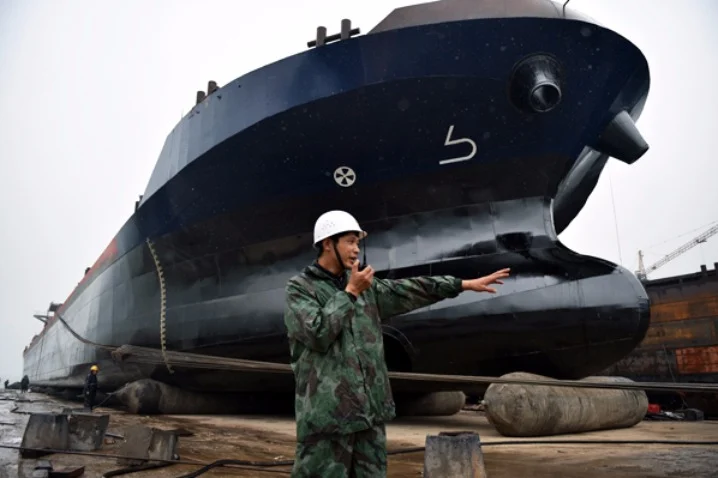
For the first time in seven years, China has ascended to the pinnacle of the global shipbuilding industry, securing the top position in new orders over the past eleven months and outperforming its long-standing rival, South Korea. This landmark achievement, revealed by the authoritative British shipbuilding and marine analysis agency Clarkson Research Services, signifies a crucial turning point in the fiercely competitive international maritime sector and underscores China’s accelerating transition towards high-value-added manufacturing and advanced industrial capabilities.
The data released by Clarkson Research Services on a Friday in late 2017 indicated that from January to November of that year, China’s shipyards amassed a total of 7.13 million compensated gross tons (CGT) from 324 vessels. This impressive volume placed China firmly ahead of South Korea, which recorded 5.74 CGT during the same period. The distinction of CGT, a measure that accounts for the amount of work required to build a ship rather than just its raw tonnage, highlights the increasing complexity and technological sophistication of the vessels being ordered from Chinese yards. This performance translates into a significant 36.3 percent share of the global shipbuilding market for China, a substantial 7 percentage points higher than South Korea’s 29.4 percent. The shift represents not merely a change in market share but a profound reordering of the industry’s competitive landscape.
A Decade of Dynamic Shifts: The Historical Context
The global shipbuilding industry has historically been characterized by cycles of boom and bust, heavily influenced by global trade volumes, economic growth, and commodity prices. For decades, the sector was dominated by European nations, particularly the United Kingdom, before a major shift saw Japan rise to prominence in the mid-20th century. By the late 20th and early 21st centuries, South Korea emerged as the dominant force, leveraging advanced technology, efficient production processes, and a strategic focus on high-value, complex vessels such such as Liquefied Natural Gas (LNG) carriers, offshore drilling rigs, and ultra-large container ships.
China’s entry into the global shipbuilding arena began in earnest in the late 1990s and early 2000s, initially focusing on simpler, bulk cargo carriers and tankers, often benefiting from lower labor costs and significant government support. The global financial crisis of 2008-2009 profoundly impacted the industry, leading to a sharp decline in new orders and a period of intense competition and consolidation. During this downturn, many shipyards, particularly in Europe and Japan, struggled, while South Korea managed to maintain its lead by doubling down on technological superiority. China, however, continued to expand its capacity and gradually climb the value chain, learning from international partnerships and investing heavily in research and development. This persistent effort laid the groundwork for the eventual market leadership seen in 2017. The seven-year period preceding this milestone was one where South Korea consistently held the top spot, making China’s recent achievement a testament to its sustained strategic push.
Key Orders Signifying a Strategic Leap
The surge in China’s shipbuilding orders in 2017 was bolstered by several high-profile contracts that underscored a critical shift in the types of vessels being commissioned from Chinese shipyards. These orders were not just about volume but about complexity, value, and strategic importance, challenging the long-held perception that Chinese yards were primarily geared for mass production of simpler ships.
One of the most significant deals of the year came in August when the French shipping giant CMA CGM SA placed an order for nine ultra-large container vessels, each with a staggering capacity of 22,000 twenty-foot equivalent units (TEUs). This monumental contract was split between two of China’s leading shipbuilders: Shanghai Waigaoqiao Shipbuilding Co and Hudong Zhonghua Shipbuilding Co. The construction of such enormous container ships, which are among the largest in the world, requires advanced engineering capabilities, sophisticated manufacturing techniques, and a proven track record of delivering high-quality, reliable vessels. Securing this order against fierce international competition, including from South Korean yards, demonstrated China’s growing prowess in the high-end container ship segment.
Another groundbreaking agreement emerged in October, signaling China’s ambition to enter an entirely new, highly lucrative, and technologically demanding segment: luxury cruise ship construction. China State Shipbuilding Corp (CSSC), a major state-owned enterprise, partnered with China Investment Corp (CIC), a sovereign wealth fund, and Carnival Corp, the world’s largest cruise operator, to invest a substantial 25.5 billion yuan (approximately $3.85 billion at the time) into a joint venture. The primary objective of this venture was to build a super luxury cruise ship, marking the first order of its kind ever received by Chinese shipbuilding companies. This foray into the ultra-complex cruise ship market, traditionally dominated by a handful of European yards with decades of specialized expertise, represented a monumental leap for China’s shipbuilding industry, signaling its commitment to mastering the most intricate and high-value aspects of maritime construction.
From Quantity to Quality: The Drive for Innovation and Sustainability
The narrative of China’s shipbuilding industry has unequivocally shifted from merely dominating in terms of sheer volume to prioritizing quality, technological sophistication, and environmental sustainability. This strategic pivot is a core component of China’s broader industrial upgrading agenda, aiming to move its manufacturing base up the global value chain.
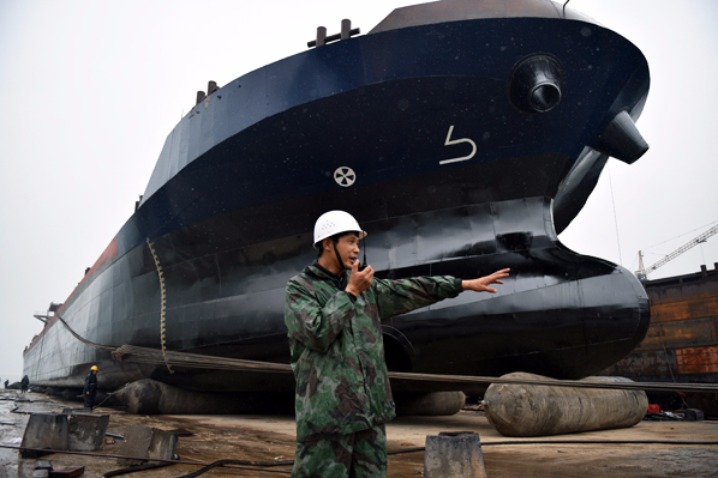
Dong Liwan, a respected shipbuilding industry researcher at Shanghai Maritime University, observed the palpable impact of these developments, stating that "with the orders for high-value-added ships continuing to go to Chinese shipyards, their South Korean competitors will definitely feel the pinch." This "pinch" refers to the erosion of South Korea’s competitive edge in the premium segments that have historically underpinned its market leadership.
The push for innovation is evident in the adoption of intelligent and environmentally friendly technologies. Sun Licheng, President of the China Classification Society, articulated this transformation, noting that "China’s shipbuilding industry is realizing the transformation with its hardworking spirit to achieve technical breakthrough and innovation." He further elaborated that "While maintaining growth, it is realizing production mode transformation, structural adjustment and transformation, and upgrading, and reinforcing China’s shipbuilding status in the world." This statement encapsulates the multifaceted approach China is taking: simultaneously expanding capacity, improving efficiency, and elevating technological standards.
A tangible example of this innovation was showcased at the All China Maritime Conference and Exhibition, where China State Shipbuilding Corporation delivered the world’s first smart ship, named "Great Intelligence." This vessel, with a loading capacity of 38,800 metric tons, integrates advanced technologies such as intelligent navigation systems, real-time data analysis, autonomous operational capabilities, and optimized route planning powered by artificial intelligence and the Internet of Things (IoT). Such "smart ships" promise enhanced safety, reduced operational costs, and improved energy efficiency, setting new benchmarks for maritime logistics.
Furthermore, Chinese shipyards are actively embracing environmentally conscious solutions. COSCO Dalian shipyard, for instance, signed orders with Thordon Bearings, a prominent marine industry solution provider, for its water-lubricated propeller shaft bearings. This technology represents a significant advancement in marine propulsion systems, as it uses seawater as the lubrication medium instead of traditional oil. The shift away from oil-lubricated systems drastically reduces the risk of oil spills and pollution, aligning with increasingly stringent international environmental regulations. Alex Li, managing director of CY Engineering Co Ltd and Thordon Bearings’ partner in China, emphasized the importance of this collaboration, stating that "the latest order is a significant sign showing Chinese shipbuilders’ commitment to reducing industry-borne emissions and pollutants." This commitment reflects not only a response to global environmental pressures but also a strategic move to position China as a leader in green maritime technology.
Broader Implications and Future Outlook
The resurgence of China’s shipbuilding industry to the top spot carries profound implications, not only for the economies of China and South Korea but also for the broader global maritime trade and technological landscape.
Economic Impact on China: For China, this achievement is a significant validation of its long-term industrial policies, particularly initiatives like "Made in China 2025," which prioritize upgrading the manufacturing sector through technological innovation and higher value creation. The shipbuilding industry is a major employer, and its growth contributes significantly to job creation, technological advancement, and regional economic development. Dominance in shipbuilding also enhances China’s strategic independence in maritime logistics and national security. The ability to build advanced vessels, including those for commercial, naval, and specialized purposes, strengthens China’s position as a maritime power.
Challenges for South Korea: For South Korea, this shift represents intensified competitive pressure. While South Korean shipyards still hold strengths in certain ultra-high-tech niches, such as very large LNG carriers and complex offshore structures, the erosion of their lead in overall orders necessitates a re-evaluation of strategies. South Korean companies may need to accelerate their own innovation efforts, further specialize in niche markets, or diversify their business models to maintain global relevance. The "pinch" described by industry experts implies that South Korean firms must adapt quickly to avoid being outmaneuvered in an increasingly competitive environment.
Global Maritime Industry: The changing dynamics of shipbuilding leadership will likely foster increased competition and potentially influence global pricing and supply chain structures. As China continues to innovate, it could drive down costs for certain advanced technologies or accelerate the adoption of new standards, particularly in areas like smart shipping and green technologies. This could benefit global shipping companies by offering more competitive options for vessel procurement.
Environmental Leadership: China’s proactive embrace of environmentally friendly technologies, such as water-lubricated bearings and smart ships designed for efficiency, positions it as a potential leader in driving sustainable practices within the maritime sector. With international bodies like the IMO (International Maritime Organization) pushing for stricter emissions regulations and decarbonization targets, China’s commitment to green shipbuilding could set new global benchmarks and influence future maritime policy.
Strategic Vision for 2020 and Beyond: Sun Licheng’s declaration that the goal is to "become a strong shipbuilding country by 2020, and to accelerate the development of advanced intelligent manufacturing and industrial equipment capability," underscores a clear national strategy. While the specific 2020 target is a short-term benchmark, the underlying ambition is a sustained drive towards technological superiority and market leadership. This involves continuous investment in R&D, fostering skilled labor, and integrating advanced manufacturing techniques like automation and digitalization across the entire shipbuilding value chain.
In conclusion, China’s ascent to the top of the global shipbuilding order book in 2017 was more than a statistical victory; it was a profound declaration of its industrial maturity and strategic intent. By combining sheer scale with a focused pursuit of advanced technology and environmental responsibility, China has not only reclaimed market leadership but has also set a new course for the future of the global maritime industry. The reverberations of this shift will continue to shape competition, innovation, and sustainability across the world’s oceans for years to come.

 Evan Lee Salim
 Suro Senen